A 28,800 mph radar track at RAF Benbecula (1993)
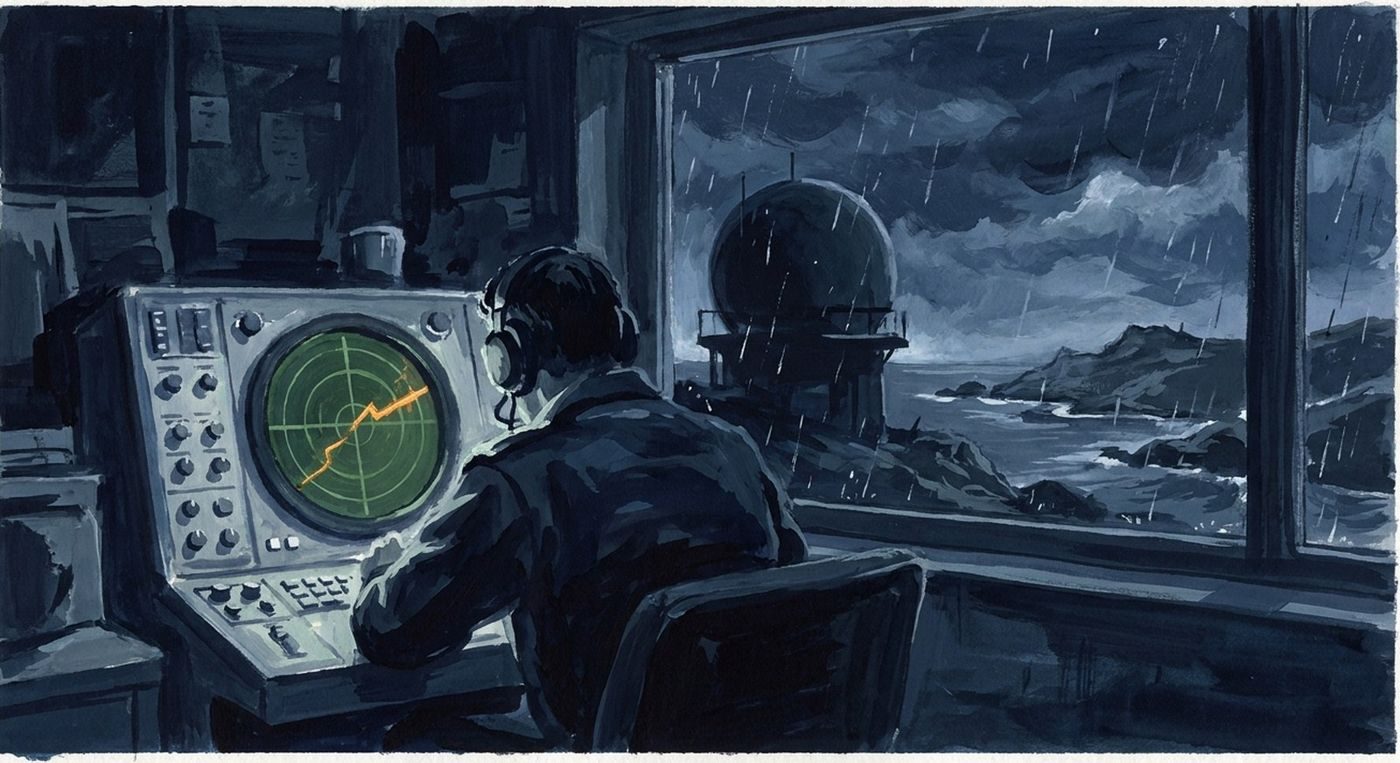
In 1993 an RAF radar technician at RAF Benbecula in the Outer Hebrides says he watched an object cross the station's 640-mile radar display in 70 to 80 seconds, about 28,800 mph, after he and his colleagues found nothing wrong with the set. The next day staff were told it had not happened, and no radar record or log has been released; the technician, Matthew Hope, later a police constable, told the story on the record to Inspector Roy Teague.
Hope's job was to keep the radar working. On a night shift a colleague ran into the room next door and asked him to confirm whether there was a fault. There was none, Hope says: he and his colleagues checked the diagnostics. What the screen showed was a target painted once on each 10-second sweep, its trail laid out in white blips, crossing 640 miles of coverage in 70 to 80 seconds. At 80 seconds that is 28,800 mph, Teague's arithmetic; at 70 seconds it would be faster still.
"That didn't happen"
The next day, Teague says, the radar operators and Hope were told "that didn't happen and you don't talk about it." Hope kept quiet for 33 years. Teague interviewed him in person at his home in Stoke, and the account went into his book Close Encounters of the Police Kind. Teague has told it twice in 2026: on Ross Coulthart's Reality Check, where he agreed with Coulthart's "January 1993 at 10:00 at night", and on Jason Samosa's channel, where the base was finally spelled out as Benbecula. The figures and the order not to talk match in both.
that didn't happen and you don't talk about it
What the radar was for
Teague describes Benbecula as a first line of defence that watched for Russian nuclear missile launches. That role is his description and has not been checked. He compares the speed with Russia's hypersonic glide vehicle, which he puts at about 22,000 mph, to argue that nothing built in 1993 could do it. Where the data went he does not know: "a department we may have never even heard of", he guesses.
What if a front-line air-defence radar logged something crossing its whole range in just over a minute, and the response was to tell the people who saw it to forget it? Teague says the account, "as told", is "a fantastic example of non-human intelligence tech". The track and the gag order are Hope's account; the reading is Teague's.
Teague's other police aircrew describe objects that leave faster than they can follow, as in the Met helicopter case over London and the Cefn Mably triangle.
No explanation is offered.
Evidence, in date order
- 16 Nov 2026Roy Teaguetestimonyin-person interview with Matthew Hope, told in his book Close Encounters of the Police Kind and in two 2026 interviews that agree on the figures and the gag order
How plausible · Moderate
A named technician who checked the equipment describes an instrument track and a gag order, with nothing to gain; one teller, no released data, and the site's role as Teague describes it is unchecked.
- ●●Access The radar technician on duty, called in to check the set.
- ●●No gain sought No gain evident; Teague says he has "everything to lose".
- ●○Cost of speaking He agreed to be named, 33 years later.
- ●○Consistent over time Teague's two 2026 tellings agree on 640 miles, 70 to 80 seconds and the next-day order; only Teague's tellings are public.
- ●○Restraint Hope reports a track and a fault check; the non-human reading is Teague's.
- ●○Character record An RAF radar technician, later a police constable; no further detail.
Plausibility weighs how well an account fits where secrecy hides the documents by design, so missing records never count against it. Strength measures what is documented. Assessed 2026-11-18.
Claims
Similar cases
Connected cases
- The Met helicopter's dart over the MI6 building (London, 1997) 1997Another Teague account of a sighting kept quiet
People and organizations
- Roy Teague personDocumented by
Sources
- Jason Samosa, '250 British Officers Come Forward: UFOs are Real. They See Them All The Time (Roy Teague Interview)' (YouTube, 16 Nov 2026)
- Reality Check, 'UFO Sightings, Missing Time and a Mystery That Haunts British Police' (YouTube, reposted 1 Nov 2026), Insp. Roy Teague
 The Met helicopter's dart over the MI6…1997
 Todmorden1980
 The Flanagan family's lost two and a half…1981
 A mile-wide triangle over Cefn Mably, seen…2006