Lago de Cote: the disc on mapping frame 300
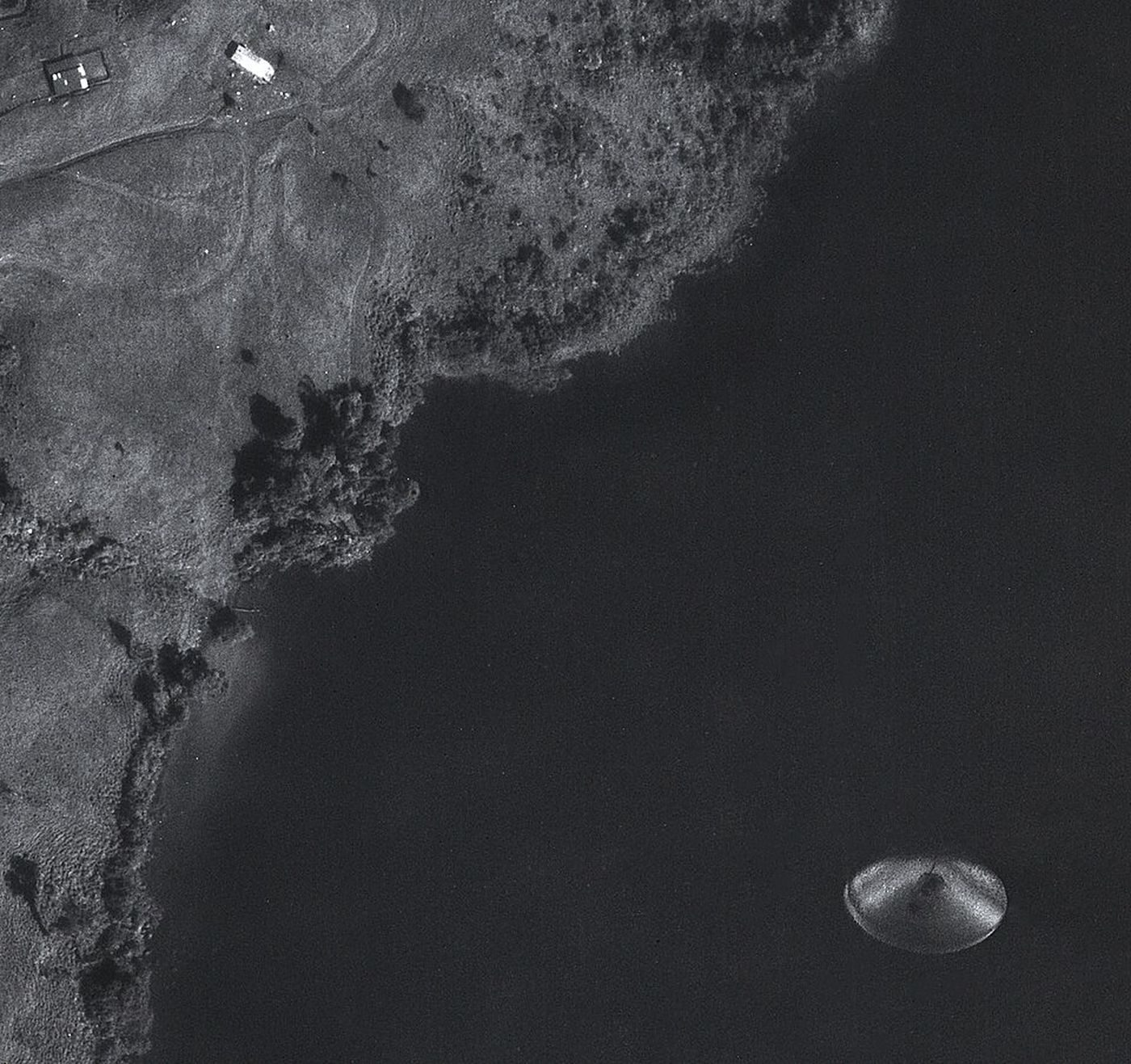
A Costa Rican government mapping photo taken from 10,000 ft on 4 September 1971 shows a sharp, shaded disc over Lago de Cote on a single frame, which nobody aboard saw and which Jacques Vallée and Richard Haines could not identify.
The frame came from a routine survey for the Arenal hydroelectric project. The camera fired on a timer, pointed down at the ground, and the frames on either side show the same lake with nothing over it. Haines and Vallée published their analysis in the Journal of Scientific Exploration in 1989. Fifty-five years after the flight, a documentary, The Cote Photo, put the photographer back in front of a camera.
The flight and the photographer
The Instituto Geográfico Nacional flew a twin-engine Aero Commander for the Costa Rican Electricity Institute that morning. Aboard were pilot Omar Arias, Francisco Reyes, Juan Bravo and aerial photographer Sergio Loaiza. The film's data strip reads "ARENAL", 10,000 ft, 4-9-71, with the camera clock at 08:25. None of the four reported anything unusual.
Loaiza says the object turned up only later, when the institute went back to the photos for a new study. A co-worker looking over the prints called out, as Loaiza tells it to La Nación in 2021: "Look, what the heck is this? It looks like a flying saucer." He told CR Hoy in 2016:
I remember we spread out the photos, put the negative in the enlarger, and found the UFO. At that moment we were totally forbidden to talk about it, and we couldn't tell anyone.
He says they took an enlargement to the institute's director, who called in the head of the sister Geodetic Institute, and that official told them on the spot not to discuss the photo with anyone. In the same 2021 interview Loaiza describes later personal contact experiences of his own.
What the analysts found
Researcher Ricardo Vílchez obtained the photo and in 1979 sent it to Ground Saucer Watch in the United States, which judged it made in good faith, according to CR Hoy. One of the two authors saw it at a meeting in Costa Rica in 1985, and Vílchez gave them a second-generation negative to take home.
Haines and Vallée found the disc lit like a solid object, with a sharp edge on the sun's side and a diffuse edge on the other. They found no distortion of the film grain around it and no sign of a double exposure or fabrication. They also found no shadow on the ground. The camera's geometry caps the size: at ground level, 10,000 ft away, the object would be 210 m (683 ft) across at most. In their words, "the various analyses failed to identify the image", and they left the case open until more information came in.
The referee's dissent
The journal printed a dissent beside the paper. Its referee, Marilyn Bruner of the Lockheed Palo Alto Research Laboratory, judged the northern edge too sharp for a real object and proposed a pressure mark from a particle caught in the film roll. She named a test: examine the original negative under glancing light for dents or scratches. Haines and Vallée replied that rooftops on the same negative have sharper edges, and that a particle should have left matching marks on frames 299 and 301, which they could not find.
Where the negative is now
In 2022 lawyer Esteban Carranza had a drum scan made of a contact copy of the negative that he said came from the National Archive, according to IFLScience. The producers of The Cote Photo (76 minutes, directed by Adam Pillon with Megan Woomer, released on Apple TV on 4 September 2026) say its chain of custody is held at the National Archive. Leslie Kean is listed on the production team.
Pressure mark on the film proposed by the referee in 1989; not demonstrated.
Evidence, in date order
- 4 Sept 1971Instituto Geográfico Nacional de Costa Ricaphotosurvey frame 300 with its data strip (clock 08:25, altimeter 10,000 ft, 'ARENAL', 4-9-71), plus frames 299 and 301 for comparison
- 1979Ground Saucer Watchdocumentjudged the photo made in good faith after Ricardo Vílchez sent it in 1979
- 1989Richard F. Haines and Jacques F. ValléedocumentPhoto Analysis of an Aerial Disc Over Costa Rica: enlargements, digital enhancement, sun-angle and shadow search on a second-generation negative Journal of Scientific Exploration 3(2), pp. 113-131
- 4 Sept 2026Archivo Nacional de Costa Ricadocumentholds the photo's chain of custody, according to the producers of The Cote Photo; a contact copy of the negative came from the archive, according to Esteban Carranza (2022)
How plausible · High
A government mapping camera caught a sharp disc on one frame that a published analysis could not explain; a referee's pressure-mark idea was rebutted and never tested on the original negative.
- ●●Access Government survey camera, fixed mount, looking down.
- ●●No gain sought Nobody aboard saw it; the frame surfaced years later during routine photo work.
- ●●Checkable details check out Frames 299 to 301 exist; the archive copy can be re-examined.
- ●●Physical traces or official reaction The film itself.
- ●○Restraint The crew reported nothing at the time.
- ●○Character record Professional government cartographer; he later described personal contact experiences.
Plausibility weighs how well an account fits where secrecy hides the documents by design, so missing records never count against it. Strength measures what is documented. Assessed 2026-11-19.
Claims
Similar cases
People and organizations
- Jacques Vallée personCo-author of the 1989 analysis
- Leslie Kean personOn the production team of The Cote Photo
Sources
- Haines and Vallée, "Photo Analysis of an Aerial Disc Over Costa Rica", Journal of Scientific Exploration 3(2), 1989, pp. 113-131 (with referee review and reply)
- CR Hoy (28 Aug 2016): Hace 45 años, un OVNI impresionó a Costa Rica y al mundo
- La Nación (13 Nov 2021): Un ovni sobre el lago Cote: hace 50 años Sergio Loaiza tomó la foto que le cambió la vida
- La Nación (4 Sep 2026): Documental que se estrena en Apple TV revive uno de los grandes misterios de Costa Rica
- IFLScience (10 May 2022): Best UFO photo ever gets a high-resolution makeover
- The D-Word: The Cote Photo (2026), film listing
 AAWSAP and AATIP2008
 Haynesville, Louisiana1966
 Two yellow 'cigars' off Alderney, seen by…2007
 Greenland2024