Vancouver Island: the disc over the peak that nobody saw
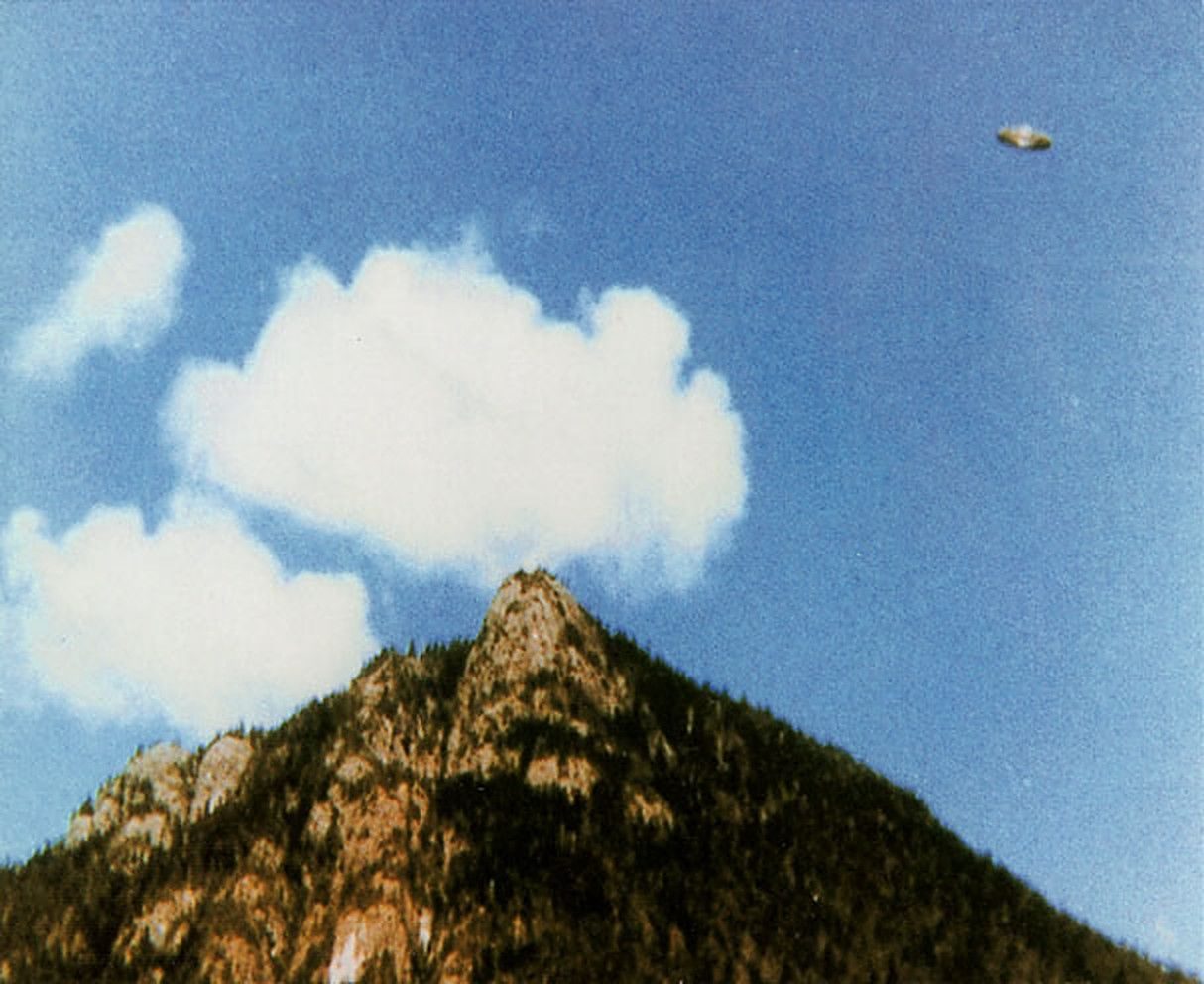
A colour photo that Hannah McRoberts took of a mountain peak on northern Vancouver Island on 8 October 1981 shows a sharp, domed disc in the clear sky beside it, which she never saw, and which a scientist's study of the original negative could not explain.
The photo came from an ordinary family trip. The original negative stayed with the family, and in 1987 Richard Haines published a full study of it in the Journal of Scientific Exploration. He examined the negative, borrowed the camera, interviewed the family and surveyed the site. He found no hoax and no identity for the disc.
A snapshot of a mountain
McRoberts, then in her mid-twenties, was driving north from Campbell River with her husband, their 18-month-old daughter and the dog to visit her sister at Holberg. They stopped at a provincial park beside Highway 19. A cloud sat on a peak, looking to the family like "a volcano issuing steam", so she photographed it with her Mamiya 35 mm camera. Nobody saw anything else in the sky.
The disc turned up about 18 days later, when the prints came back from the lab. "Well, we didn't know what to do," she told Haines. The peak sits near the centre of the frame and the disc above and to its right, off centre, which Haines read as support for her account that she was aiming at the mountain.
What the negative showed
Haines worked from the original 35 mm negative. The frame before it shows her husband and daughter at a pond in the same park, and the frame after was taken back home in Campbell River, matching the trip. He found:
- No thread or double exposure. Scans of each colour layer showed no suspension line, and the camera's frame lock prevents double exposures.
- A solid, dull object. Its brightest spot was dimmer than the sunlit cloud. Haines judged its surface "very likely not" polished metal.
- Distance. The disc is as sharp as the mountain. His abstract puts it "at a distance of at least 30 feet from the camera". Hung over the peak 7,580 ft away, it would be about 173 ft wide.
His conclusion: "a mature adult with high credibility and little or no interest in UFO phenomena obtained a single, colored, sharp imaged photograph of an unidentified aerial disc-like object."
Earlier, in November 1982, Berkeley engineering professor James Harder had reported on prints for APRO. The group's bulletin called it "an excellent and probably genuine photo of a classical disc". Harder noted that the highlight on the disc fits the sun's position behind the camera, but he was more careful: proving authenticity "is likely to be elusive", with only internal consistency to go on.
Who was told
In mid-November 1981, McRoberts phoned the Canadian Forces base at Comox to ask if anyone wanted to see the photo. According to Haines, an air force representative said they were not interested but took her name and address. In the summer of 1982 the family took a print to the Vancouver Planetarium, whose director brought in David Powell, and the photo reached APRO from there.
The frisbee question
Haines took the thrown-object idea seriously. The husband owned a dull black frisbee and handed it over at once. Haines found a frisbee's surface too glossy and its shape wrong, and a frisbee he fitted with a light dome "would not fly very far nor very high". The image also shows no motion blur. The couple said nobody else was at the park, and neither admitted to throwing anything.
Thrown object (frisbee or hubcap) proposed by Metabunk analysts in 2019; not demonstrated.
Evidence, in date order
- 8 Oct 1981Hannah McRobertsphotothe original 35 mm Kodacolor II colour negative, frame 11, cut in a strip with the next frame; the preceding frame shows her husband and daughter at the same park
- 4 Nov 1982James Harder (University of California, Berkeley) for APROdocumentreport on prints of the photo, 4 November 1982 APRO Bulletin 30(12)
- 1987Richard F. Hainesdocumentmicro-densitometry, colour-layer scans and enhancements of the original negative, tests with the same camera, interviews, and a surveyed site visit on 7 to 8 October 1983 Journal of Scientific Exploration 1(2), pp. 129-147
How plausible · Moderate
A named photographer who never claimed to see anything, an original negative examined in a published analysis, and neighbouring frames that match her story; a thrown object was proposed but never shown.
- ●●No gain sought Waited months before seeking answers; almost no profit, per Haines.
- ●●Restraint Never claimed to have seen a UFO.
- ●●Checkable details check out Negative, camera and site examined.
- ●○Access She took the photo but did not see the object.
- ●○Character record Haines and radio host Bill Allan found her credible.
- ●○Consistent over time The frames before and after fit the trip she described.
Plausibility weighs how well an account fits where secrecy hides the documents by design, so missing records never count against it. Strength measures what is documented. Assessed 2026-11-19.
Claims
Sources
- Richard F. Haines, "Analysis of a UFO Photograph", Journal of Scientific Exploration 1(2), 1987, pp. 129-147
- Gordon Creighton, "The Vancouver Island Photograph" (reprint at UFO*BC, with James Harder's APRO report)
- Metabunk: Hannah McRoberts' 1981 UFO revisited (2019 onward)
- Patrick Gross: The Hannah McRoberts photograph, Canada, 1981