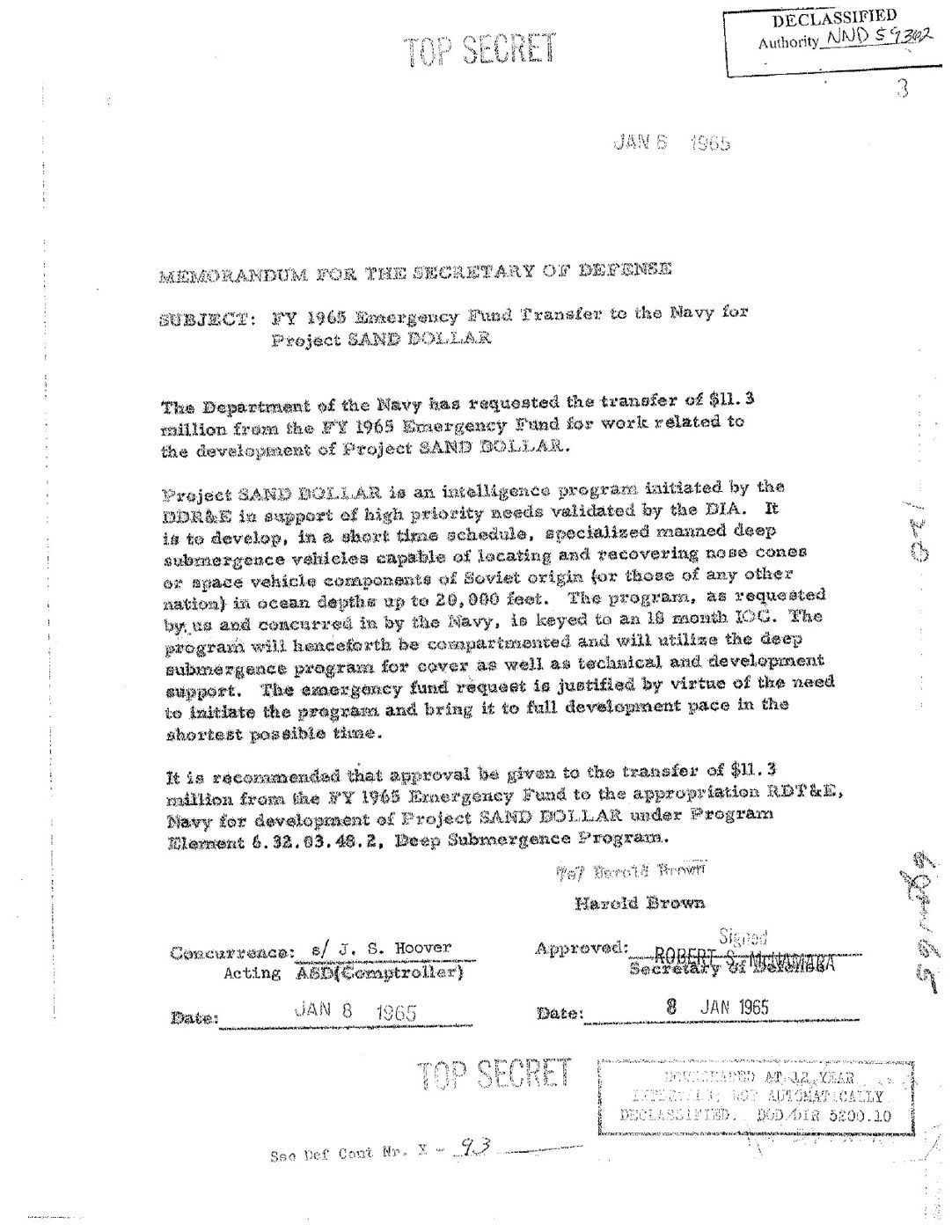
DDR&E memo funding Project SAND DOLLAR (6 January 1965)
On 6 January 1965 Harold Brown, the Pentagon's Director of Defense Research and Engineering, sent the Secretary of Defense a Top Secret memo asking for $11.3 million from the FY1965 emergency fund to go to the Navy for "Project SAND DOLLAR". The acting comptroller, J. S. Hoover, concurred and Robert McNamara approved it on 8 January. The memo is now declassified and held at the National Archives; the National Security Archive published it in 2018.
It describes Sand Dollar as "an intelligence program initiated by the DDR&E in support of high priority needs validated by the DIA", to build manned deep submergence vehicles "capable of locating and recovering nose cones or space vehicle components of Soviet origin (or those of any other nation) in ocean depths up to 20,000 feet". The program was to be compartmented and "will utilize the deep submergence program for cover as well as technical and development support".
It matters here because it puts on the record what John Piña Craven described in his memoir: a DIA-backed seabed recovery program hidden inside the Navy's deep submergence effort, begun in early 1965. The memo names Soviet hardware but leaves the scope open to objects of any origin, and UAP Gerb reads Sand Dollar as the Navy's first program for retrieving objects of unknown origin from the sea. That reading is his; the program, its cover and its date are now documented.
Connected
- The Silent War: John Pina Craven on Project Sand Dollar (2001) documentConfirms
- John Piña Craven personProgram he ran
Sources
- National Security Archive, Document 16: Harold Brown to the Secretary of Defense, 'FY 1965 Emergency Fund Transfer to the Navy for Project SAND DOLLAR' (6 Jan 1965)
- Document 16 (PDF of the declassified memo)
- National Security Archive Briefing Book 616, 'Scavenging for Intelligence', ed. James E. David (31 Jan 2018)
- Navy FOIA logs FY18-20 (DON-NAVY-2018-010209, partial grant)
- CIA FOIA case log FY2020 (F-2020-00472, Project Sand Dollar)