Max Derakhshani's objects
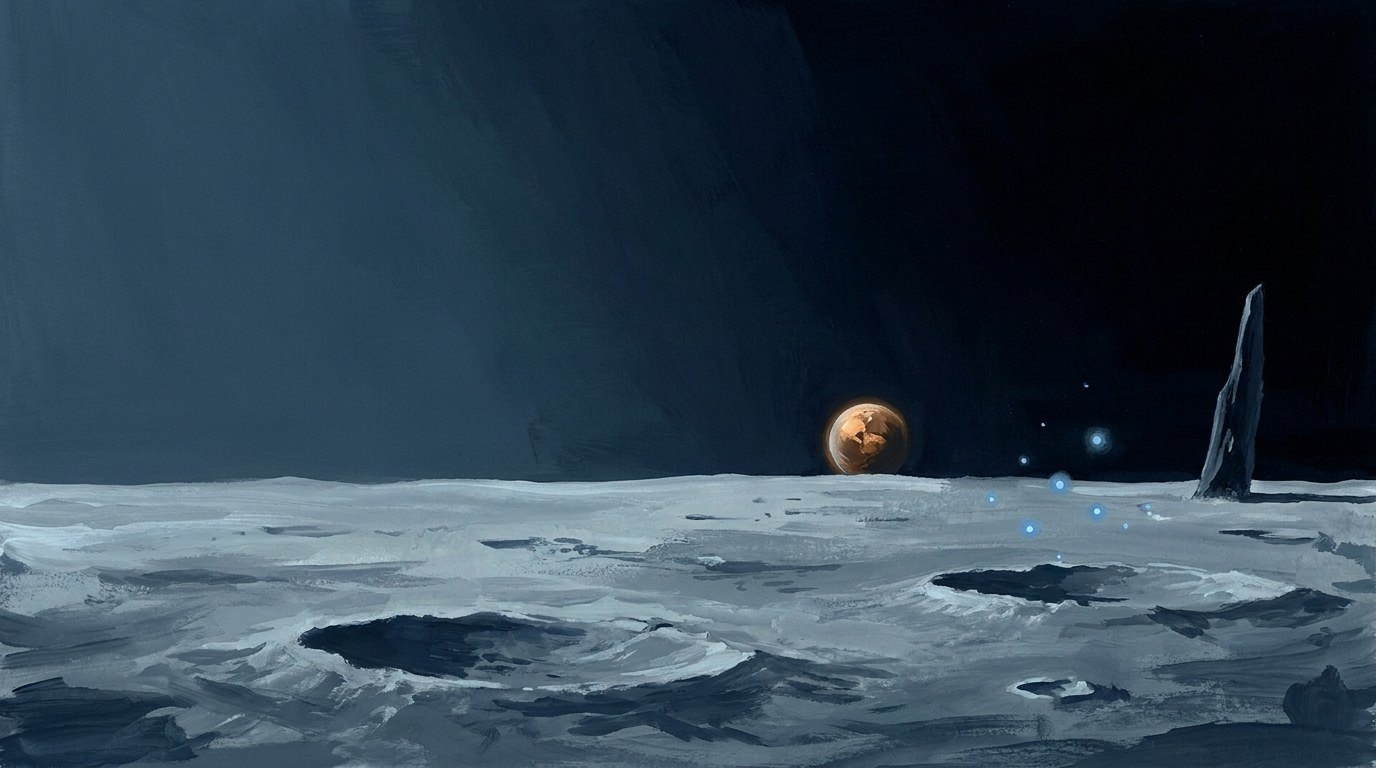
The Moon, Mars and shuttle objects discussed with Max Derakhshani.
Case files (17)
- 2025Blue Ghost's unexplained lighting
- 2023Compton-Belkovich heat anomaly
- 2023Marshall Space Flight Center ISS feed, May 2023
- 1996STS-80 video objects
- 1994Clementine's blurred areas
- 1993Lights in the Shuttle footage
- 1991STS-48: the object that turns
- 1989Phobos 2's elongated object
- 1972Apollo 17 three dots (war.gov VM006)
- 1972Apollo 17: tumbling fragments and Cernan's distant 'flasher'
- 1972Flashes on the Moon: Apollo 16, Apollo 17, Artemis II
- 1972Schmitt's flash north of Grimaldi
- 1971Apollo 14 blue orbs
- 1969Apollo 12 lights released by war.gov (VM001-VM005)
- 1969Apollo 12: lights 'escaping the Moon' and the tracking-light puzzle
- 1968Apollo 8's far-side light
- 1967Lunar horizon glow
People, organizations and fields (1)
Articles (11)
Blue lights across four Apollo missions
Apollo 11: AS11-40-5938, a trio of lights (Max; being pulled). Apollo 12: five war.gov frames. On 6846 to 6847 one light holds its place in the camera view while the landscape moves about 1000 px, and it brightens. Apollo 14: AS14-66-9301, a blue light with a double core, on the same camera model…
One Apollo 17 frame, from a podcast to Congress to the Pentagon
Max showed the Apollo 17 "trio of blue lights" on Reality Check. Per Max, Mike Gold then showed it to Reps. Burchett, Luna and Burlison at a congressional UAP briefing. In May 2026 war.gov released the same frame as NASA-UAP-VM006, saying it is "potentially the result of a physical object in the…
Alan Bean painted what his colleagues photographed
Bean flew Apollo 12. On its transcript he describes lights “escaping the Moon”, and he always called the lunar sky shiny "patent leather". In 1984 he painted the Apollo 14 site with reflective specks in the sky, the same mission whose frame AS14-66-9301 shows blue lights.
Gene Cernan is on three of these threads
Cernan flew Apollo 10, whose film caught the moon pigeon. As Apollo 17 commander he sketched the horizon glow and reported a distant rotating “flasher”: “It's something physical in the distance.” The same mission produced VM006.
Flashes on the Moon and a 54-year loop
Harrison Schmitt saw a flash north of Grimaldi in 1972 and asked Houston to check the seismometers. In 2026 he co-wrote the paper that checked every Apollo flash against seismic data and found no matches. The Artemis II flashes can't be checked at all, because no seismometer has worked on the Moon…
The secrecy chain
The Space Act lets NASA withhold classified material and the Brookings report raised withholding ET finds. Clementine was a DoD mission, and Brandenburg says it looked for bases. Its maps show blurred areas. Mitchell called speaking out “treason”. The UAP study team was kept away from the archives.…
Swann's Moon, the lights record and Apollo 18
Swann said that in 1975 he remote-viewed the Moon for 'Mr. Axelrod' and saw lights on towers over a hundred feet tall on a crater rim, with tread marks below. That is the same order of size as the Plaskett U shadows, and the tread marks echo the tracks Max points to at Schröteri. His wider case…
Aristarchus keeps coming up
Houston asked the Apollo 11 crew to look at Aristarchus after German astronomers reported a glow, and Armstrong saw it "considerably more illuminated". The two leading TLP researchers were pushed out of the field in the early 1970s, per Peter Schultz. Apollo 18 was reportedly to land nearby. The…
Mark Carlotto bridges Mars and the Shuttle
Carlotto built the 3D Face model and co-wrote the fractal method Max's algorithms reproduce. He then published analyses of STS-48 and STS-80, and co-wrote the Paracelsus C far-side study. Sagan wrote to him in 1986 conceding the Face was not a trick of lighting. Sagan's 1963 paper had already said…
Puthoff, Swann, Clarke and Aldrin: Moon, Mars and Phobos
Hal Puthoff ran SRI's remote viewing with Ingo Swann, whose Penetration describes towers and lights on the Moon, and the Army's 1984 Mars session described pyramids. Puthoff also asked Bernard Haisch about the Mars glass worm. Arthur C. Clarke said the glass worm meant life on Mars, with Buzz…
STS-48 and North West Cape
The STS-48 object was filmed near the west coast of Australia in September 1991. That was the last year of full US control of the Harold E. Holt station at North West Cape, where Coulthart's witnesses describe a bulldozed site and triangle sightings.