'Oumuamua (1I/2017 U1): the first known interstellar object
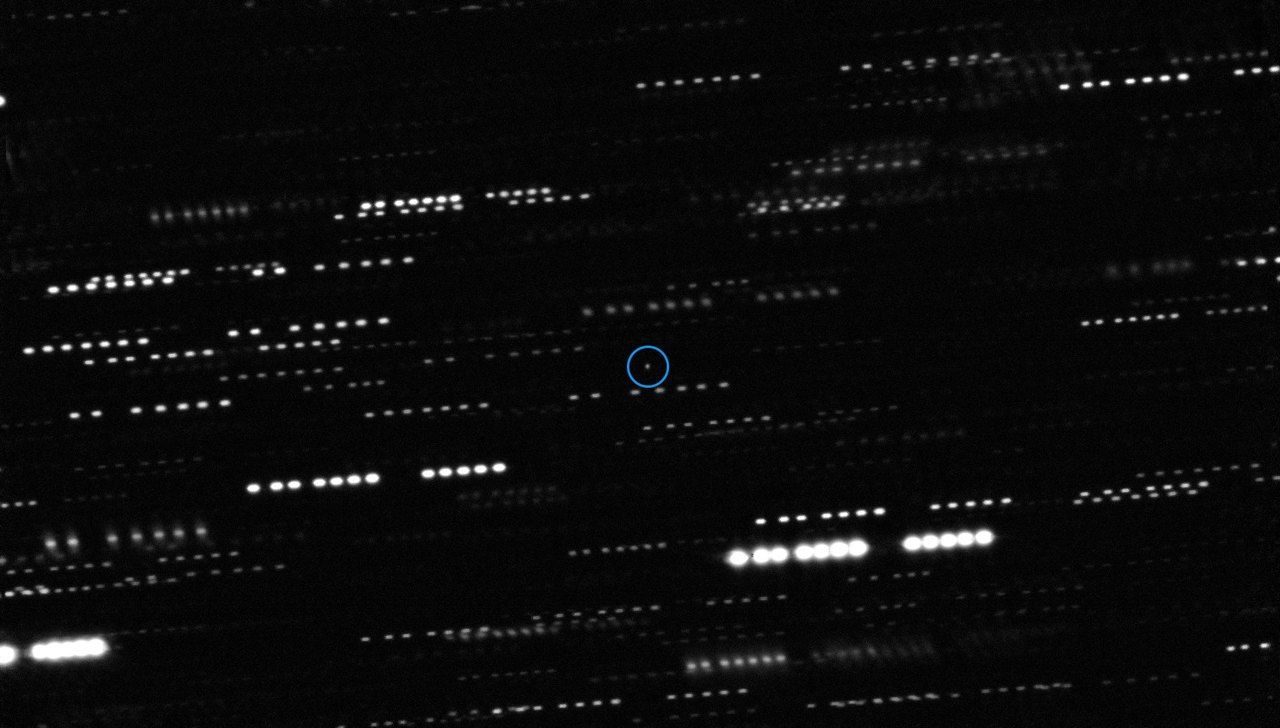
On 19 October 2017 the University of Hawaii's Pan-STARRS1 telescope found an object on an unbound, hyperbolic path. It was the first object known to come from outside the Solar System, and the IAU named it 1I/2017 U1 ('Oumuamua). NASA describes it as up to about 400 m long, possibly ten times longer than wide and slightly red, with a brightness that changed by a factor of ten as it spun. It showed no visible coma. In June 2018, Micheli et al. (Nature) reported a non-gravitational acceleration at 30σ, falling off roughly as r^-2 (or r^-1) with distance from the Sun. They proposed cometary outgassing as the cause, but called that hypothesis "tentative" because no gas or dust was seen. This anomaly started a long debate: - Bialy & Loeb (2018) asked whether sunlight pressure on a very thin sheet, like a light sail, could explain it. - Loeb (2022) argued that an artificial origin "must be considered". - Others proposed natural bodies: hydrogen ice, nitrogen-ice fragments, hydrogen released from irradiated water ice, and fragmentation models. The ISSI team review (2019) found all observations consistent with a purely natural origin. The object left before the question could be settled.
Evidence, in date order (3)
- 2017Meech et al. (Nature)documentExtreme elongation and no visible coma Meech et al. 2017, Nature 552, 378
- 2018Micheli et al. (Nature)sensor dataNon-gravitational acceleration at 30 sigma, with no coma or outgassing seen Micheli et al. 2018, Nature 559, 223
- 27 Jun 2018NASA/JPLofficialReported the unexpected speed boost NASA/JPL, "Our Solar System's First Known Interstellar Object Gets Unexpected Speed Boost" (27 June 2018)
How plausible · High
Non-gravitational acceleration measured at 30 sigma with no gas or dust; named scientists argue artificial origin must be considered.
- ●●Access Direct observation or instruments.
- ●●No gain sought Nothing to gain.
- ●●Character record Trained professionals.
- ●●Checkable details check out Released official records.
- ●●Physical traces or official reaction Instrument data or physical traces.
- ●○Restraint Reported plainly.
Plausibility weighs how well an account fits where secrecy hides the documents by design, so missing records never count against it. Strength measures what is documented. Assessed 2026-10-23.
On the record
- Discovered on 19 Oct 2017 by the University of Hawaii's Pan-STARRS1 telescope (funded by NASA's NEO Observations program). Named 1I/2017 U1; "'Oumuamua" is Hawaiian for "a messenger from afar arriving first" — firsthand (official) — NASA Science.
- First classified as a comet, then briefly as an asteroid, until measurements showed a slight acceleration — firsthand (official) — NASA Science.
- Up to about 400 m long, possibly 10 times as long as wide, reddish. Brightness varied by a factor of 10 over a 7.3-hour spin. No signs of cometary activity after its September 2017 pass by the Sun — analysis — NASA Science.
- Non-gravitational acceleration detected "at 30σ significance". It fits a radial acceleration proportional to r^-2 or r^-1 — analysis — Micheli et al. 2018.
- Several causes ruled out: solar radiation pressure, drag- or friction-like forces, solar-wind interaction for a highly magnetised object, and geometric effects. Outgassing is "viable" if 'Oumuamua has comet-like volatiles; "Our hypothesis remains tentative" — analysis — Micheli et al. 2018. Note: Micheli et al. excluded radiation pressure for a body of normal density. Bialy & Loeb later asked what mass-to-area ratio it would take.
- By 2 Jan 2018 the object was about 40,000 km (25,000 miles) from where gravity alone would have placed it — analysis — NASA/JPL release, 27 June 2018.