Beatriz Villarroel, VASCO and the pre-Sputnik Palomar transients
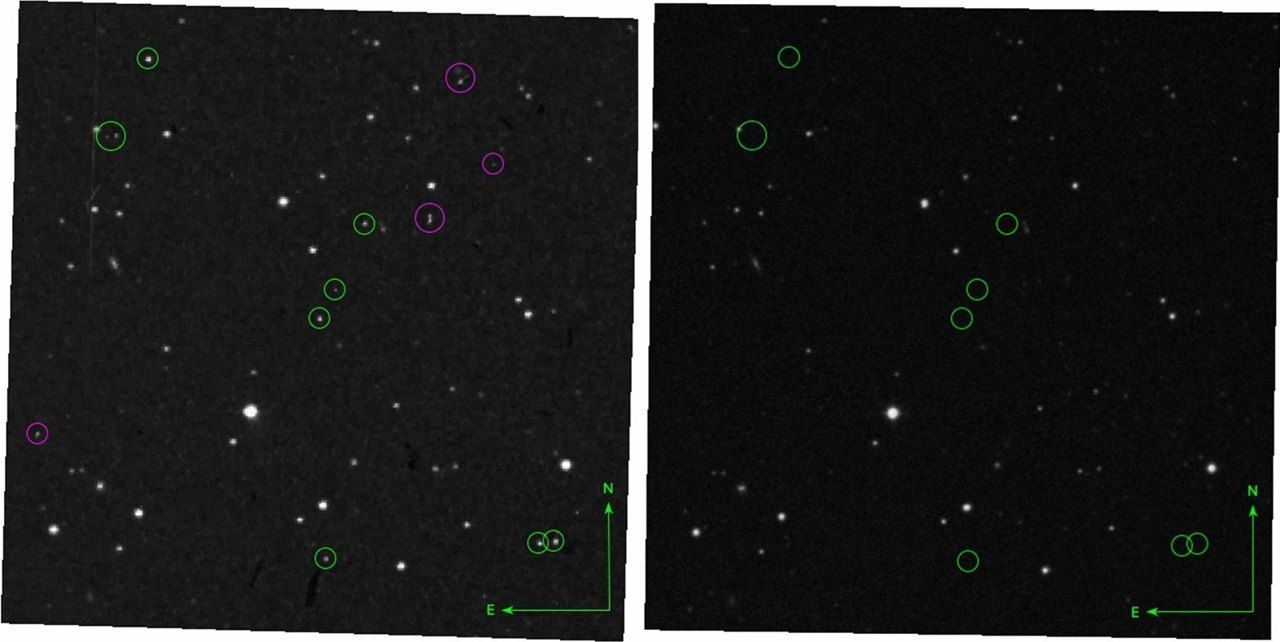
Beatriz Villarroel is an astronomer at Nordita (Nordic Institute for Theoretical Physics), Stockholm University. She leads VASCO ("Vanishing & Appearing Sources during a Century of Observations"), which compares old sky surveys with modern ones to find objects that vanished. The project's search of the First Palomar Observatory Sky Survey (POSS-I, plates taken before Sputnik in October 1957) turned up thousands of short-lived, star-like "transients". Some appear in groups within one exposure, and some appear in lines. The papers built on this work in stages: - *Villarroel et al. 2021 (Scientific Reports*): nine sources appeared and vanished on a single April 1950 plate. The authors say this could be plate contamination or, if contamination is excluded, sub-second sunlight glints from objects near geosynchronous orbit. - Hambly & Blair 2024 (RAS Techniques and Instruments): these transients are "likely to be spurious artefacts of the photographic emulsion". - Villarroel et al. 2025 (PASP): aligned multiple-transient events, plus a strong shortage of transients inside Earth's shadow. - Bruehl & Villarroel 2025 (Scientific Reports):** transients were 45% more likely within ±1 day of a nuclear test, and each additional UAP report on a date was linked to 8.5% more transients. In 2026 the group and independent authors posted further preprints, some supporting the result and some arguing over plate defects. Villarroel is also named as a co-founder of the Stockholm-based Beyond Institute, a foundation for "the data-driven scientific study of anomalies and non-human artifacts".
Evidence, in date order (2)
- 2026Brian Dohertydocumentindependent rerun reproduces the nuclear-test link and the Earth-shadow shortage Doherty 2026, Independent replication (preprint)
- 2026Ivo Buskosensor datasimilar narrow transients on 1950s Hamburg Observatory plates Busko 2026, Fast transients on Hamburg plates (preprint)
How plausible · High
Named astronomers publish peer-reviewed analyses of the original plates, with independent replication; plate defects are still argued.
- ●●Access Original plates.
- ●●No gain sought Science.
- ●●Restraint Statistical claims only.
- ●●Character record Peer-reviewed.
- ●●Independent convergence Replicated.
- ●●Checkable details check out Published.
Plausibility weighs how well an account fits where secrecy hides the documents by design, so missing records never count against it. Strength measures what is documented. Assessed 2026-10-23.
On the record
- Villarroel is an astronomy researcher at Nordita, Stockholm University, and "forskningsledare för forskningsprojektet VASCO" (research leader of VASCO). VASCO aims "att identifiera astronomiska objekt som försvunnit helt från vår natthimmel" (to identify astronomical objects that have entirely vanished from our night sky) — firsthand (official) — Stockholm University.
- The first VASCO search compared about 600 million USNO-B1.0 objects with Pan-STARRS DR1. It found about 150,000 preliminary candidates and about 100 point sources seen in only one epoch — analysis — Villarroel et al. 2020 (*AJ*).
- The citizen-science project had examined 15,593 candidate image pairs and classified 798 objects as "vanished", with a volunteer network led by amateur associations mainly in Algeria, Cameroon and Nigeria — firsthand — Villarroel et al. 2022 (*Universe*).
- The POSS-I red search found 298,165 sources seen only on POSS-I plates. Most were explained by cross-matches, asteroids, variables and artefacts, leaving 5,399 unidentified transients — analysis — Solano, Villarroel & Rodrigo 2022 (*MNRAS*).
- Nine point sources appeared within half an hour in a ~10 arcmin region of an April 1950 red plate, and are absent from earlier, later and modern images. The paper offers plate contamination or, if that is excluded, sub-second solar reflections from objects near geosynchronous orbit — analysis — Villarroel et al. 2021 (*Sci. Rep.*).
- Three ~15th-magnitude sources within 10 arcsec, on POSS-I plates of 19 July 1952, vanished within an hour and are absent to magnitude 25.5 in 2023 Gran Telescopio Canarias images. "The explanation ... remains unclear" — analysis — Solano et al. 2023 (*MNRAS*).
Claims
In The picture
Similar cases · sharing people, threads, topics or era
People and organizations
Threads · click one to see it on the board
Sources
- Stockholm University, open lecture "Jakten på utomjordiskt liv"
- Villarroel et al. 2020, VASCO I (AJ 159, 8)
- Villarroel et al. 2022, Launching the VASCO Citizen Science Project (Universe 8, 561)
- Villarroel et al. 2021, Nine simultaneously occurring transients (Sci. Rep. 11, 12794)
- Solano, Villarroel & Rodrigo 2022, Vanishing objects in POSS I (MNRAS 515)
- Solano et al. 2023, A bright triple transient (MNRAS 527)