Saturn's north-polar hexagon (and the new south-pole decagon)
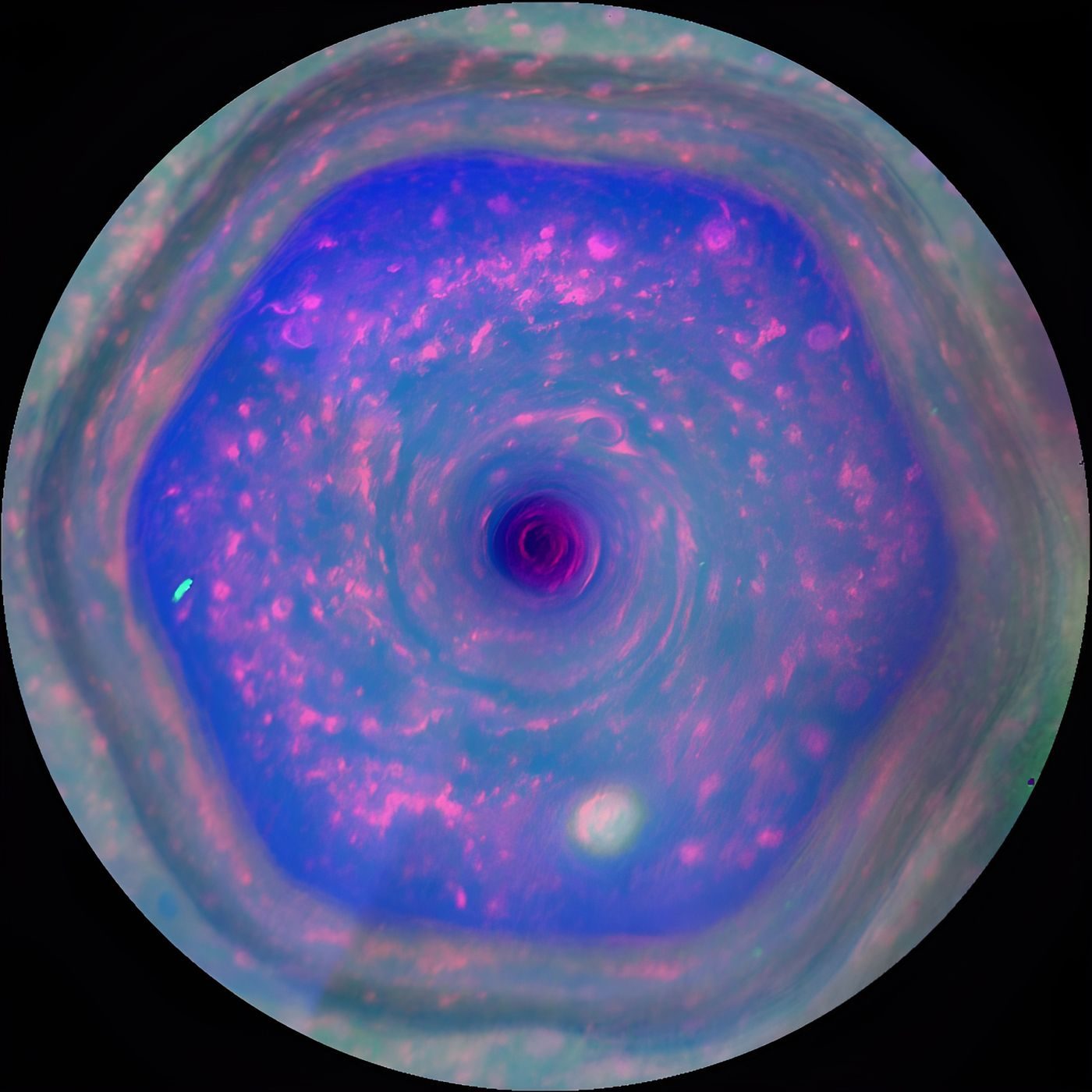
Around Saturn's north pole, at about 78°N, a jet stream runs in a near-perfect six-sided shape.
- Each side is about 14,500 km long, longer than Earth is wide.
- The whole figure is about 29,000 km across.
- It has kept its shape since at least 1980.
Nothing else like it was known in the solar system until a ten-sided pattern appeared at Saturn's south pole in 2023–2025.
- Its period is extraordinarily steady: it rotated once every 10 h 39 min 23.01 s, give or take a hundredth of a second, from 2008 to 2014.
- In 2018 it was found to reach some 300 km up into the stratosphere.
- Between 2012 and 2017 the inside turned from blue to gold.
- A storm 2,000 km wide spins at its centre, fixed exactly on the pole.
Scientists agree it is a wave in a jet stream. They do not agree on what makes it six-sided, what keeps it so steady, or why it is so deep. Bergrun's book (1986) predates its discovery and does not mention it.
Around Saturn's north pole a jet stream runs in a near-perfect hexagon about 29,000 km across, unchanged since at least 1980, turning with a clock-steady period and reaching 300 km up into the stratosphere. In 2023-25 a ten-sided pattern appeared at the south pole. Scientists agree it is a wave in a jet stream but not on why it is six-sided, so steady or so deep.
Timeline (record)
| Date | What happened |
|---|---|
| 1980–81 | Voyager 1 and 2 fly past. The north pole is seen only obliquely. |
| 1988 | David Godfrey (Icarus) pieces Voyager views together and finds the hexagon. |
| 1990 | Godfrey (Science) gives its rotation period. |
| 1990–91 | Ground telescopes and Hubble (Sánchez-Lavega et al. 1993; Caldwell et al. 1993) confirm it is still there 10 years later. |
| 2006–07 | Cassini sees it in thermal infrared through the polar night (PIA09186). |
| 2009 | The north pole comes out of winter darkness and Cassini images it in reflected light (PIA11682). |
| 2012–13 | Cassini films it from high above the pole and images the central storm, nicknamed "the Rose" (PIA17652, PIA14946). |
| 2014 | Sánchez-Lavega et al. (Geophysical Research Letters 41) measure the steady period. |
| 2016–17 | Cassini sees the colour change (PIA21049, PIA21611). |
| 2018 | Fletcher et al. (Nature Communications) find a hexagon in the stratosphere. |
| 2019 | Hueso et al. (Icarus) track it with Hubble and amateur telescopes after Cassini ended. |
| May 2025 | Saturn's equinox; the north pole begins to turn away from the Sun. |
| 2023–25 | A decagon forms at 63°S (Sánchez-Lavega et al., Science Advances, 2 Sep 2026). |
The pictures
- Nine Cassini views from 2006 to 2017 are shown with their explanations in the pictures below.
Measurements (record)
| Quantity | Value | Source |
|---|---|---|
| Latitude of the jet | about 78°N | Godfrey 1988; Wikipedia summary |
| Side length | about 14,500 km | NASA |
| Wind in the jet | about 100–125 m/s (popular sources say ~90 m/s / 320 km/h) | Cassini VIMS (USGS / Baines et al.) |
| Polar cyclone eye | about 2,000 km wide; edge clouds 150 m/s | NASA/JPL, Apr 2013 |
| Rotation period (2008–2014) | 10 h 39 min 23.01 ± 0.01 s | Sánchez-Lavega et al. 2014, GRL 41:1425 |
| Rotation period (Voyager era, 1980–91) | about 3.5 s shorter | same paper |
| Vertical reach | from the cloud tops to about 300 km above, into the stratosphere | Fletcher et al. 2018, Nature Communications |
| Lifetime | seen at every look from 1980 to at least 2018 | Hueso et al. 2019 |
Anomalies worth noting
- A straight-sided, sharp-cornered shape that lasts for decades. Weather on giant planets usually comes as bands, ovals and swirls. The hexagon has kept the same six corners for at least 38 years of direct observation (1980–2018) and probably longer. No consensus mechanism explains why it is exactly six and why it is so stable (open).
- A clock-like period. From 2008 to 2014 it turned once every 10 h 39 min 23.01 s, steady to a hundredth of a second, through a whole change of season. Sánchez-Lavega's team suggested it might mark the true rotation of Saturn's interior (proposed).
- A twist: in 2019, Mankovich et al. used waves in Saturn's rings, which respond to vibrations inside the planet, to measure the interior's rotation directly. They got 10 h 33 min 38 s, about 6 minutes faster (Astrophysical Journal 871, Jan 2019; range −1 m 19 s / +1 m 52 s).
- That means the hexagon is not locked to the planet's deep interior. It sits almost exactly on the period of Saturn's radio emission as Voyager measured it in 1980–81 (10 h 39 min 24 s).
- Why a cloud pattern and a radio signal from the magnetosphere should share a period while the interior turns faster is not explained in anything we found (open; this pairing is our own observation from the published numbers).
- It changed speed once. In the Voyager era it went round about 3.5 seconds faster. The authors tie this to a large storm (the "North Polar Spot") that sat beside it then and has since gone (proposed). Hueso et al. (2019) found the later drift changes "cannot be fit by seasonal changes".
- It reaches the stratosphere. Fletcher et al. (2018) found a warm hexagon about 300 km above the clouds, directly over the cloud-level one.
"either a hexagon has spawned spontaneously and identically at two different altitudes, one lower in the clouds and one high in the stratosphere, or the hexagon is in fact a towering structure spanning a vertical range of several hundred kilometres."
The wave that makes it had been expected to stay trapped in the lower atmosphere (record for the finding; open for how).
- A dead-centre polar storm. The 2,000 km "Rose" cyclone sits fixed on the pole inside the hexagon, with 150 m/s winds. Hurricanes on Earth always drift. Saturn's south pole has a similar fixed cyclone but no hexagon around it (Cassini 2004–2017) (record).
- The colour change and the blue centre (see the pictures above). The haze explanation is proposed. The blue eye that stayed blue is open.
- The south pole: no hexagon, then suddenly a decagon.
- Cassini saw no lasting polygon in the south from 2004 to 2017.
- Hubble's OPAL programme first caught a faint ten-sided pattern near 63°S in October 2023. It sharpened by August 2024 and had all ten corners by August–September 2025.
- It is bigger and less stable than the hexagon, and it drifts east at about 10 km/h while the hexagon stays almost still. It also extends through several layers of the atmosphere.
"We've never seen anything quite like this in Saturn's southern hemisphere… The question is, why did it suddenly form now when we haven't seen one before?" (Amy Simon, NASA Goddard)
"the 'unique' hexagon is not as extraordinary as we thought" (Agustín Sánchez-Lavega)
Cause unknown (open). Science Advances 12(36), 2 Sep 2026, doi 10.1126/sciadv.aee4251.
(The Hubble image of the decagon is shown with the pictures below.)
- A family of polygons elsewhere. NASA's Juno probe (2016 on) found Jupiter's poles circled by geometric clusters of cyclones: eight around the north pole, and five around the south pole that became six in 2019 (record). Their mechanism is also debated. Polygons at the poles of gas giants are clearly a real pattern of nature, but none of the clusters is a single straight-sided jet like Saturn's.
The proposed explanations (all proposed, none demonstrated)
| Idea | Who | Status |
|---|---|---|
| A standing Rossby wave on the jet, held by a large storm to the south | Allison, Godfrey & Beebe 1990 | Weakened: Cassini found that storm gone, yet the hexagon remained |
| A trapped Rossby wave that needs no outside push, on a deep jet | Sánchez-Lavega et al. 2014 | Fits the steady period |
| Jet instability: a sharp change in wind speed with latitude breaks into a polygon | Barbosa Aguiar et al. 2010 (Oxford, rotating-tank lab) | The lab made 3- to 8-sided shapes, mostly 6, depending on jet speed; critics note the tanks also make vortex chains the hexagon doesn't show |
| A shallow meandering jet | Morales-Juberías et al. 2015 | Simulations reproduce its look and slow drift |
| Jet instability plus the polar cyclone stabilising it | Rostami et al. 2017 | Long-lived hexagon in models |
| Deep rotating convection (thousands of km down) | Yadav & Bloxham 2020 (Harvard, PNAS) | Hexagon forms naturally in deep models |
| Deep instabilities | Gavriel & Kaspi 2021 | Called "most viable" |
The fact that the tank experiment makes a hexagon from simple fluid rules is the strongest prosaic data point. It covers the six-sidedness. It does not by itself cover the period, the depth, or why the south pole made ten sides only now.
Unconventional readings
- We found no serious anomalist case that the hexagon is artificial.
- Richard Hoagland linked it to the "hyperdimensional" geometry he also applies to crop circles. This is secondhand, from a critic's blog (Skeptophilia, 2010); we did not find his own text.
- Online "portal" and "cymatics" talk exists. The cymatics analogy (standing waves making shapes) is actually close to the mainstream lab explanation.
- None of this adds data.
What to watch
- The north pole is tipping into its 15-year winter after the May 2025 equinox, so the hexagon will be hard to see in sunlight until the late 2030s. Infrared (JWST) can still follow it.
- The southern decagon will be well placed for Hubble, JWST and amateurs through the next decade. The key question is whether it settles into a stable, locked pattern like the hexagon, and at what period.
- No spacecraft is scheduled to return to Saturn before the 2030s.
Evidence (9)
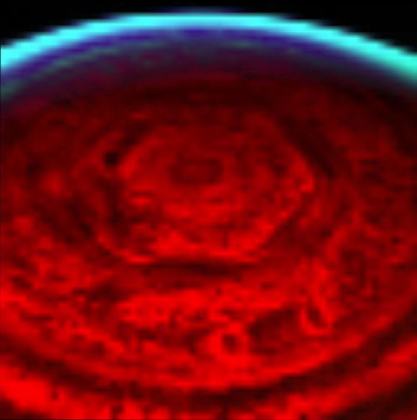
Cassini infrared, 2006–07: the hexagon glowing through the polar night
PIA09186, Cassini VIMS infrared, 2006–07. Heat from deeper layers shines through, so the hexagon is seen against the planet's own glow during the 15-year polar night. This shows it is not just a cloud-top feature.
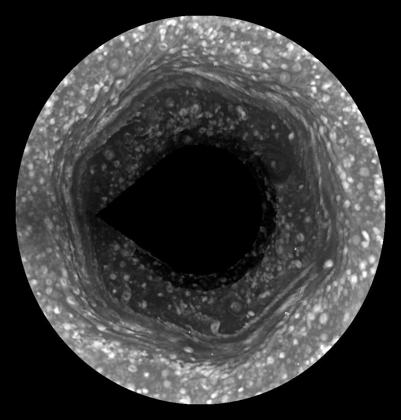
Cassini, 2009: first look in sunlight
PIA11682, Dec 2009. This is the first clear look in sunlight, as spring reached the pole, shown as a mosaic map looking down on the pole. The black wedge is the part still in shadow. The jet runs along the edge, and dozens of small storms dot the region around it.
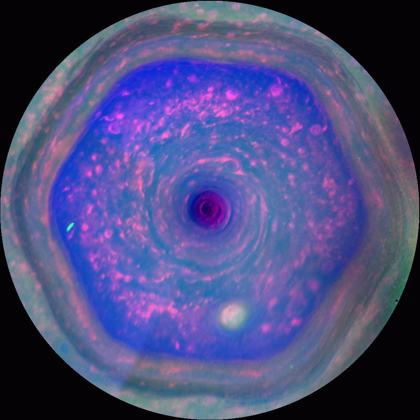
Cassini false colour, 2012–13: the full hexagon and the central storm
PIA17652, "In Full View: Saturn's Streaming Hexagon", 2013. The whole hexagon from above, in false colour. The dark eye at the centre is the polar cyclone. The small bright oval at lower right is a separate storm that drifts around the inside.
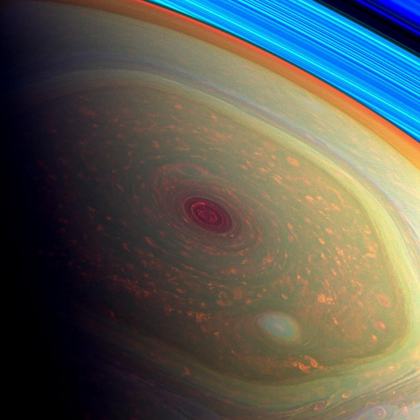
Cassini false colour, 2012: the eye of the polar storm
PIA14946, "Enter the Vortex", Nov 2012. False colour from about 30° above the pole. The dark red eye is about 2,000 km wide, roughly 20 times a hurricane eye on Earth. Clouds at its edge move at 150 m/s, about 540 km/h (record, NASA/JPL 2013). Unlike hurricanes on Earth, it never moves off the pole.
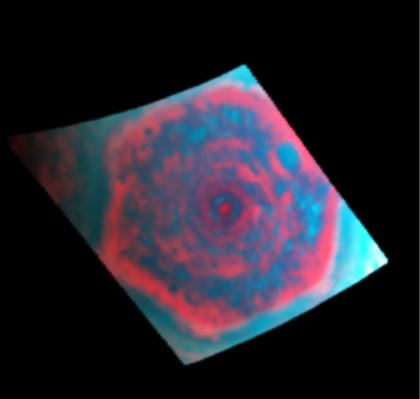
Cassini infrared, 2013: polar projection
PIA17654, 2013. An infrared frame from a Cassini movie, reprojected to look straight down. The red/blue contrast shows different cloud depths, and the six-sided wall is sharp at depth as well.
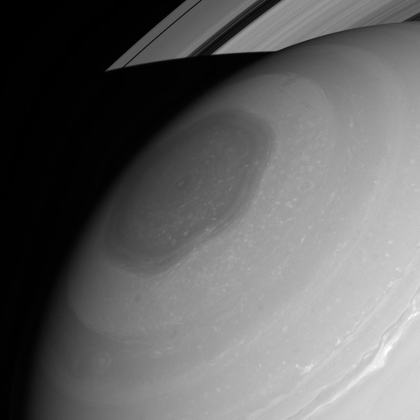
Cassini red light, 2013: a meandering jet
PIA18287, "Wavy Polar Jet", July 2013, 58 km per pixel. NASA's caption: "although it looks like a simple hexagon, this feature… is really a manifestation of a meandering polar jet stream. Scientists are still working to understand more about its origin and behavior."
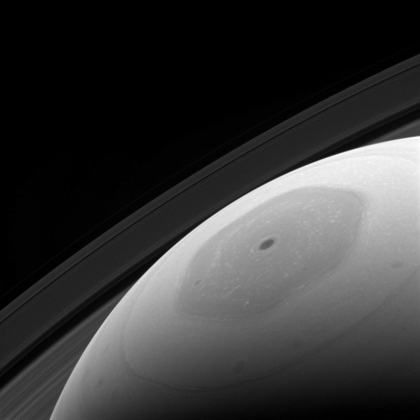
Cassini near-infrared, Jan 2017
PIA21327, "Hail the Hexagon", 22 Jan 2017, 54 km per pixel, near-infrared at 939 nm.
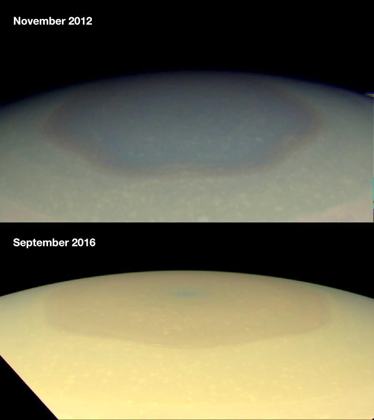
Colour change, Nov 2012 to Sep 2016 / Colour change, Jun 2013 to Apr 2017
PIA21049 and PIA21611: the colour change. Both are natural colour. In 2013 the whole inside was blue. By 2017 most of it was golden, but "only the center of the polar vortex retained the blue color".
- NASA's explanation is that summer ultraviolet light makes photochemical smog (proposed).
- NASA's added suggestion is that the hexagon "might act as a barrier that prevents haze particles produced outside it from entering" (proposed).
- Why the centre stayed blue is listed as open: "Scientists are considering several ideas."
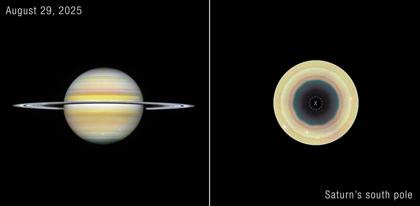
Hubble, 29 Aug 2025: Saturn and its south pole
Hubble, 29 Aug 2025 (credit: NASA/ESA/STScI, A. Sánchez-Lavega, A. Simon, M. Wong, A. Pagan). Right: the south pole reprojected. The dark polar cap is ringed by a ten-sided boundary, and the X marks the pole.
How plausible · Very high
A real, repeatedly measured natural feature; the anomaly is that its shape, steadiness and depth are unexplained.
- ●●Access NASA spacecraft and Hubble data.
- ●●No gain sought Peer-reviewed science.
- ●●Consistent over time Seen at every look since 1980.
- ●●Restraint Researchers call the mechanism open.
- ●●Independent convergence Voyager, Hubble, Cassini and ground telescopes.
- ●●Checkable details check out Public archive images and papers.
Plausibility weighs how well an account fits where secrecy hides the documents by design, so missing records never count against it. Strength measures what is documented. Assessed 2026-10-28.