458 cases · 37 threads
Show
1980 · Saturn's A ring, Encke and Cassini divisions

Bergrun's ring vehicles in the Voyager plates
Sourced, unconfirmed
Strength D · 3/10
Evidence 1/4 · Witnesses 2/3 · Backing 0/3

The vehicles are Bergrun's reading of enlarged Voyager prints. Plate 3 is matched to JPL's P-22994C, whose caption proposes a processing explanation for its clipped ring and colour spots (proposed, not demonstrated); Plates 7-45 are unexamined.

Plausibility Moderate
Score 10 · 9 factors for, 2 against

A NACA, Lockheed and NASA Ames engineer spent years measuring the Voyager plates and published his reading; a processing explanation has been proposed for the prints of Plates 3-6, while Plates 7-45 remain unexamined. Revised 2026-10-23 at Igor's challenge: one JPL caption is weighed as a proposed processing explanation for the prints of Plates 3-6 only. Plates 7-45 are untraced, which means unexamined, not explained.

See the factors ↓

Unresolved
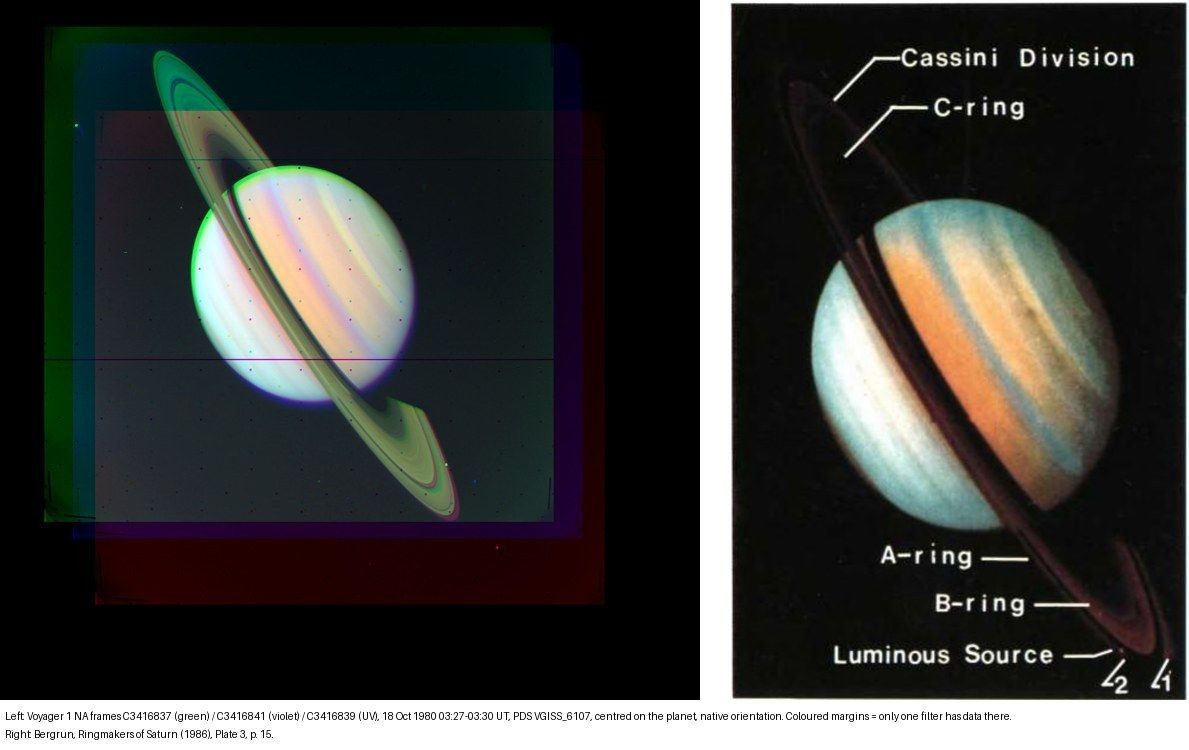
Bergrun's Plate 3 from Ringmakers of Saturn set beside the Voyager 1 frames it was drawn from. · Norman Bergrun (Ringmakers of Saturn, 1986); NASA/JPL
When1980 – 1981 (Voyager images); published 1986
WhereSaturn's A ring, Encke and Cassini divisions

In their own words

“This is not a theory when there's data.”
Norman Bergrun (TV interview, in the video at 25:12)

In a Voyager view of Saturn (Plate 3), Bergrun saw the A ring missing across a chord between two points, with a reddish-orange luminous source. His microscope enlargements of those two points (Plates 5 and 6) show what he calls slender vehicles, each laying down a trail of ring material. Plates 7 and 8 show more of them forming the Encke division and the outer A ring. He estimated one body at about 0.3 Saturn diameters long and concluded that the rings are made and maintained.

How plausible · Moderate

A NACA, Lockheed and NASA Ames engineer spent years measuring the Voyager plates and published his reading; a processing explanation has been proposed for the prints of Plates 3-6, while Plates 7-45 remain unexamined. Revised 2026-10-23 at Igor's challenge: one JPL caption is weighed as a proposed processing explanation for the prints of Plates 3-6 only. Plates 7-45 are untraced, which means unexamined, not explained.

  • ●●
    Access A qualified aerospace image analyst working from NASA's own Voyager imagery.
  • ●●
    Consistent over time Held the same reading from 1986 to his death.
  • ●●
    Character record NACA, Lockheed and NASA Ames engineer.
  • ●○
    Cost of speaking Staked his name and professional reputation.
  • ●○
    No gain sought A small self-published book; no business built on it.
  • ●○
    Independent convergence The 1917 Ainslie-Knight crossing and Cassini-era ring-edge structures (B-ring towers, F-ring jets) are independent threads.
Against
  • −
    Contradicted by an insider A processing explanation has been proposed for the prints of Plates 3-6 (JPL 1980 caption for P-22994C); not shown for the rest.
  • −
    Lone source, no corroboration He is the only analyst so far to read them as vehicles.

Plausibility weighs how well an account fits where secrecy hides the documents by design, so missing records never count against it. Strength measures what is documented. Assessed 2026-10-23.

On the record

  • The plates are what Bergrun published in 1986 from public Voyager 1 and 2 negatives; the vehicle reading is his analysis (firsthand to the images).The 1917 light that crossed Saturn's rings
  • The video shows Plate 5 at 23:26-24:46 and 28:34-29:58, Plate 6 at 26:32 and 30:52, Plate 7 at 31:36-32:31, Plate 8 at 32:31-33:38 and Plate 28 at 25:36-26:32.
  • Plate 3 is JPL press photo P-22994C (Voyager 1, 18 Oct 1980). JPL's caption proposes that the lower ring edge was 'clipped' by spacecraft drift and that the colour spots are a processing artifact: a processing explanation for the prints of Plates 3-6, proposed, not demonstrated. Plates 7-45 are unexamined and stand on their own.

Claims

Enlargements of Voyager negatives show slender cylindrical vehicles with efflux along their length and flames at both ends, laying down the A-ring trail (Plates 5-6, fineness ratio about 13:1).analysisSourced, unconfirmedNorman Bergrun
A vehicle at a slightly smaller radius forms the Encke division, with fans of jets as "pinched plasma" swellings (Plate 7, about 10:1); a second vehicle forms the outer A ring and the Encke gap (Plate 8).analysisSourced, unconfirmedNorman Bergrun
The Encke gap's position depends on the vehicle's length, which would explain the scatter in historical measurements of the gap.analysisSourced, unconfirmedNorman Bergrun
Vehicles come in 1, 2 and 4 unit sizes and lay rings at about a 15 degree attitude (Plates 27-28).analysisSourced, unconfirmedNorman Bergrun
Plate 3 is JPL press photo P-22994C, a colour composite from Voyager 1 on 18 Oct 1980; JPL's caption says 'The lower edge of the rings were "clipped" due to a slight drift of the spacecraft. Color spots in the rings are an artifact of image processing.' The A-ring chord and the reddish-orange 'luminous source' Bergrun built Plates 3 to 6 on sit there. This is a processing explanation proposed for the prints of Plates 3-6, not demonstrated; Plates 7-45 are unexamined.The 1917 light that crossed Saturn's ringsfirsthandOn the recordJPL caption (28 Oct 1980), matched to the PDS raw frames
The third-party 'P-23870' label is a typo: at JPL P-23870 is an artist's conception of Voyager, and the Saturn image is P-23876C, an August 1981 re-issue 'composed from 4 Voyager 1 images'.secondhandSourced, unconfirmedan early-2000s anomalog.com researcher, via a 2007 AboveTopSecret thread

In The picture

The pictureThe neighbourhood is kept. In 1917 two British astronomers independently watched a bright point cross Saturn’s rings. Norman Bergrun, a NACA and Lockheed engineer, read the Voyager photos of Saturn as enormous electromagnetic craft laying down and maintaining the rings. Cassini later found moonlets being born at the …
The RingmakersUnder a microscope, Bergrun's enlargements of the Voyager plates show slender luminous vehicles laying down trails of ring material and carving the Encke division and the edge of the A ring. Across the whole ring system runs a narrow coloured band with at least five lights working along it, which he read as built on …
‹ Previous in Saturn's RingmakersThe 1917 light that crossed Saturn's rings2 of 5Next in Saturn's Ringmakers ›The ring discontinuity band and its five lights

Connected cases

People and organizations

Threads · click one to see it on the board

Sources

A research project by Igor FrancePrivacy