Show
1803 · Hitachi Province (now around Kamisu, Ibaraki), Japan; sheet held at Kuki, Saitama

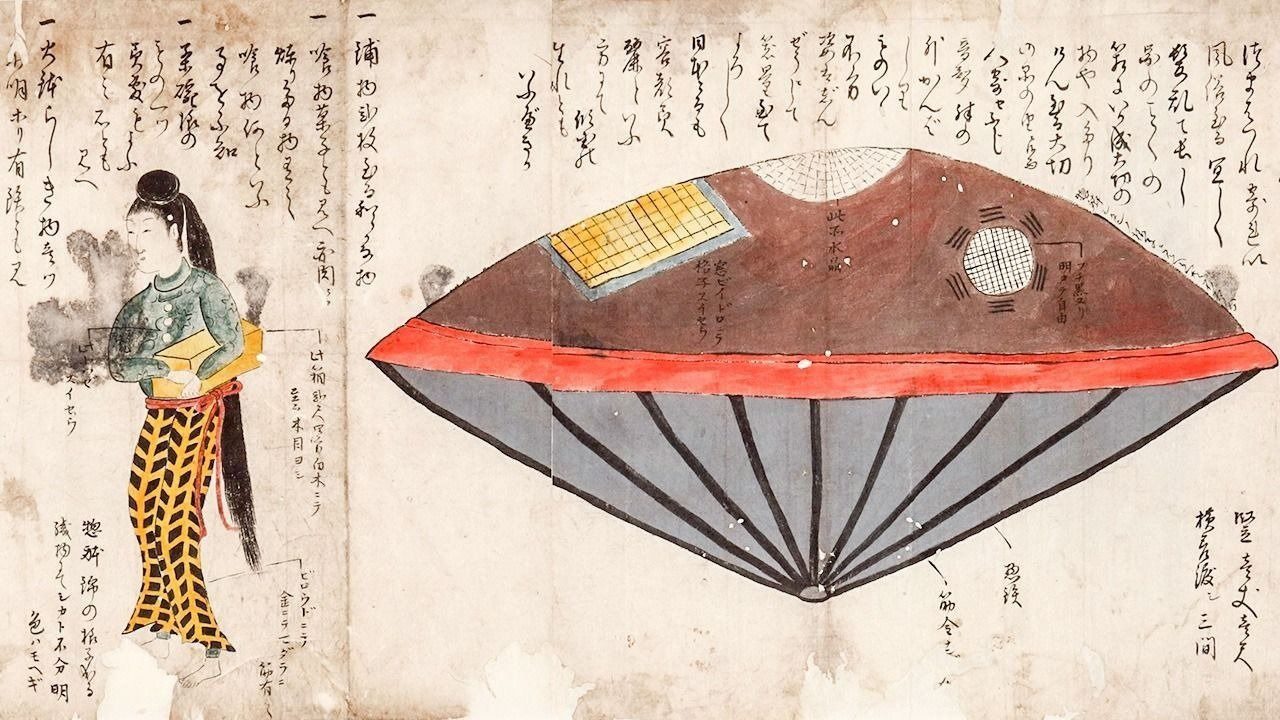
The hollow boat at Hitachi: the Kuki utsuro-bune sheet (1803)
Sourced, unconfirmed
Strength E · 2/10
Evidence 1/4 · Witnesses 0/3 · Backing 1/3

A period manuscript, one of a dozen-plus versions; no named witness.

Plausibility Low
Score 4 · 4 factors for, 1 against

A genuine period record of a story told widely at the time, but every version is hearsay and the details grew in later copies.

See the factors ↓

Historical record
An Edo-period drawing of the utsuro-bune and the woman with her box, one of the many versions of the 1803 Hitachi story (not the Kuki sheet itself). · Public domain, via Wikimedia Commons
  • An Edo-period manuscript of the 1803 'hollow boat' story, from the Okada family papers in Kuki, Saitama.
  • It records a 5.5 m bowl-shaped boat, a woman of about 20 holding a box, and four unreadable characters.
  • It is hearsay with no named witness; the museum judges it less embellished than other versions.
WhenFebruary 1803
WhereHitachi Province (now around Kamisu, Ibaraki), Japan; sheet held at Kuki, Saitama

A sheet titled 'Utsuro-bune no zu' (空舩之図), kept in the papers of the Okada family, village headmen near Kurihashi, records that in early 1803 a hollow boat drifted ashore in Hitachi Province with a young woman inside who spoke an unknown language and clutched a box. The Kuki city museum found it last summer and is showing it for the first time; its study judges this version closer to the original story than the other dozen-plus known copies.

How plausible · Low

A genuine period record of a story told widely at the time, but every version is hearsay and the details grew in later copies.

  • ●●
    Checkable details check out The sheet is on public display and over a dozen other manuscripts exist.
  • ●○
    Independent convergence Many manuscripts agree on the boat, the woman and the box, though they may share one rumour.
  • ●○
    No gain sought A village headman's family papers.
  • ●○
    Fits the documented skeleton Shape and the unknown script recur across versions.
Against
  • −
    Story grew Later versions add imaginative detail; this one less so.

Plausibility weighs how well an account fits where secrecy hides the documents by design, so missing records never count against it. Strength measures what is documented. Assessed 2026-10-28.

Claims

In the second month of Kyōwa 3 (1803) a hollow boat (utsuro-bune), shaped like two bowls joined, drifted ashore in Hitachi Province. Inside was a woman of about 20, about 150 cm tall, pale-faced with red-black eyebrows, who could not be understood and carefully held a box about 60 cm square. The boat was about 5.5 m long, and four undecipherable characters are recorded.secondhandSourced, unconfirmed'Utsuro-bune no zu' (空舩之図), Okada family papers, Kuki
The museum's study found that the Kuki sheet has fewer imaginative later additions than other versions and was probably written close to the Kyōwa period. More than a dozen manuscripts of the story are known across Japan.analysisSourced, unconfirmedKuki City Washimiya local history museum, via Tokyo Shimbun (28 Oct 2026)

Where

Hitachi Province (now around Kamisu, Ibaraki), Japan; sheet held at Kuki, Saitama
36.0°N 138.0°E · region only

Sources

A research project by Igor FrancePrivacy