United States v. The Progressive (1979)
United States v. The Progressive is the 1979 case in which a federal judge in Wisconsin stopped a magazine from printing an article on how the hydrogen bomb works, written by a journalist from public sources. It is the clearest test of how far the Atomic Energy Act's "born secret" rule reaches.
Judge Robert Warren wrote that "a mistake in ruling against the United States could pave the way for thermonuclear annihilation for us all." Six months later, after the same ideas appeared in another paper, the government dropped the case as moot, and the article ran that November. No appeals court ever ruled, so whether the rule can reach a private citizen's own reasoning remains undecided.
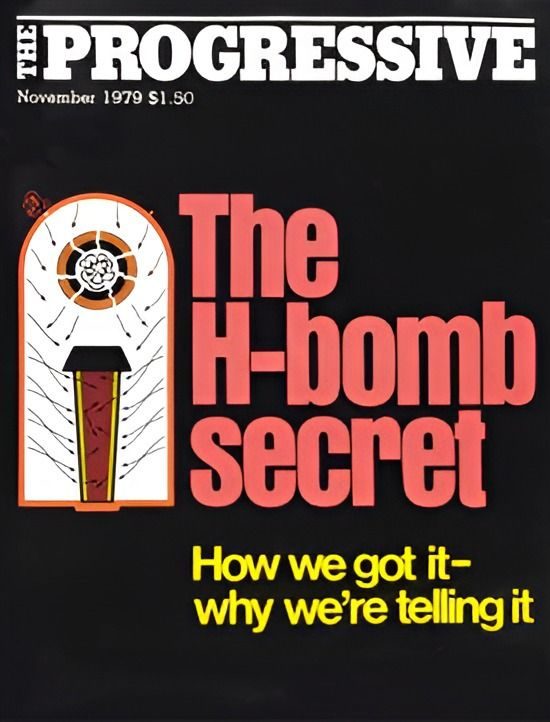
On 9 March 1979 Judge Robert Warren issued a temporary restraining order barring The Progressive, its editors Erwin Knoll and Samuel Day Jr. and Morland from publishing "any restricted data" in "The H-Bomb Secret: How We Got It, Why We're Telling It." A preliminary injunction followed on 26 March. The government's case was that the assembled whole was Restricted Data, even if each piece was public.
What the judge weighed
A mistake in ruling against the United States could pave the way for thermonuclear annihilation for us all. In that event, our right to life is extinguished and the right to publish becomes moot.
-- Judge Robert Warren, 467 F.Supp. 990
The defendants could not attend the secret hearings without signing non-disclosure agreements. Their lawyers were cleared but could not tell their clients what they heard.
How it ended
While the appeal was pending, the hobbyist Chuck Hansen wrote to a senator setting out what he had deduced about H-bomb design, and charged that government scientists, Edward Teller among them, had leaked more. The Madison Press Connection printed his letter on 16 September 1979. The government then dropped its case as moot, and Morland's article ran in the November issue. Because no appeals court ruled, the question the case raised was never settled: can born secret cover ideas a private person works out alone?
Why it matters here
It shows the reach that UFO researchers point to when they say the Act could hold recovered material: the rule applies to information itself, wherever it comes from. Twenty-two years later the Department of Energy used the same reach on a private company's laser process (SILEX, 2001).
Open questions
- Has the government tried prior restraint under the Act against anyone since 1979?
On the record
- 467 F.Supp. 990 (W.D. Wis. 1979), memorandum and order of 26 March 1979.
- The Progressive, November 1979.
Connected
- Atomic Energy Act of 1954 documentApplies
- DOE decision to classify the SILEX process as Restricted Data (2001) documentSame reach into private work
- Edward Teller personNamed in the Hansen letter