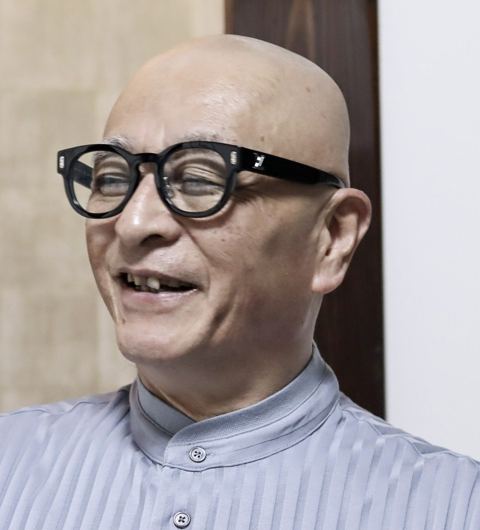
Takano Jōsen
Takano Jōsen is a Buddhist priest in Hakui, a small town on Japan's Noto Peninsula, who began as a television producer and went on to fill the town's museum with real NASA and Soviet spacecraft. Long before that, he says, friends at NASA let him into rooms he was never cleared to enter, and he walked out with the originals.
Takano is the 41st-generation head priest of Myōhōji, a temple of the Nichiren school. He started out as a television writer and science journalist. Later, as an official of Hakui's city government, he was the man behind Cosmo Isle Hakui, a space and UFO museum that opened in 1996 with American and Soviet spacecraft on long-term loan. Letters and photographs from his NASA friendships hang on its walls.
The drawers at "Omega"
Takano's most startling story goes back to the early 1990s. He told Jesse Michels that NASA staff let him into a building at the Johnson Space Center in Houston, which he calls "Omega". It held the agency's raw UFO photographs and film, kept as they were, in his words, "before it was airbrushed".
Nothing in those drawers was allowed to leave. Takano says he opened them himself, chose the originals he wanted and took them out. He had copies made in Los Angeles and sent the originals back in secret through a contact. The copies ended up as a hidden bonus at the end of a CD-ROM game from TV Asahi. He remembers the footage as "lots of firefly-like objects flying around". He kept no copies himself, and he has forgotten the name of the game. NASA never complained, he says, and he thinks he knows why: "That would mean admitting it's real."
Three minutes with Teller
In the 1980s, while working for TV Asahi, Takano was given three minutes to interview Edward Teller. He opened with a pointed question. If the American and Soviet space weapons were aimed out into deep space, he asked, then who was the enemy? Next he showed Teller documents that named him in the Air Force's early UFO projects, Sign, Grudge and Twinkle. Teller said, "I have no interest in UFOs," and ended the interview.
What he says he saw himself
Two of Takano's stories are about things he saw for himself. The first is film of Bluegill Triple Prime, an American nuclear test set off high above the Pacific in 1962. Takano says he saw it around 1967 or 1968, and that it showed an object rising out of the plume. The footage was not declassified until three decades later. When Michels asked where he had seen it, Takano answered only, "I can't say."
The second took place in New Mexico. He says Walter Haut and Jesse Marcel Jr. once took him to what they called the real Roswell crash site, far from the official marker. The ground there had been gouged out by something several meters across. Later, Takiharu Mikami, the editor of the Japanese magazine Mu, led a group to the site, and they picked up a small fragment. It is now on display at Cosmo Isle Hakui. No one has ever tested it.
What others told him
The rest Takano heard from other people, many of them now dead or unnamed, and it reaches us only through him. Gene Cernan, the last astronaut to walk on the Moon, told him at his home why the Apollo missions ended with Apollo 17. The astronauts had been warned never to come back, Takano says, and the warning came "straight into his brain". Takano says Cernan also gave him a photograph of "artificial constructions" on the far side of the Moon. When Michels ran a reverse image search on it, the picture turned out to be an aerial view of the Palace of Ardashir in Iran.
Takano also has papers that he describes as notes from Japan's Defense Agency, dated 1 May 1979, about a briefing by a US Air Force investigator. According to the notes, a craft had been recovered near the Mexican border, and a body lay in a glass case at Cape Canaveral. He showed the notes on camera; they have not yet been scanned or checked.
Through people close to the Harvard psychiatrist John Mack, he also learned of a shared abduction involving an American woman and the Japanese apple farmer Akinori Kimura.
Open questions
- Which game carried the "Omega" copies, and can its clips be found?
- A scan of the 1979 Tsuruta notes, and any record of an OSI officer named Yamada.
- Who showed him the Bluegill films in the 1960s, and who told him their purpose?
- The Hakui fragment: has anyone tested it?
Claims
What Takano Jōsen said
Cases
Connected
- Edward Teller personInterviewed
- Gene Cernan personFriend (by his account)
- Harald Malmgren personSame Bluegill claim
- John E. Mack personIntroduced to abductees through
- Walter Haut personGuided by (by his account)