McMinnville: two photos of a disc over the Trent farm
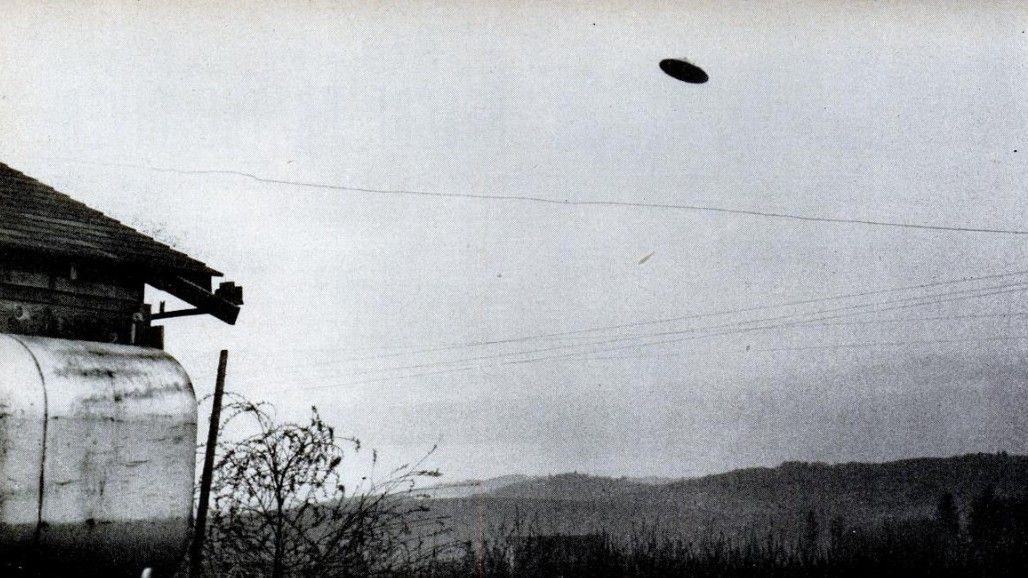
Two photographs of a metal-looking disc that Oregon farmer Paul Trent took over his farmyard on 11 May 1950, which the Air Force-funded Condon study later called "one of the few UFO reports" where every factor it checked fit "an extraordinary flying object".
The negatives went missing for 17 years, then went under the densitometer twice: first for the Condon study, then for physicist Bruce Maccabee. The argument since is simple to state. Either a large object was far off over the fields, or a small model hung from the wire above the yard.
"No noise or smoke"
Evelyn Trent was feeding rabbits behind the house at about 19:30 when she saw it, according to the accounts gathered by astronomer William K. Hartmann for the Condon study. She called her husband. The camera was in the house, already loaded with a roll bought that winter. Paul Trent took one picture, wound the film on, stepped to his right and took a second, both within about thirty seconds by his estimate.
The Trents told reporters it was very bright, almost silvery, with "a sort of superstructure", and that there was "no noise or smoke". Paul added: "There wasn't any flame and it was moving fairly slow." It tipped, gathered speed and left toward the west. Asked to guess its size, he once said "20 or 30 ft."
He did not go to the papers. He was "kind of scared of it", the Oregonian reported, and thought it was a secret American craft: "now I have an idea the Army knows what they are." A reporter, Bill Powell, heard about the pictures from two local bankers and found the negatives on the floor where the Trents' children had been playing with them. The McMinnville Telephone-Register ran both photos on its front page on 8 June 1950, saying expert photographers had found no tampering. Life printed them on 26 June.
What the negatives showed the Condon study
Life misplaced the negatives. In 1967 the Condon study found them in the files of United Press International, and Hartmann measured the originals.
- No retouching, and the object in the second frame is the same object as in the first, seen tipped at a new angle.
- No spin. The small "pole" on top sits off centre by the same amount in both frames. Hartmann called this "a rather strong argument" against a thrown, spinning model.
- Haze. The shaded underside looks pale, as distant hills do. Calibrating against the hills, the barn and a white house in the same frames, Hartmann put the object at roughly 1.3 ± 0.4 km, tens of metres across.
His conclusion: "one of the few UFO reports in which all factors investigated, geometric, psychological, and physical appear to be consistent with the assertion that an extraordinary flying object, silvery, metallic, disk-shaped, tens of meters in diameter, and evidently artificial, flew within sight of two witnesses." He kept the caveat in the same paragraph: the evidence does not positively rule out a fabrication, and the object hangs under the same part of the overhead wire in both photos.
Maccabee later wrote that the Condon report's own summary never mentioned Hartmann's conclusion, citing instead another analyst's remark that the photos were "too fuzzy to allow worthwhile photogrammetric analysis".
Maccabee's second look
Maccabee borrowed the negatives from 1974. Correcting for glare inside the camera, he found that a white underside that gave off no light of its own would put the object about a kilometre away. He was careful about what that proves: the photometry "did not, however, prove that the object was distant." He reports that Robert Nathan at the Jet Propulsion Laboratory searched the negatives for a suspending thread and found none. The pictures' low contrast, he argues, fits dull evening light rather than morning sun.
The skeptics' model
Philip Klass and Robert Sheaffer argued that shadows under the garage eaves show morning sun, so the story's evening time is false and the object is a small model on a thread. Hartmann then wrote that Sheaffer's work "removes the McMinnville case from consideration as evidence" for disc-shaped craft, as Maccabee quotes him. Maccabee answered that the shadow edges are too soft for direct sunlight. A 2013 French study by IPACO claimed to detect a thread. The Trents, never paid for their negatives, repeated their story until Evelyn died in 1997 and Paul in 1998.
A model on a wire proposed; not demonstrated.
Evidence, in date order
- 11 May 1950Paul Trent's cameraphototwo photographs on one roll of film; the original negatives were examined by the Condon study in 1967 and by Bruce Maccabee from 1974
- 8 Jun 1950McMinnville Telephone-Registerdocumentfront-page story with both photographs; the paper said expert photographers found no tampering with the negatives
- 1968University of Colorado UFO study (Condon Committee), Air Force contractofficialgeometric and photometric analysis of the original negatives, case 46 Condon Report, Section IV, case 46
How plausible · High
Two named farm witnesses with two photographs whose negatives survive, a Condon analyst's positive finding and a later physicist's support; a model on a wire is argued by skeptics and the Condon analyst later wavered, but no hoax has been demonstrated.
- ●●Access They saw it and took the photos themselves.
- ●●Consistent over time Told the same story until their deaths in 1997 and 1998, per Maccabee.
- ●●Restraint Paul Trent thought it was a secret Army craft; he did not seek publicity.
- ●●Checkable details check out Original negatives survive and were measured.
- ●●Physical traces or official reaction Two photographs.
- ●○No gain sought Never paid for the negatives, by Hartmann's and Maccabee's accounts; a trip to New York was the only reward.
Plausibility weighs how well an account fits where secrecy hides the documents by design, so missing records never count against it. Strength measures what is documented. Assessed 2026-11-19.
Claims
Connected cases
- Condon Committee 1966Analysed by the Condon study
 The Condon study (1966-1969)1966