Lubbock Lights: the professors' lights and Hart's photos
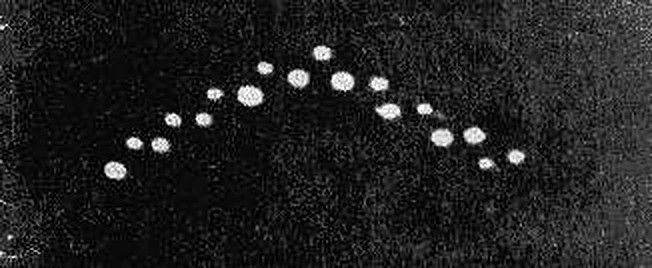
Formations of soft blue-green lights that four Texas Tech professors watched and timed over Lubbock again and again in late summer 1951, and that freshman Carl Hart Jr. photographed as a V of dots; the Air Force's photo lab could not prove his pictures fake or genuine, and its investigator wrote: "Officially all of the sightings, except the UFO that was picked up on radar, are unknowns."
That investigator was Edward Ruppelt, soon to head Project Blue Book. The case reached him in September 1951 as a thick report from Reese Air Force Base, with photographs clipped inside. He flew to Lubbock, interviewed the professors and Hart, and told the story in his 1956 book.
Four professors in a back yard
On 25 August 1951, at about 21:10, four Texas Tech faculty were in Dr. W. I. Robinson's back yard watching for meteors: Robinson in geology, A. G. Oberg in chemical engineering, W. L. Ducker, head of petroleum engineering, and a physics professor. A semicircle of 20 to 30 lights crossed overhead from north to south, about as bright as a bright star but larger, according to the Air Force report. Another flight came over later that evening.
Over about three weeks they logged some twelve flights, with a mathematics professor and a graduate student joining them. They measured what they could:
- Speed across the sky: nearly 30 degrees a second.
- Path: lights switched on about 45 degrees up in the north and went out about 45 degrees up in the south.
- Rhythm: two or three flights a night, about an hour and ten minutes apart.
- Sound: none.
They laid out a base line with angle-measuring teams to fix the height. The lights never came on those nights. The Air Force report says at least 100 people around Lubbock saw them.
When the local paper asked, Ducker would not call them birds. "Anyone trained in scientific observation won't go half cocked on anything like that," he told the Lubbock Morning Avalanche on 2 September. "We discussed whether what we saw might be birds, but we ruled that out."
Hart's five frames
Carl Hart Jr. was lying in bed by an open window late on 30 August when a formation crossed the sky. He took his Kodak 35 into the back yard, set f/3.5 at a tenth of a second, and caught two more passes on five frames. The Avalanche ran one enlarged; the caption counted 18 to 20 dots, one flying off to the side. Tech's head of biology, J. C. Cross, looked at the photographs and said the dots "definitely was not caused by birds."
Hart could produce only four negatives for the Air Force. The Photo Reconnaissance Laboratory at Wright Field found circular, near-pinpoint sources whose positions shifted within the V in a definite pattern. No stars showed on the film, so the lights were far brighter to the film than the stars. The lab told Ruppelt that a very bright source deep in the red, near infrared, could look dim to the eye yet bright on film, and that nothing known that flies does this.
Ruppelt's official line: "The photos were never proven to be a hoax but neither were they proven to be genuine." At an April 1952 meeting with a Los Angeles civilian group, he said: "I think these Lubbock pictures are the best we have ever received." The professors disagreed. Their lights were soft and mostly in loose groups, and Ruppelt says they were "firmly convinced" Hart's photos were of "home manufacture."
A flying wing the same night
Twenty minutes before the professors' first sighting, a Sandia employee of the Atomic Energy Commission, holding a "Q" clearance, and his wife in Albuquerque watched a silent "flying wing" pass low over their home, with pairs of glowing bluish lights on its trailing edge, Ruppelt writes. Shown Hart's photos without being told what they were, the couple wired back that this was what they had seen. A rancher told Ruppelt that his wife had seen the same kind of wing over Lubbock that evening.
Birds, and an answer never shown
Ruppelt's own working theory was plovers lighting up under Lubbock's new mercury-vapour street lamps. An old man in Lamesa told him one of the lights had called out "Plover." A game warden said plovers rarely flew in more than twos and threes. The paper of 2 September reported that some flights were birds; a radio engineer saw wings flapping. Ruppelt named the theory's "big hitch" himself: people living miles from the lit boulevards saw the lights too. Jerome Clark reports that the Avalanche-Journal's chief photographer, William Hams, photographed birds over the street lights at night and could not reproduce Hart's pictures.
By 1956 Ruppelt had changed his mind: "They weren't birds, they weren't refracted light, but they weren't spaceships." He wrote that a scientist had positively identified the professors' lights as a common natural phenomenon, and that he had promised the man anonymity, so he could not say what it was. Harvard astronomer Donald Menzel had offered refracted city lights, without access to the full file, Ruppelt notes.
Birds proposed, then an undisclosed natural cause; neither demonstrated.
Evidence, in date order
- 1951Air Force Photo Reconnaissance Laboratory, Wright Fieldofficialfound near-pinpoint circular lights shifting position within the formation, far brighter than the stars, which did not register
- 1951Project Grudge (Air Force UFO project)officialstatus report appendix on the Lubbock sightings, with the professors' measurements
- 30 Aug 1951Carl Hart Jr.'s Kodak 35photofive frames of a V formation of lights; four negatives analysed by the Air Force photo laboratory at Wright Field
- 2 Sept 1951Lubbock Morning Avalanchedocumentnamed residents' reports, Ducker's statement and Tech biologist J. C. Cross on the photos
How plausible · High
Several named professors measured repeated flights, many residents reported them, and a student's photos defeated the Air Force's photo lab; Ruppelt's birds and his undisclosed natural answer were never demonstrated.
- ●●Access The professors and Hart saw the lights themselves.
- ●●No gain sought Professors had reputations to lose and nothing to sell.
- ●●Character record Geology, chemical engineering, petroleum engineering and physics faculty.
- ●●Independent convergence Several professors, two more observers, and hundreds of residents.
- ●●Checkable details check out Air Force report, Ruppelt's account, contemporary press.
- ●●Physical traces or official reaction Photographs and an Air Force lab analysis.
Plausibility weighs how well an account fits where secrecy hides the documents by design, so missing records never count against it. Strength measures what is documented. Assessed 2026-11-19.
Claims
Similar cases
Connected cases
- Blue Book 1959Investigated by the Air Force UFO project
People and organizations
- Wright-Patterson AFB & 'Hangar 18' orgPhotos analysed at Wright Field
Sources
- Edward J. Ruppelt, The Report on Unidentified Flying Objects (1956), chapter 8 (Wikisource)
- Project Grudge status report, appendix: Lubbock, Texas, 25 August 1951 (Patrick Gross transcript)
- Lubbock Morning Avalanche, 2 September 1951: Opinion divided over reports of objects seen in Lubbock skies (transcript)
- Minutes of the Air Force meeting with Civilian Saucer Investigations, Los Angeles, 2 April 1952 (transcript)
- Wikipedia: Lubbock Lights
 Project Blue Book1959