Rogue River: a disc through Navy binoculars
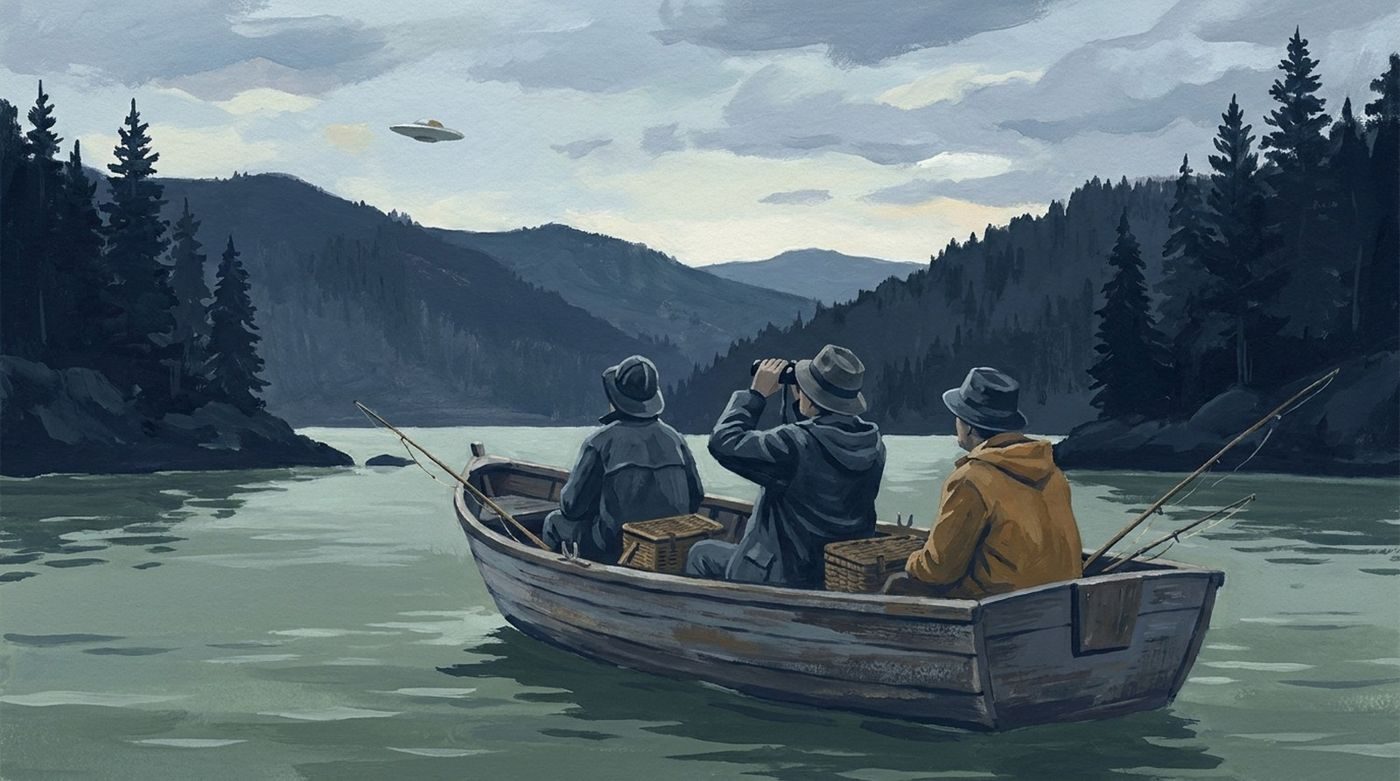
A strong sighting with no photograph, only a sketch: on 24 May 1949 five people fishing on Oregon's Rogue River, two of them staff of a federal aeronautical laboratory, watched a metallic disc with a fin through 8-power Navy binoculars for up to three minutes, and the Air Force's Battelle study later listed it among its unknowns.
The witnesses were trained to look at aircraft shapes. Don Heaphy worked on the 1- by 3-foot supersonic wind tunnel at the NACA's Ames Aeronautical Laboratory at Moffett Field, California; Gilbert Rivera worked in its drafting section. Their lab's security officer sent the report to the Air Force, an Air Force agent took signed statements, and Battelle drew it for its 1955 report. Bruce Maccabee dug out the full file in 1983.
Through the glasses
The party was anchored midstream, looking upriver for feeding fish, when a glitter caught their eye. To the naked eye it looked, Heaphy wrote, "like a round shiny object such as a round mirror with the sun shining on it and the mirror standing on edge." He took the 8-power glasses. "With the glasses there was no glare."
- Shape: flat and round "like a pancake", thicker in the centre, flat on the bottom, with a fin rising from midships to the trailing edge.
- Size and height: 25 or 30 ft across, at about 5,000 ft, by his estimate.
- Surface: "It looked as if it was built out of aluminum and some of the metal looked a little dirty." The trailing edge looked rough.
- Propulsion: "I looked very close for propellers or a jet stream but could see none." There was "no sound of any kind."
- Departure: it sped up as it left; in the last half minute "its speed was about like a jet plane." Another witness, in his signed statement, saw it turn to the south "with no banking or leaning."
His drawing went into the Air Force file with labels: "Rough and wrinkled in rear", "Surface appeared dirty and spotty in color", "Something equivalent to a patch".
"Undoubtedly competent"
On 13 June 1949 the Ames security officer, Arthur B. Freeman, forwarded the report to Fourth Air Force intelligence. Heaphy, he wrote, was "necessarily somewhat familiar with high-speed flight configurations," so the report went on "inasmuch as the observers were undoubtedly competent."
Special Agent C. E. Brooks of the Air Force Office of Special Investigations interviewed the two men in June and took signed statements in August. He described one as "sober, well-rounded, very mature not easily swayed by someone else's opinion." Another agent took statements from a married couple who had been in the boat. The husband said he had fished there for years and seen many planes, "but have never observed anything of this nature before," as Maccabee transcribes the file. Weather charts showed a clear coast. No radar covered Gold Beach.
Kites, aircraft, unknown
Brooks's report raised one possibility: aluminium radar-test "kites", lifted by small balloons twice a day from Treasure Island and Fort Baker in San Francisco, about 340 miles south. "It is possible that one of these 'kites' may have blown as far north as Gold Beach," he wrote. Maccabee found the multi-witness case listed in Blue Book's index as "Other (Kites)" and missing from the files. A separate interview with a fifth member of the party sat in another folder, marked "aircraft".
Battelle disagreed with both labels. Special Report 14 carried it as Case X among its illustrated unknowns: the object "was of metallic construction and was seen with good enough resolution to show that the skin was dirty." Its one doubt was printed in brackets: "(Did glasses have filter?)"
Maccabee, in the Journal of UFO Studies in 1983, argued that the two Blue Book entries are one sighting and should read unidentified. A radar kite is a folded corner reflector, square or hexagonal in outline, never round. The upper winds that day, from the west and north-west and nowhere near 50 mph, could not have carried one 340 miles north in time.
A radar kite proposed in 1949, a blimp suggested later; neither demonstrated.
Evidence, in date order
- 13 Jun 1949NACA Ames Aeronautical Laboratory security officer Arthur B. Freemanofficialforwarded Heaphy's report and sketch to Fourth Air Force intelligence because "the observers were undoubtedly competent"
- 2 Aug 1949Air Force Office of Special Investigationsofficialinterviews and signed statements from the witnesses, character references, weather and radar checks (file 24-14, incident 367)
- 5 May 1955Battelle Memorial Instituteofficiallisted as an unknown, with a redrawn sketch, in Special Report 14 Special Report 14, Case X (serial 1119.00)
How plausible · High
Wind-tunnel staff watched a finned metal disc through binoculars with three other witnesses in clear weather; the Air Force investigated, Battelle kept it unknown, and the radar-kite idea fails on shape and wind.
- ●●Access Seen firsthand, two of them through binoculars.
- ●●No gain sought Reported through the lab's security officer, not the press.
- ●●Character record Aeronautical lab staff; OSI character references.
- ●●Independent convergence Five witnesses, including one interviewed separately.
- ●●Checkable details check out Blue Book and OSI file; Special Report 14.
- ●○Restraint One witness said he could not see possible vents well enough to be sure.
Plausibility weighs how well an account fits where secrecy hides the documents by design, so missing records never count against it. Strength measures what is documented. Assessed 2026-11-19.
Claims
Similar cases
Connected cases
- Blue Book 1959Air Force UFO project file
People and organizations
- Battelle Memorial Institute orgListed as unknown in Special Report 14
Sources
- Project Blue Book Special Report 14 (Battelle, 1955), Case X, p. 86, and the 1949 Air Force file (scans on the UAP Discovery forum)
- Bruce Maccabee, Addendum: Sighting at Rogue River, Oregon, May 24, 1949, Journal of UFO Studies 3 (1983), pp. 45-52
- Air Force file: unconventional aircraft at Rogue River, 24 May 1949 (UFOScans)
- Keith Rowell, An Oregon oldie but goodie (Oregon MUFON)
 Project Blue Book1959