Electrogravitics Systems (Aviation Studies, February 1956)
In February 1956 the Gravity Research Group of Aviation Studies (International) Ltd, a London consultancy, issued Report GRG-013/56, "Electrogravitics Systems". A copy stamped "Property of USAF" sits in the technical library at Wright-Patterson Air Force Base.
It names the US aircraft companies said to be working on gravity control: Glenn Martin, Convair, Sperry-Rand, Sikorsky, Bell, Lear and Clark Electronics, with Lockheed, Douglas and Hiller as earlier names. Martin, it says, put gravity control six years off with "a Manhattan District type of effort"; Bell had a rig meant "to cancel out gravity". Its own first conclusion is blunt: "No attempts to control the magnitude or direction of the earth's gravitational force have yet been successful."
It matters here because it is a dated snapshot of an industry talking openly about gravity control in 1955 and 1956.
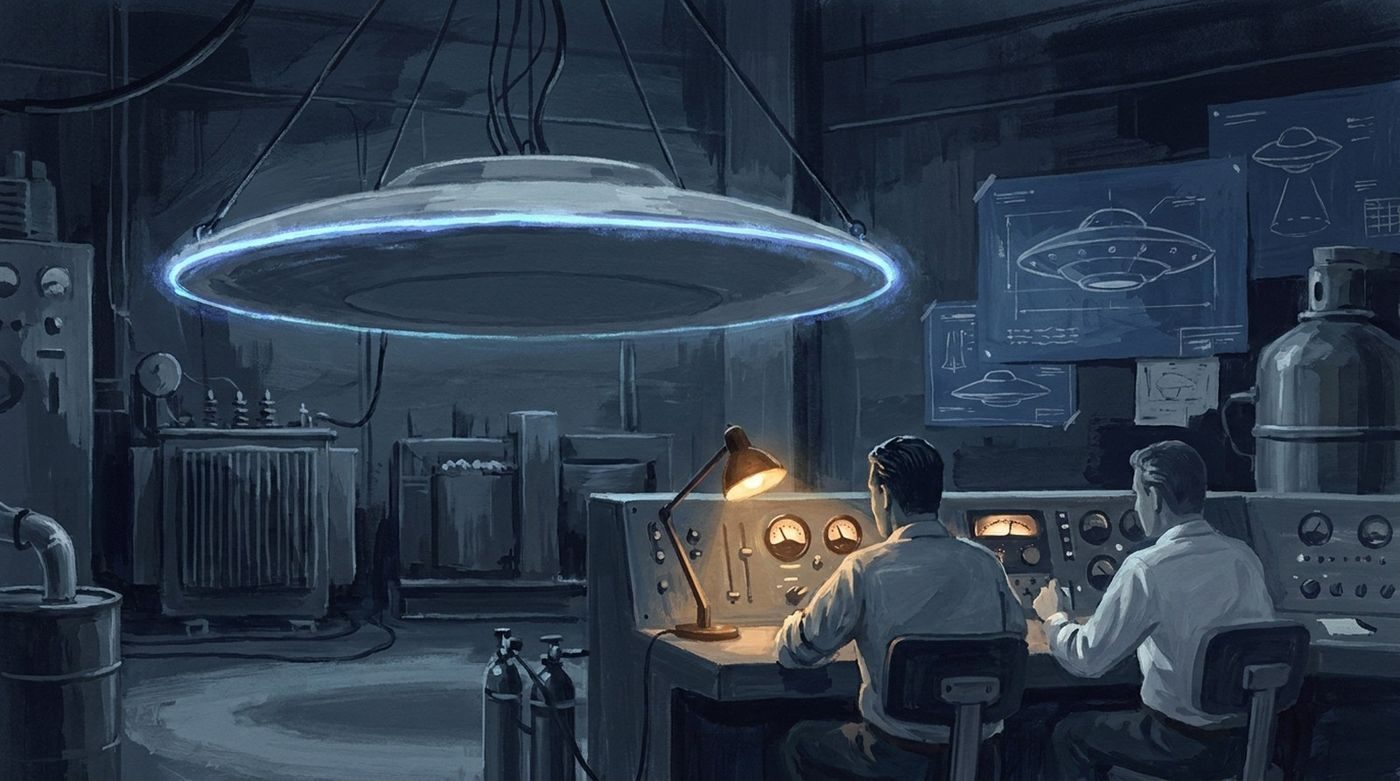
The report, numbered GRG-013/56, comes from the Special Weapons Study Unit of Aviation Studies (International) Ltd. It summarises the field for an industry audience, sets out lines of research, and reprints a year and a half of the firm's own Aviation Report items, which it says were part of a drive to get aviation business interested. The company list therefore rests on trade-press reporting, and some of that reporting is the firm's own.
Who was said to be working on it
An Aviation Report item of 15 November 1955 names Glenn Martin, Convair, Sperry-Rand, Sikorsky, Bell, Lear Inc. and Clark Electronics, with Lockheed, Douglas (McDonnell Douglas) and Hiller as earlier names. The body adds detail:
- Bell has an experimental rig intended "to cancel out gravity", and Lawrence Bell is "convinced that practical hardware will emerge from current programs".
- Convair "is extensively committed to the work with several rigs".
- Douglas "has counterbary on its work agenda but does not expect results yet awhile".
- Martin "is setting up a Research Institute for Advanced Study which has a small staff working on gravity research", the institute George Trimble proposed. The Herald Tribune had already reported, on 20 November 1955, that Martin had put the German theorists Burkhard Heim and Pascual Jordan under contract.
- Curtiss-Wright, Lockheed, Boeing and North American "have not yet declared themselves, but all these four are known to be in various stages of study with and without rigs".
What it claims and what it admits
It credits Townsend Brown as the founder of the field, "the equivalent of Frank Whittle in gas turbines", and cites a 1952 report, Project Winterhaven, that sketched a saucer as a possible Mach 3 interceptor. Its first conclusion cuts the other way: "No attempts to control the magnitude or direction of the earth's gravitational force have yet been successful."
Later readings
Within a year the Air Force was helping pay for a university conference on gravitation, the Chapel Hill meeting of January 1957, which it issued as its own technical report. After that the open record of the industry programs goes quiet. Eric Weinstein asks what the conference "was actually about". Nick Cook argues the research went black; no released document shows that it did.
Paul LaViolette, who has written on the 1956 papers, argues that 1950s electrogravitics research ended up in the B-2 bomber, a claim on the Northrop Grumman page that remains his own analysis (gravity research).
Open questions
- When did the Wright-Patterson copy enter the library, and who requested it?
- Which of the named companies' gravity programmes left records of their own, beyond Martin's RIAS?
On the record
- The report's title page: Report GRG-013/56, February 1956, with the Wright-Patterson Technical Library stamp, TL 565 A9.
- New York Herald Tribune, 20 November 1955: the same wave of company claims, reported in the US press, including Martin's contracts with Burkhard Heim and Pascual Jordan.
Connected
- The Chapel Hill conference on gravitation (January 1957), WADC Technical Report 57-216 documentThe conference a year later
- Glenn L. Martin Company (now Lockheed Martin) orgNames
- Lockheed Martin Skunk Works orgNames
- McDonnell Douglas (now Boeing) orgNames Douglas
- George S. Trimble personHis institute named in
- Thomas Townsend Brown personCredits as founder of the field
- Wright-Patterson AFB & 'Hangar 18' orgCopy held in its technical library
- Gravity and antigravity research fieldGravity research
- Northrop Grumman orgLaViolette's B-2 reading
- Eric Weinstein personGravity years cited by
- Harry Turner's secret JIO assessment of the UFO problem (Australia, May 1971) documentThe anti-gravity effort it describes