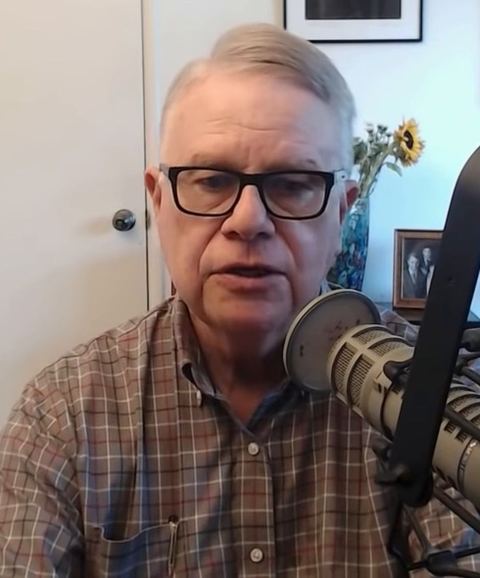
Whitley Strieber
The horror novelist whose *Communion*, his account of being taken from his cabin in upstate New York by beings he calls the visitors, became one of the best-known abduction books ever written. He also says his uncle examined the Roswell debris, and that Gen. Arthur Exon confirmed it to him in 1988.
By 1985 Strieber had already made his name with The Hunger, the vampire novel that became a film with David Bowie. On the night of 26 December that year, at his cabin in upstate New York, he woke with the memory of big black eyes and thought at first that an owl had got into the house. Over the following weeks more came back, some of it under hypnosis with the psychiatrist Donald Klein, a leading forensic hypnotist. An injury sent him to a doctor. Today he says it without hedging: he was raped. The beings stimulated him and took semen, and he says he watched it happen.
The first one he saw stood 4 to 5 ft tall, grey-brown, in what looked like a bodysuit. The one who came most often afterwards was female, with a large head, big black eyes, a long thin nose and a small mouth, and she could make no sound but a cry. His wife Anne lay beside him that first night and never woke. Years later, with a psychiatrist, she remembered "some kind of party", and that "it had to do with Whitley". He has passed three lie detector tests.
Communion came out in 1987 with a grey face on its cover. It went to the top of the New York Times bestseller list and sold more than two million copies, and many people who describe abductions say it was that face that brought their own memories back.
Roswell in the family
About six months after the book appeared, his aunt called. His uncle Edward "Mickey" Strieber, retired from an intelligence career he had never once talked about, wanted to see him. The uncle said he had been at Wright-Patterson with the debris brought in from Roswell, and that it was "very clearly of non-human origin": a thin foil you could do nothing to, like the material Maj. Jesse Marcel described. At one point he seemed to say he had looked inside a craft. He saw no bodies. All through the visit his aunt kept asking, "Whitley, have you seen the materials?"
The uncle's friend through both their careers was Arthur Exon, who rose to brigadier general and commanded Wright-Patterson in the 1960s. Strieber says he spoke with Exon much more often than with his uncle. Had the uncle broken his oath? "We cleared it," Exon told him. In 1988, Exon said, he was still going back to Wright-Patterson to confer with the scientific group working on the material. Meetings on the subject in his time had been "pencils up", with nothing written down, and there were still too many unknowns for anyone to know how to tell the public. Strieber says Exon told him far more than he ever told Stanton Friedman, whom Strieber introduced to him. When Friedman's interviews became public the Air Force was upset, and Exon told Friedman he thought his phones were bugged. See Roswell and Wright-Patterson.
What he says the government knew
Before Communion came out, the space scientist David Webb, a consultant to several agencies, befriended the Striebers. He sent them to an allergist for shots against reactions to the visitors and gave them epinephrine injectors to keep in the house. To Strieber that can only mean the intelligence community already knew what happens in these encounters.
Just before his later book Confirmation, which took aim at the Air Force, came out, Parade magazine reported that he had temporal lobe epilepsy and had given money to an epilepsy foundation. He calls the item "a plant, a lie". He had in fact taken the most aggressive test for the condition, and it found a brain unusually stable and resistant to hallucination.
The May 1989 night
On a warm night at the cabin, with the windows open, he heard gravel crunch in the driveway, though no car lights showed. As he reached for the shotgun under the bed he saw a man and a woman who looked entirely human standing at the foot of the bed. A man's voice outside said "condition red". They rushed him, and his head was pushed down into the pillow again and again while the woman spoke to him gently. Then it stopped, with a flash and a crash in the woods. In the morning the burglar alarm was still set, yet the garage door stood wide open. The installer who came to check it found a strong magnetic field.
He carries what he calls an implant in his left ear, and people at conferences ask to touch it. He says a slit opens in his right eye, and through it he sees typed English racing past, too fast to read; it is always there, especially when he writes. Two American men who came to his house, and whom he still cannot place, told him it draws up memories he had forgotten. It began to work in 2015, he says, and the books he has written since are some of his best.
What it cost him
His career, he says, was destroyed. He went bankrupt, lost the cabin and now publishes his own books, because many bookstores will not stock them. He is frank about the limits of his own memory. The Secret School, his account of a nighttime school the visitors ran for children in the woods of San Antonio, is "imaginary, most of it", he says now. He went back and found the tree and the benches it describes, near a home for retired nuns, and thinks the real memory is of a nun teaching a group of bright children there by day.
He believes abductions ran from the 1960s into the early 2000s and then tapered off, and that the visitors stay hidden partly because "we've been shooting them down". Ross Coulthart told him that people inside the program say abduction runs in families (Reality Check).
Open questions
- What was Edward Strieber's role in intelligence? Neither Strieber nor Coulthart has seen his file, and Coulthart offered to request it.
- Will the hypnosis tapes be released? Strieber says the stimulation can be heard on them.
Claims
What Whitley Strieber said
Cases
Connected
- Wright-Patterson AFB & 'Hangar 18' orgDiscusses
- Ross Coulthart personInterviewed by