The Question of Extraterrestrial and Human Telepathy
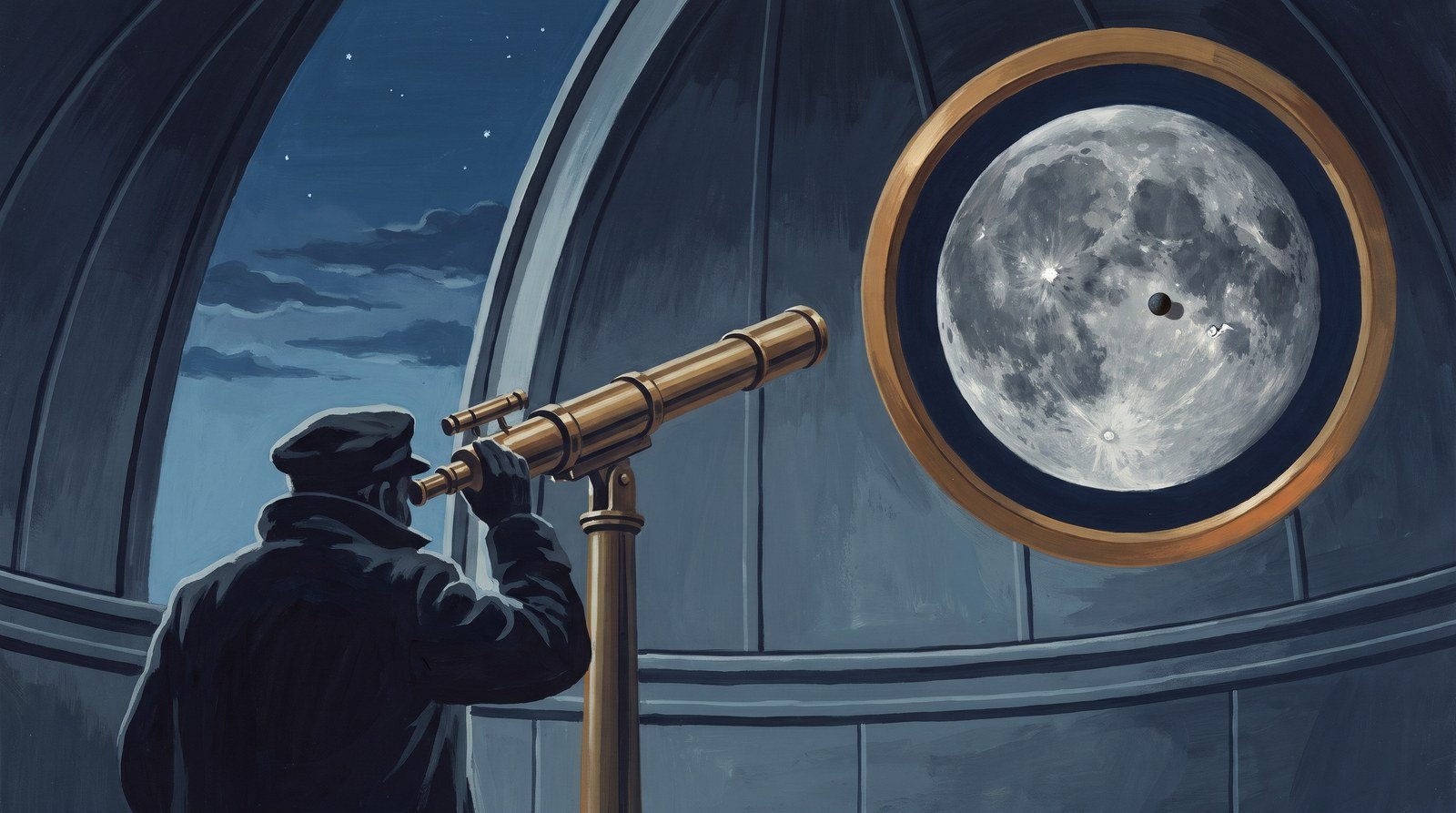
The father of remote viewing says a secret group sent him to the Moon in 1975, and he saw lights, towers, machines and people there. Then he built the case that the Moon has been hiding something all along.
Who wrote it.Ingo Swann (1933 to 2013), the artist and psychic who helped invent remote viewing at Stanford Research Institute, the CIA-funded program that later became Stargate.
The story he can't prove. In 1975 a man calling himself “Mr. Axelrod” had him hooded, flown to an underground base and given coordinates on the Moon. Swann describes green lights on towers, tread marks, domes, bridges, mining, and naked humanlike workers who seemed to sense him watching.
What came after. An unmarked copy of George Leonard’s Moon book in the mail, a supposed alien woman in a Los Angeles supermarket, a scrambled call in Grand Central, and a dawn in Alaska watching a triangular craft drink a lake.
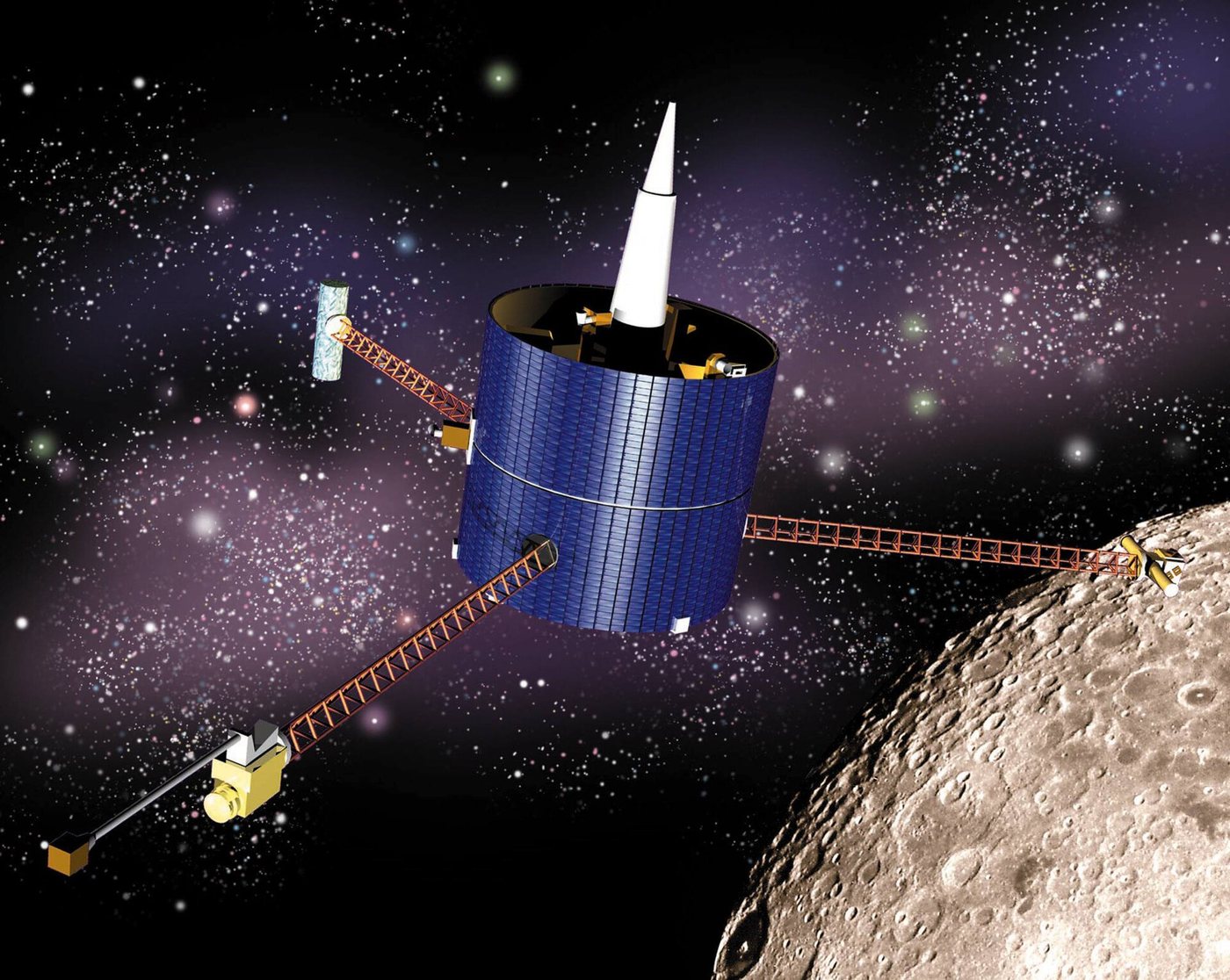
The case he builds. Part Two gathers the record that, he says, the “Dead Moon Dictum” keeps out of view: 579 lunar events in a 1968 NASA catalogue, a Moon that rang like a bell, water and air that science long denied, and an abandoned plan to colonise it.
The big idea. Part Three argues telepathy is the human faculty most suppressed on Earth, and that whoever is on the Moon has “telepathy plus” and would want it to stay that way.
What’s on the record. The CIA funding, the Jupiter session, the NASA catalogue, the cancelled Apollo 18 landing near Aristarchus and the 1998 lunar water are all documented. The 1975 Moon sessions themselves rest on Swann’s word alone.
Swann splits his own book in two: Part One is what he lived and can't prove, Part Two is what anyone can check. We follow him. Each chapter has a short summary in his terms, and a note marked On the record or Worth knowing where we checked something. Quotes are kept short.
Before Part One
Preface: why publish now
Three parts and a reason
Swann explains the plan: Part One is a personal story he “cannot prove happened”, Part Two is “on much firmer ground”, and Part Three is openly speculative. He coins two words for the rest of the book, Earthside and Spaceside, for human and non-human intelligence.
His central idea is simple. If developed psychic ability threatens Earth’s secret-keepers because it can read hidden things, it would threaten Spaceside intelligence for the same reason.
He wrote the story down after a 1990 Soviet report: General Igor Maltsev, chief of staff of Soviet Air Defence, described a disc 100 to 200 metres wide with two pulsing lights. Over twenty publishers turned the manuscript down. He revived it in 1998, after reports of “artifacts” on the far side of the Moon and a huge triangle chased over Britain and the Netherlands on 13 May 1998.
On the recordMaltsev’s statement appeared in Rabochaya Tribuna on 19 April 1990 and was widely reprinted. See Igor Maltsev.
Part One
Ultra-secret goings-on
Eleven chapters of memoir, 1971 to 1977. Swann stresses that none of it can be proved, and that he kept his promise of silence well past the ten years he was asked for.
Chapter 1
Involvement in psi research
Swann volunteers as a test subject in 1971, expecting three months of work. It becomes nineteen years, because US intelligence is worried about Soviet “psychic warfare”. In late 1972 the CIA funds a small project at Stanford Research Institute under physicist Hal Puthoff.
To break the boredom of endless trials, Swann proposes something far out: on a Saturday in April 1973 he tries to “visit” Jupiter before NASA’s Pioneer probes get there. The raw notes, one page of sketches and two and a half pages of words, are copied and handed to scientists in advance.
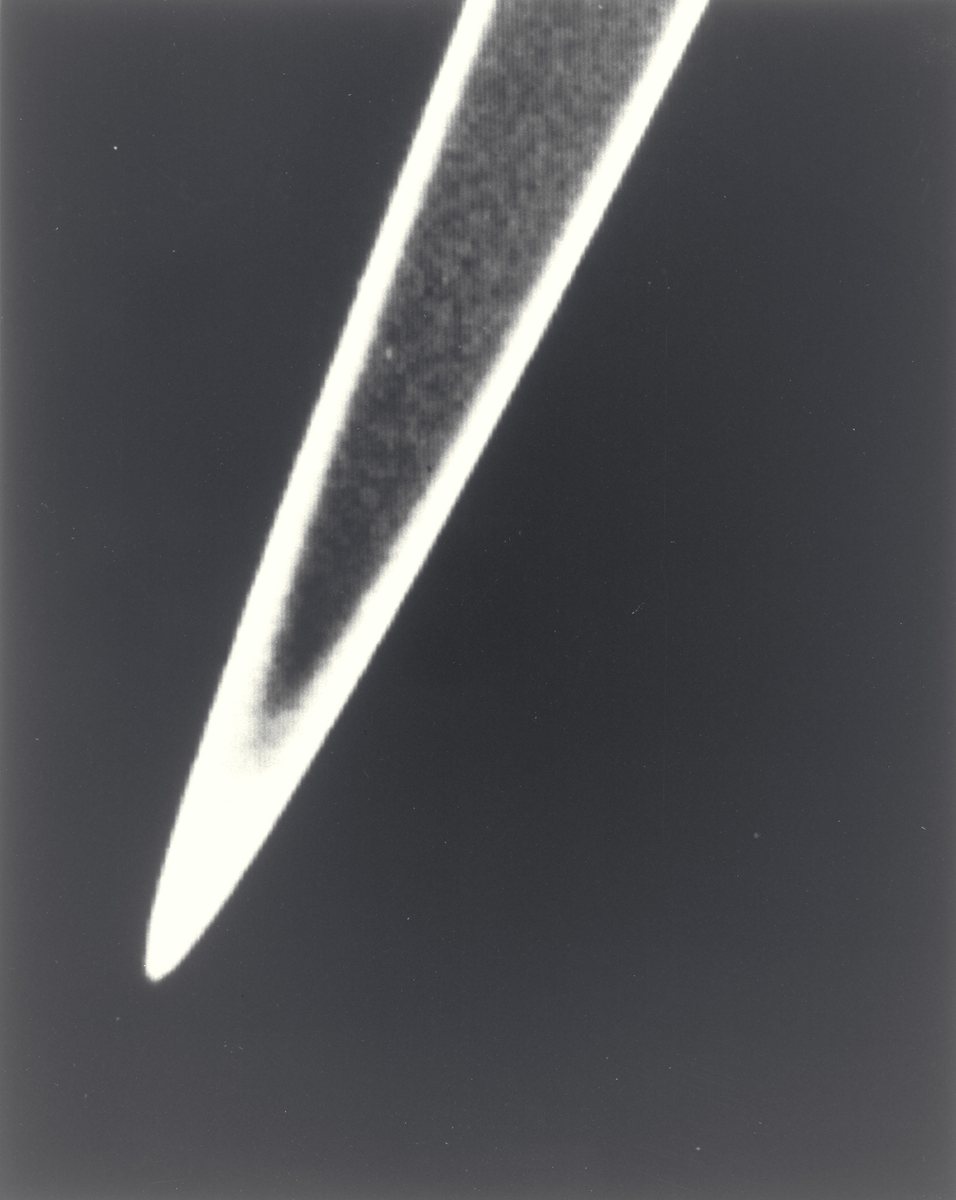
He lists 13 points that were later confirmed, from a hydrogen mantle to storms and a ring. The ring is his favourite: most scientists said Jupiter had none until Voyager found one in 1979. A very secret group, he writes, was watching.
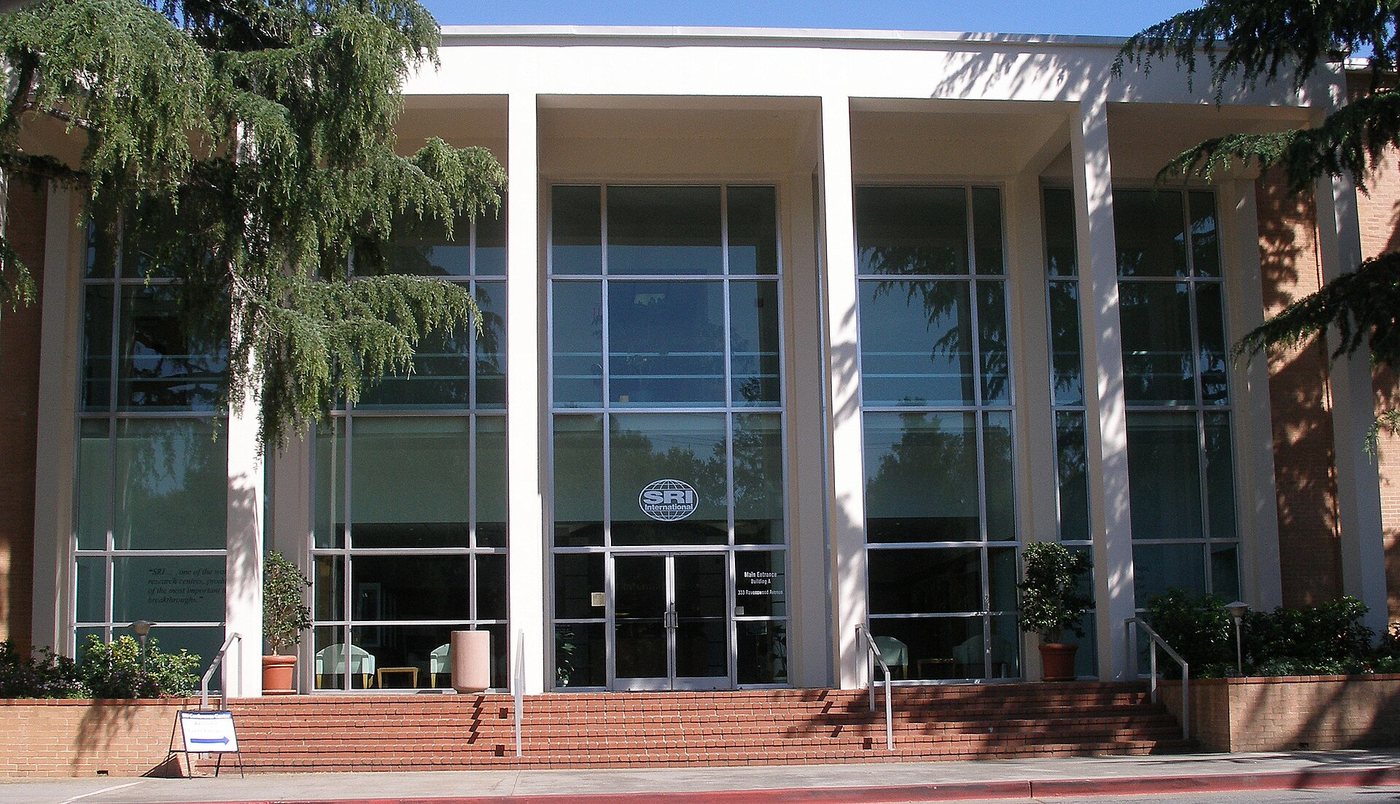
Jupiter’s faint ring, photographed by Voyager in 1979, six years after Swann sketched a ring “inside the atmosphere”. NASA Ames, ARC-1979-A79-7109Stanford Research Institute (now SRI International), Menlo Park, where the CIA-funded remote viewing work began in 1972. Coolcaesar, Wikimedia Commons, CC BY-SA 3.0
On the recordThe CIA’s funding of SRI from 1972 is confirmed by Puthoff’s own account (“CIA-Initiated Remote Viewing Program at Stanford Research Institute”, Journal of Scientific Exploration, 1996) and the CIA’s 1995 declassification. The Jupiter session (27 April 1973, with Harold Sherman) is in the CIA reading room. See Swann’s Jupiter probe.
Worth knowingSmall date fix: Swann says Pioneer 10’s data began in September 1973, but its closest pass of Jupiter was 3 to 4 December 1973.
Chapter 2
Encountering the spookiest spooks
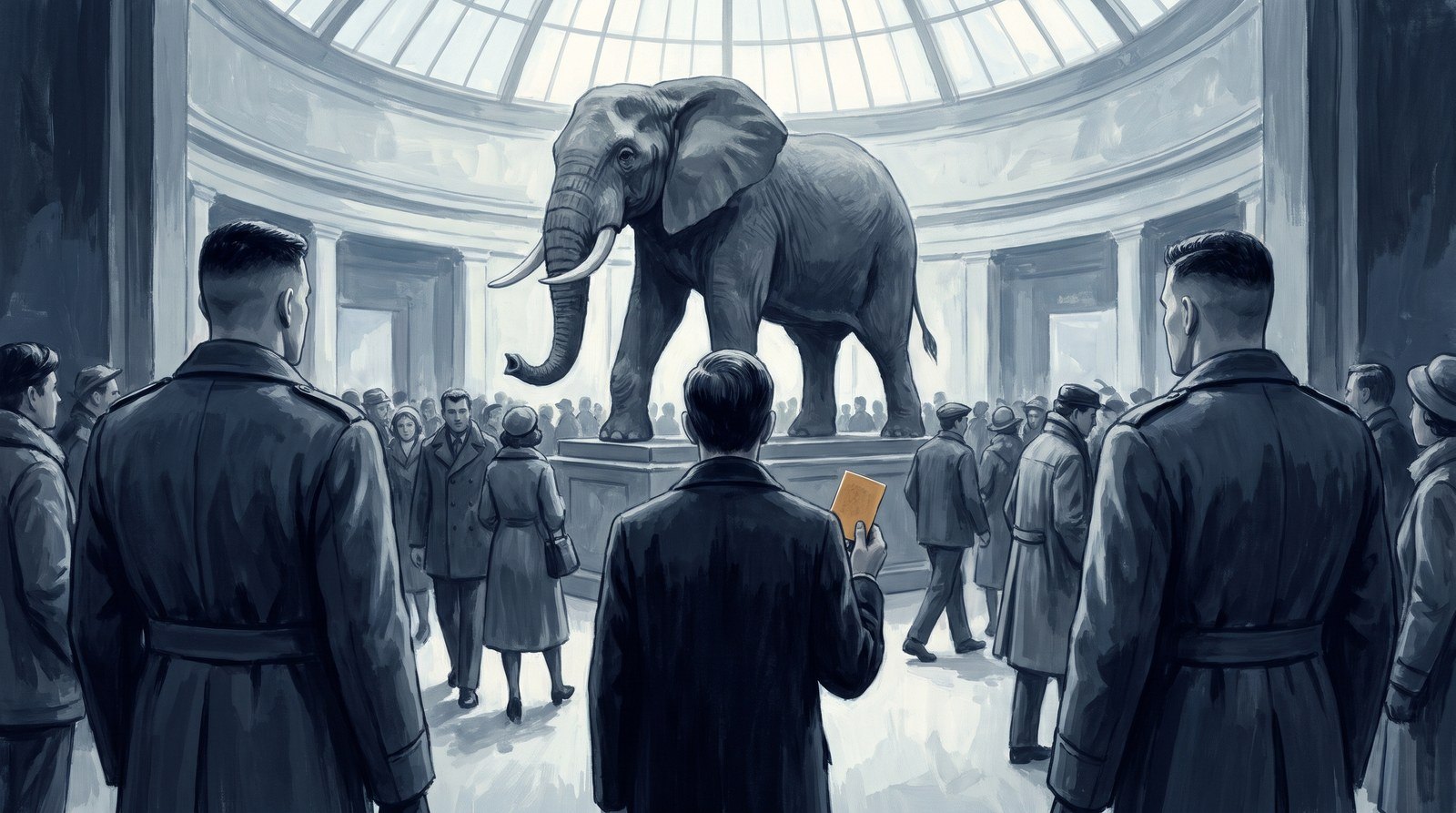
Late February 1975: a highly placed friend in Washington phones. A “Mr. Axelrod” will call; do whatever he asks and ask nothing. Four weeks later the call comes at 3 a.m. Be at the elephant in the Smithsonian’s rotunda at noon.
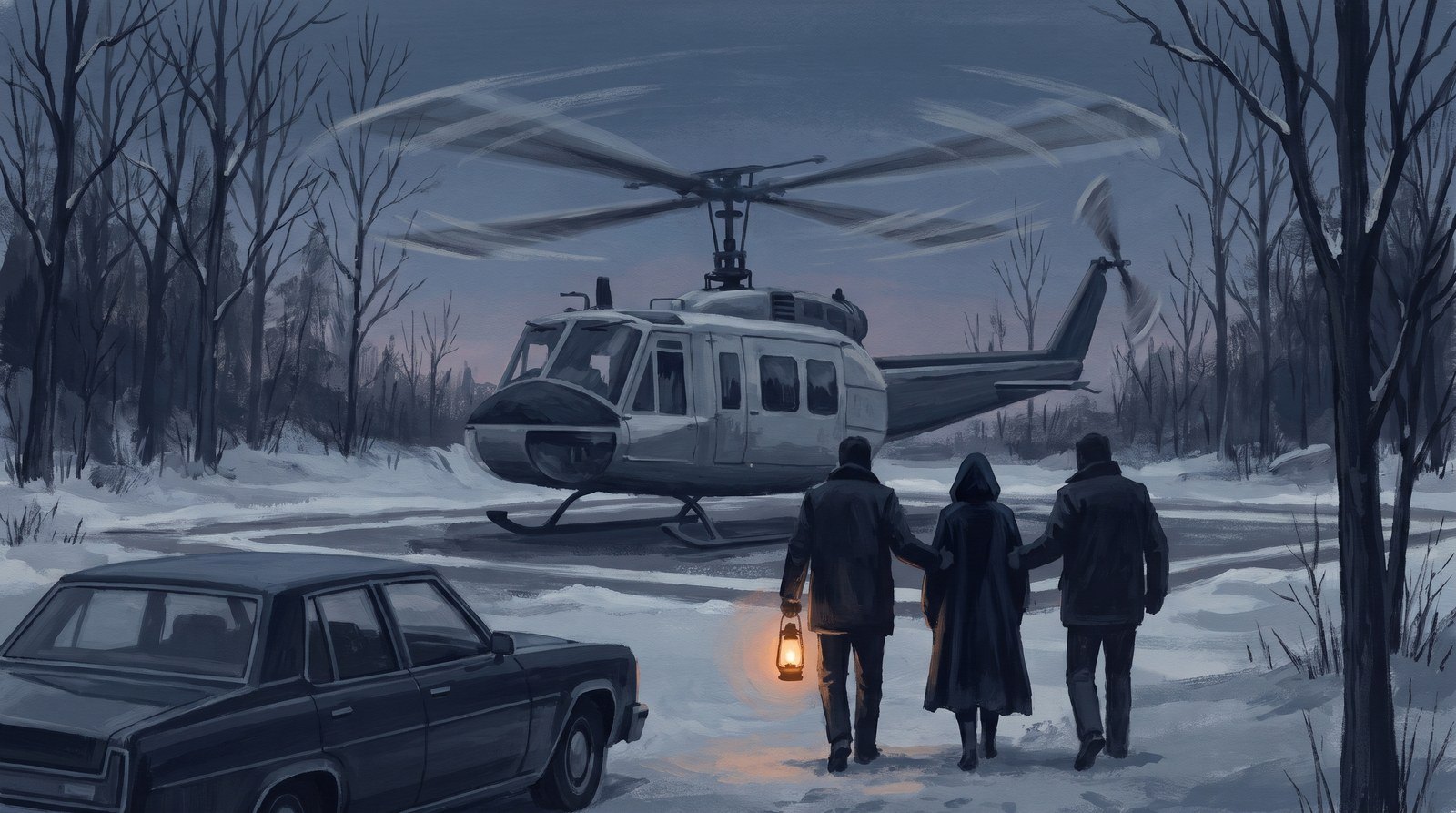
At noon a card is pressed into his hand: “Please do not speak or ask any questions.” Two tall, crew-cut young men, who look like twins, check his face against a photo and his tattoo against another. A car, a frisk, a hood over his head, a helicopter, a long walk and an elevator going down. Swann admits he was terrified.
Noon at the elephant: Swann and the “twins” in the museum rotunda. Illustration for uaptrail.comHooded and led to a helicopter, destination unknown. Illustration for uaptrail.com
Chapter 3
Underground, somewhere
The hood comes off in a dim room. Axelrod, jolly, in a dark green jumpsuit, says the name is not his own and that his group “exist[s] without leaving a paper trail”. He offers a thousand dollars a day in cash and asks for ten years of silence, with no oath to sign.
Swann explains how remote viewing began: guessing the weather in distant cities at the American Society for Psychical Research in 1971, then using map coordinates as an “address” at SRI. Axelrod seems especially stirred when Swann talks about group minds and a “universal” intelligence.
Then the question: “Ingo, what do you know about the Moon?” Axelrod has about ten lunar coordinates ready, and asks whether Swann has ever heard of a man named George Leonard. He hasn’t.
Chapter 4
Psychic touchdown on the Moon
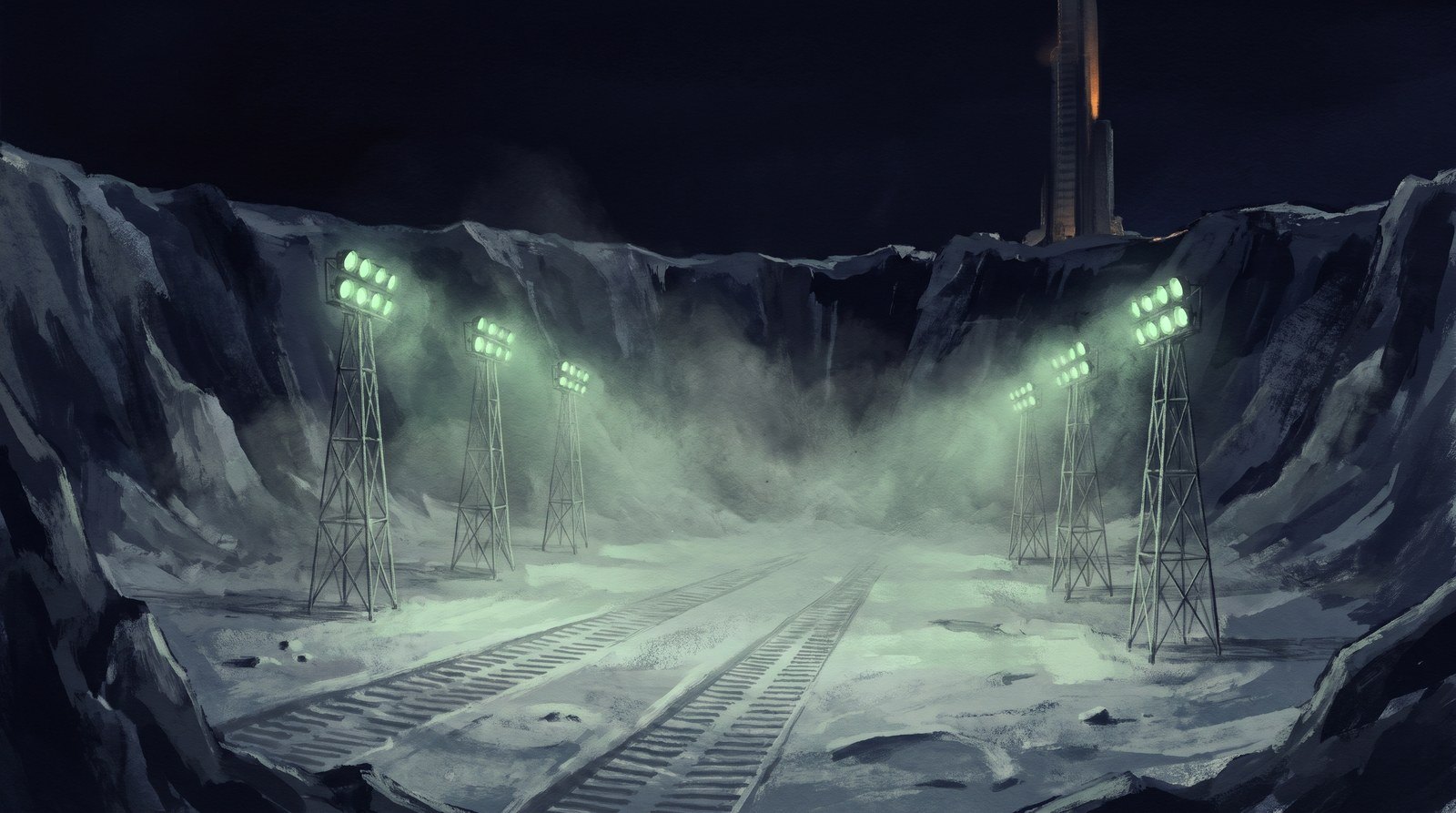
The first coordinate puts Swann in darkness beside a high cliff of glassy rock, with patterns in the dust that look like rows of “tractor tread marks”. At the next, he sees a green haze, then two rows of green lights high on towers, “like lights at football arenas”.
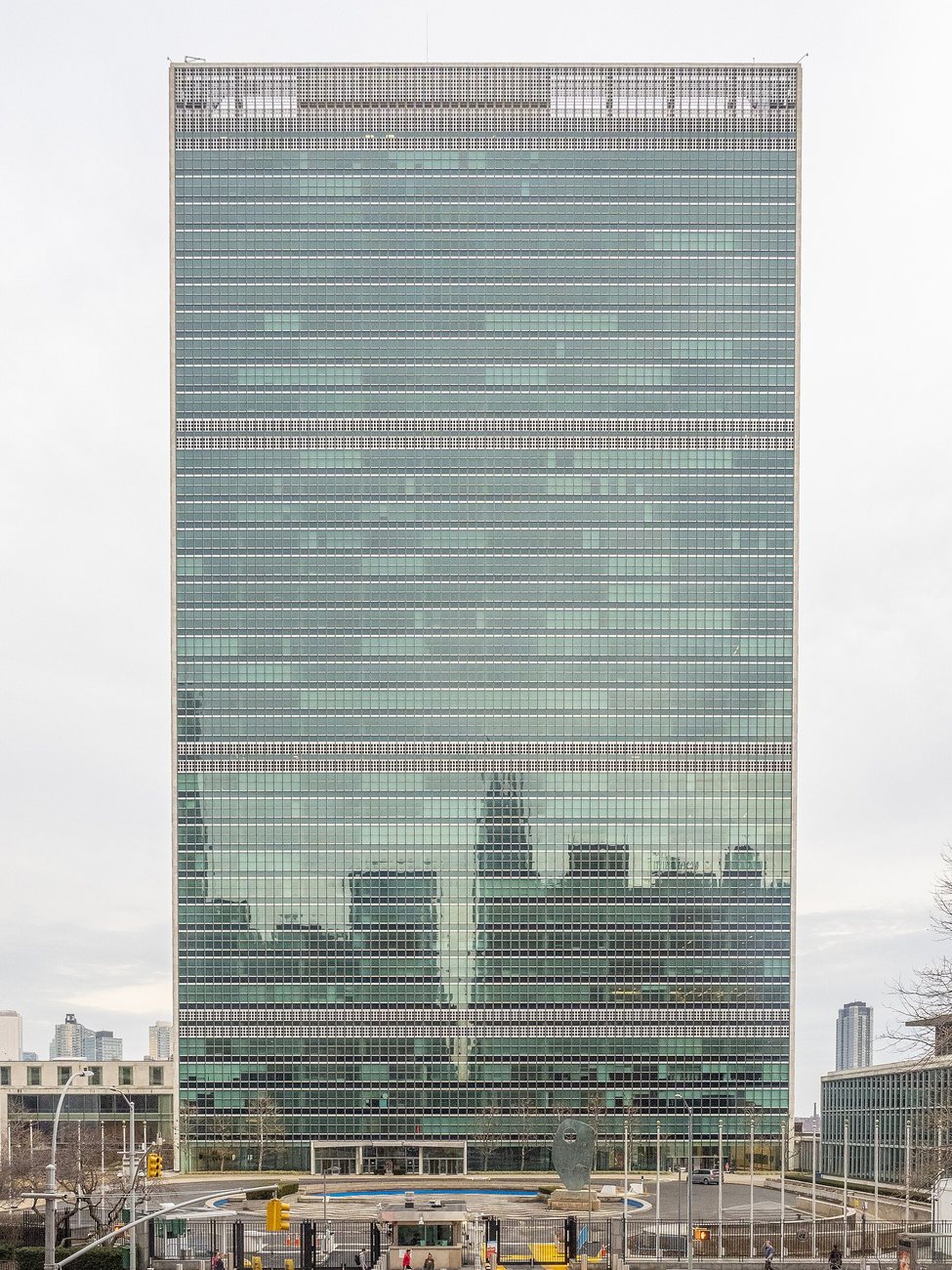
Sure he has strayed back to Earth, he apologises. Axelrod twirls his pencil, swears, and snaps it in half. Swann goes back and looks harder: dust floating in the air, a thumping sound, towers of pencil-thin struts more than a hundred feet tall. On the crater rim stands one huge tower, about as high as the 39-storey UN Secretariat building in New York.
Slowly he understands: this is not ours. He guesses that whoever is there has warned humans away, which is why a secret group needs a psychic. Axelrod half admits it: there are two reasons, and Swann is “approximately correct” about the first.
“Lights, huh? You are sure you saw lights?”
Axelrod, as Swann remembers it
The moment Axelrod snaps his pencil. Illustration for uaptrail.comWhat Swann describes: banks of green lights on thin-strut towers, tread marks, floating dust, and a giant tower on the rim. Illustration for uaptrail.comSwann’s yardstick for the rim tower: the UN Secretariat building in New York, 39 floors. Wikimedia Commons, public domain
Worth knowingTall shadows read as towers are still reported from modern lunar images, for example at Plaskett U, where shadows of roughly 95 feet show in a 2014 LRO frame. Swann gave no coordinates, so no single site can be matched to his.
Chapter 5
Humanoids on the Moon
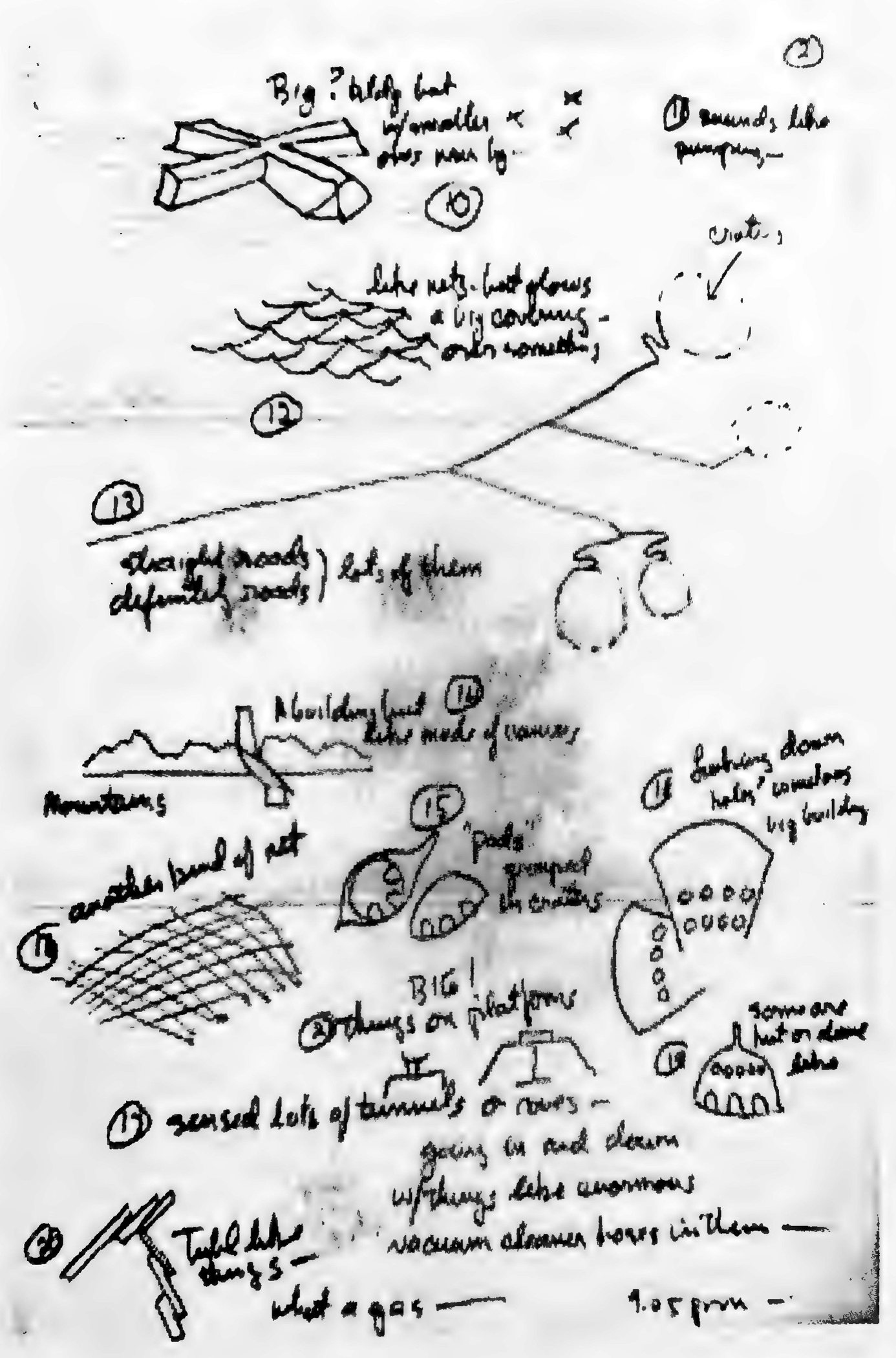
More coordinates bring towers, machinery, coloured lights, “buildings”, domes, small saucers with windows parked in caves and hangars, straight roads, obelisks, “nets” over craters, and a bridge that arches out and never lands. Axelrod takes every sketch.
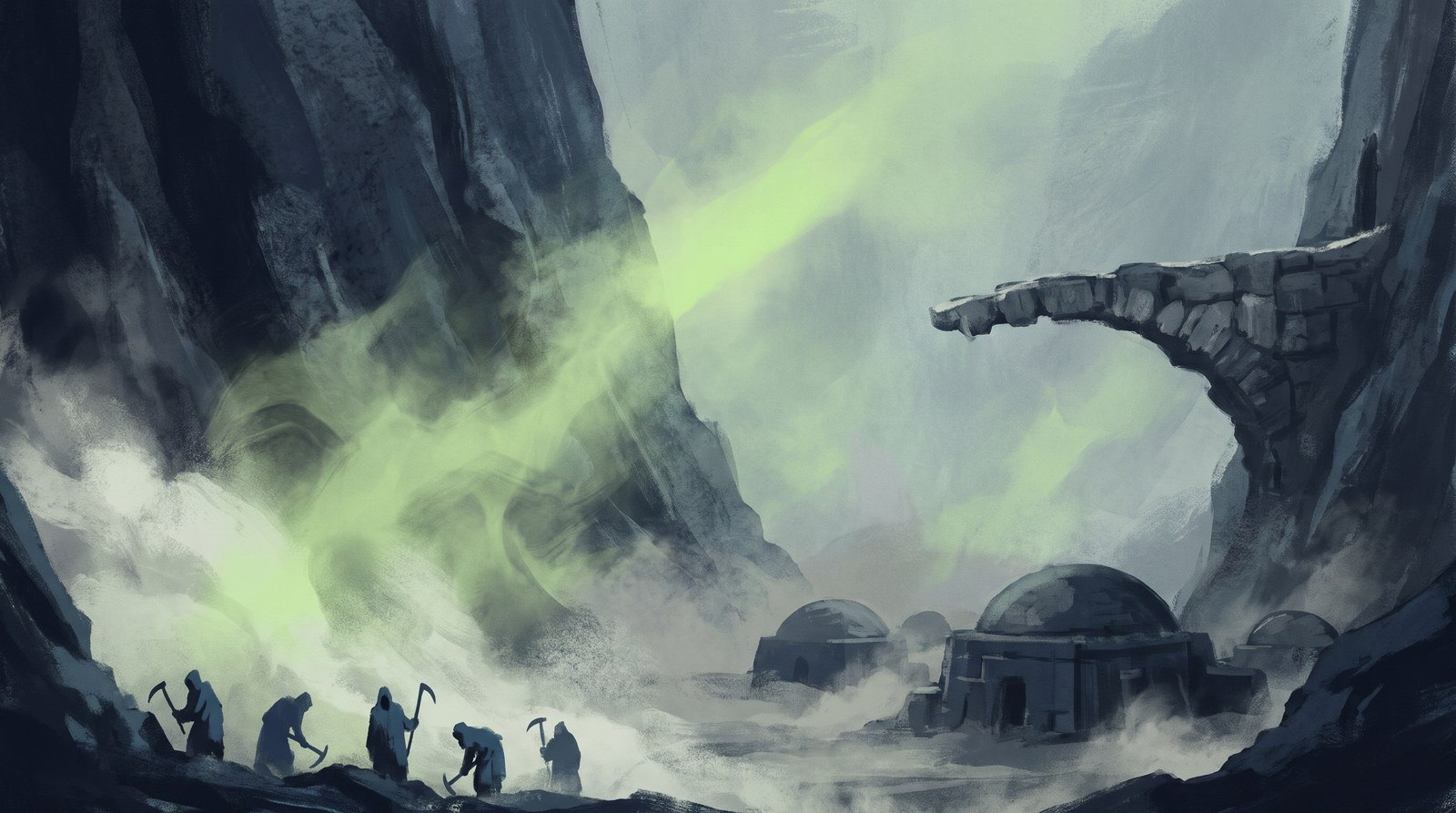
Then people. In a dark place lit by a lime-green mist, men who look exactly human, and completely naked, are digging into a cliff. Two of them point straight at him. Axelrod quietly says, “Please quickly come away from that place,” and ends the session.
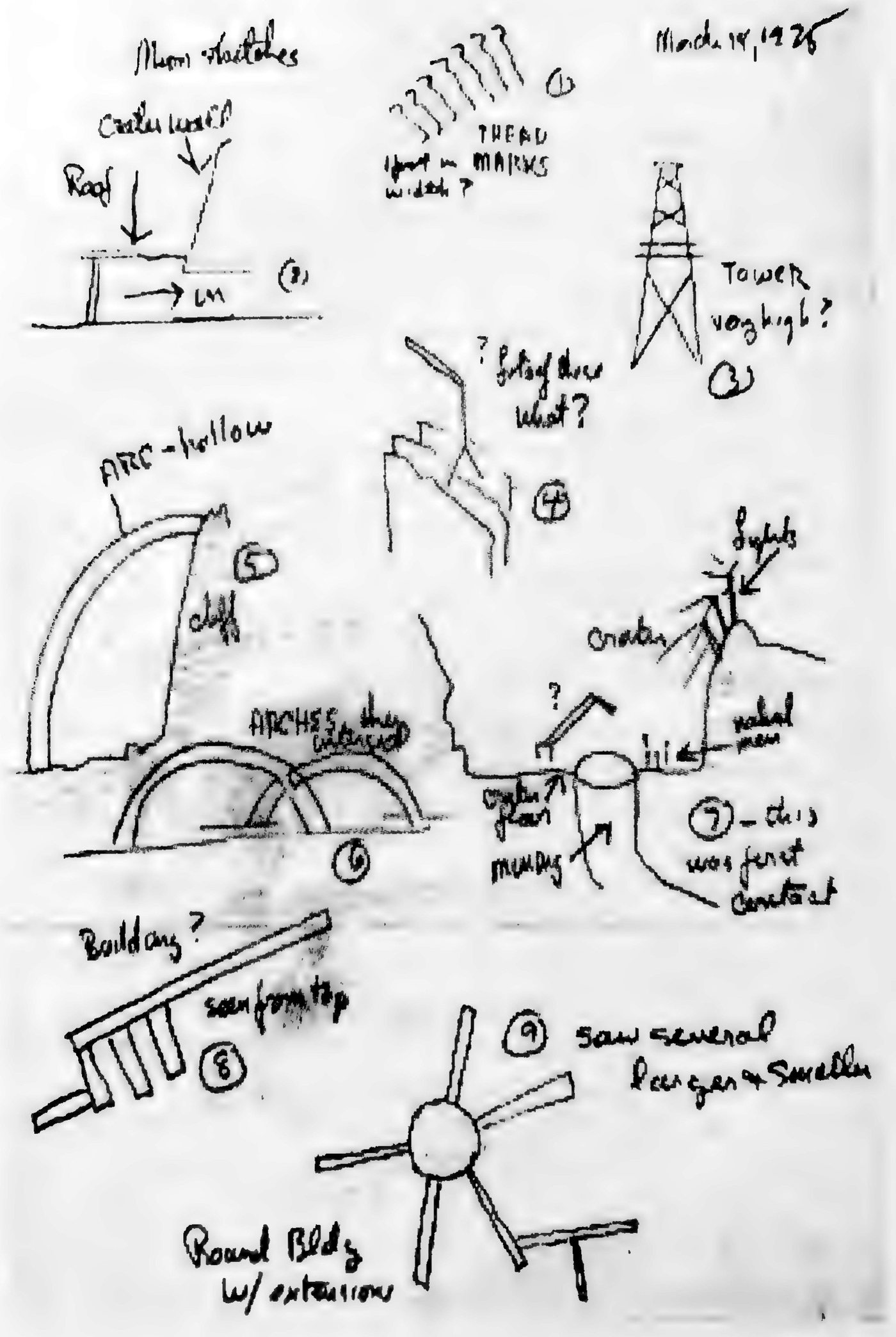
Swann decides they didn’t see him, they felt a ripple, a kind of telepathy “plus” something else. Axelrod asks him to write it down; he fills fifteen pages. Back in New York he redraws what he remembers on two sheets and locks them in a bank box. Years later a caller asks if he knows Mr. Axelrod. He says no, as told.
The workers at the cliff, in the lime-green mist, and the bridge that ends in mid-air. Illustration for uaptrail.comSwann’s “Moon sketches”, page 1: tread marks, a roofed structure, a tall lattice tower. The sheet is dated March 1975 in his hand. Ingo Swann, 1975. From Penetration: Special Edition (Swann-Ryder Productions, 2019)Page 2: domes, bridges, platforms and “lots of tunnels or caves”. Ingo Swann, 1975. From Penetration: Special Edition (Swann-Ryder Productions, 2019)
Worth knowingThe printed caption under the sketches says “March 1974”, but the sheet itself is dated March 1975, which fits Swann’s timeline. Some copies of the 1998 typescript lack these two pages; the 2019 Special Edition reproduces them.
Chapter 6
Feedback (of sorts)
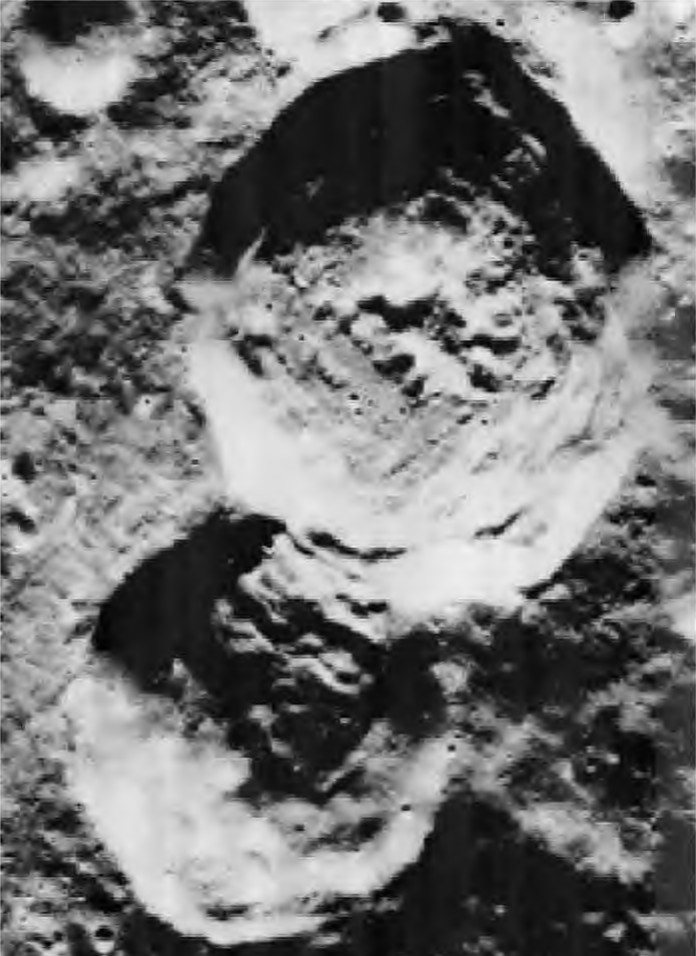
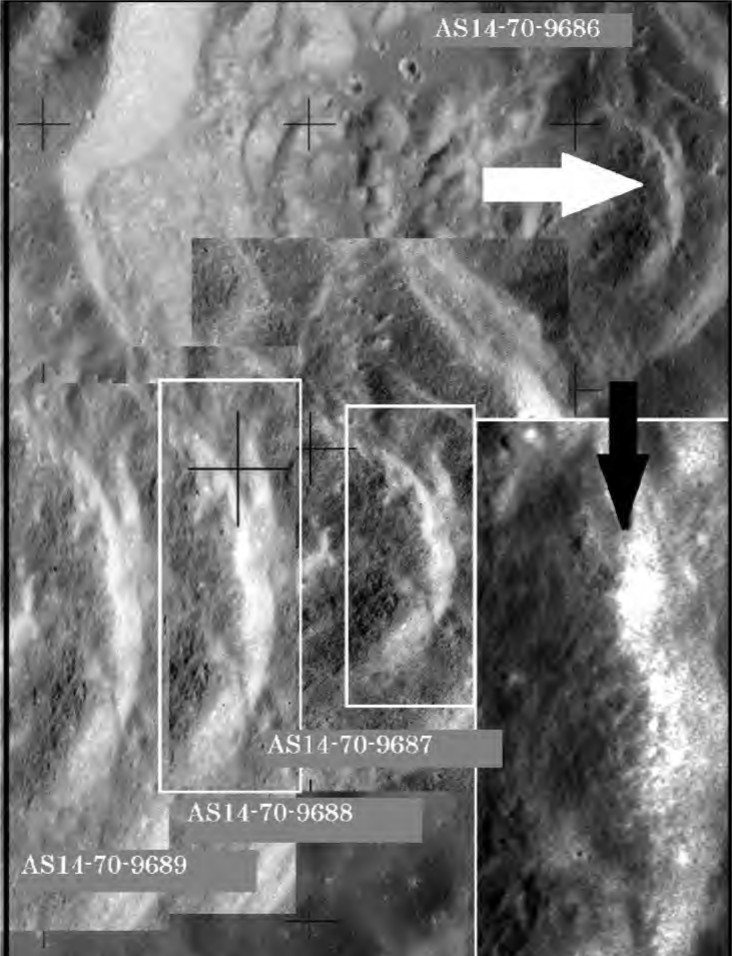
In summer 1976 a book arrives in a plain envelope with stamps but no postmark: George Leonard’s Somebody Else Is On the Moon. Leonard reads official NASA photos as evidence of an underground civilisation mining and building on the surface. Many of his sketches look like Swann’s.
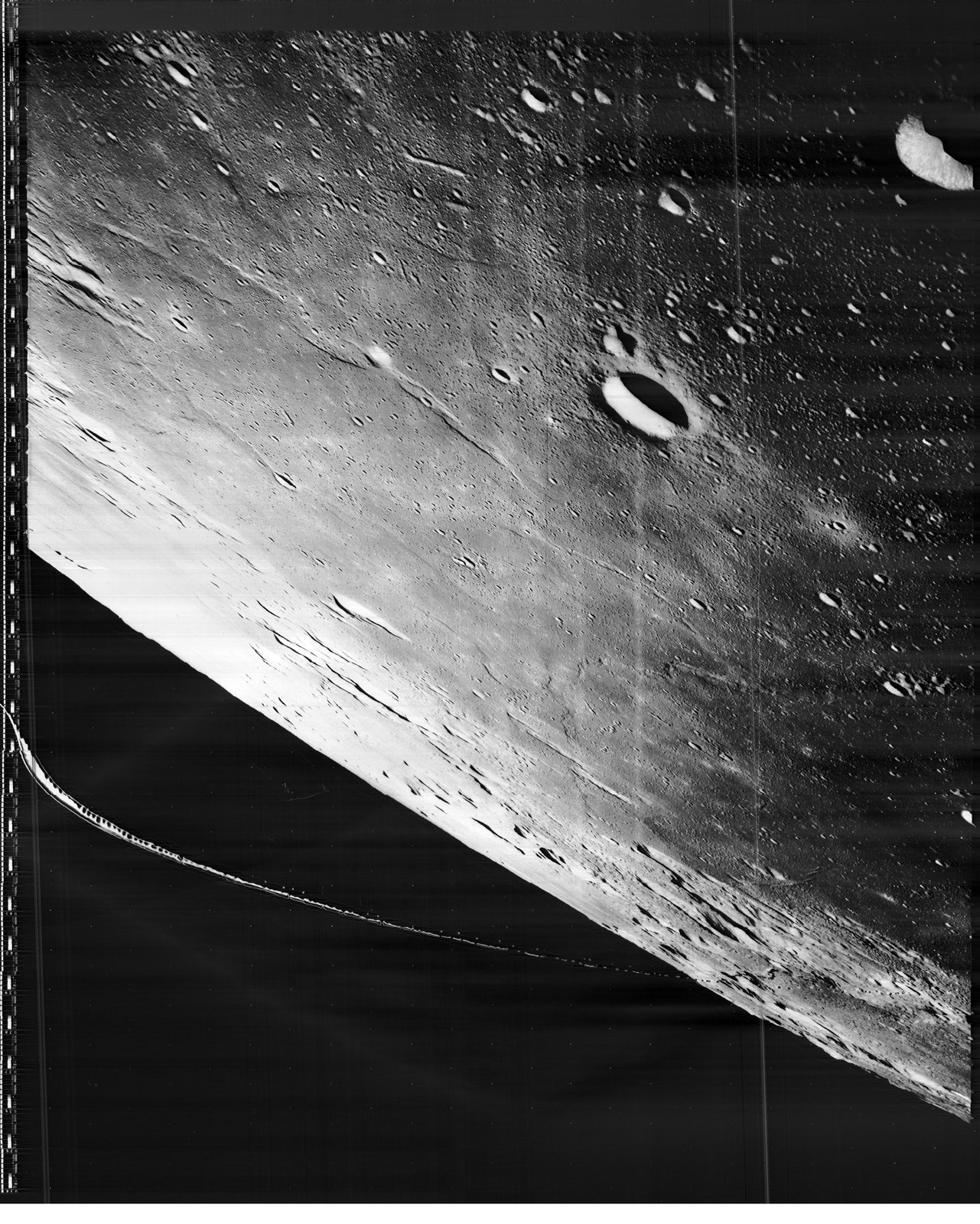
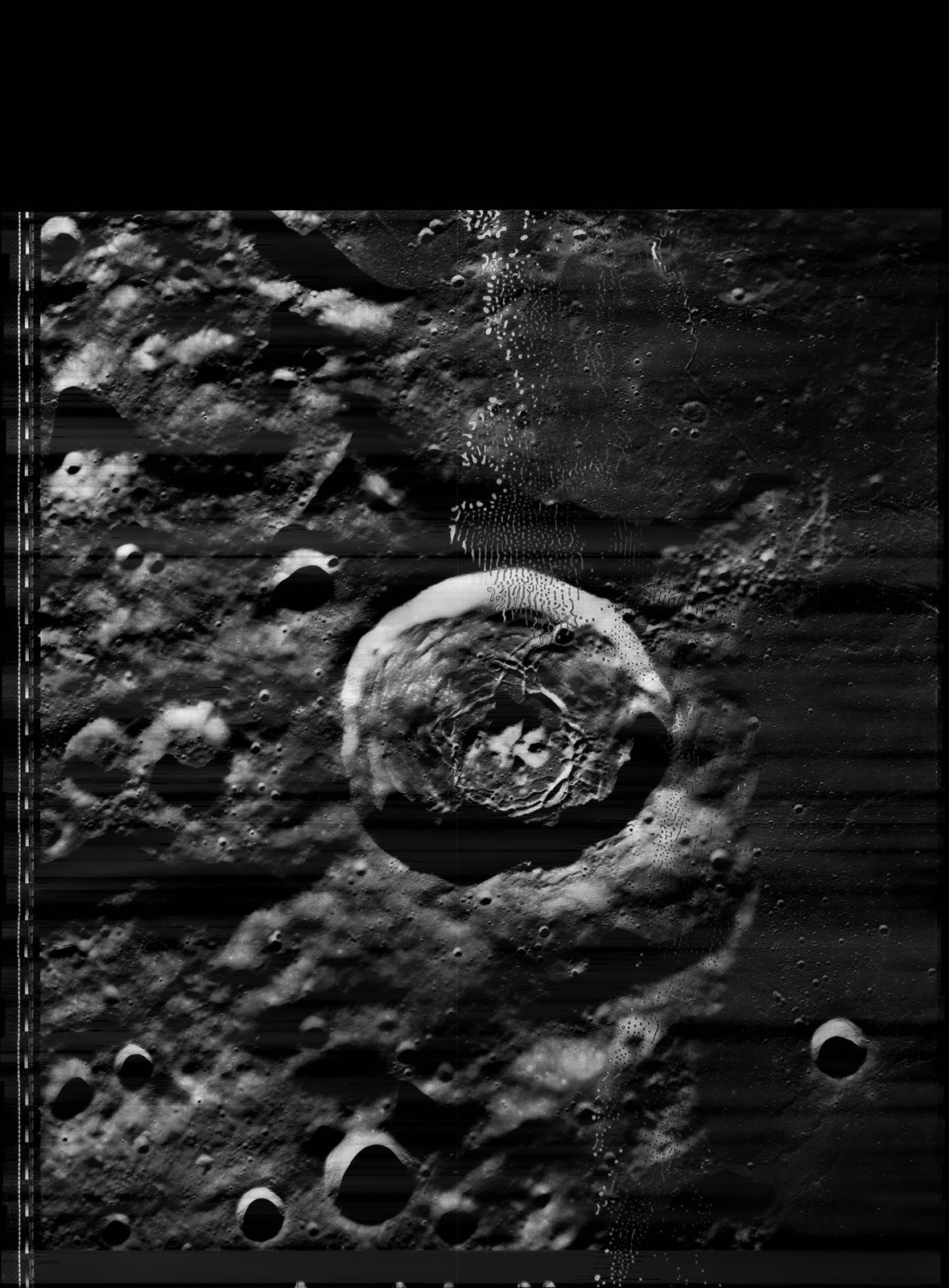
Swann takes it as Axelrod’s promised feedback. He highlights Leonard’s two “Super Rig” photos, five years apart, and later learns of Lunar Orbiter III frame 84M, where researchers name two features “the Shard” and “the Tower”, said to rise a mile and a half and five miles.
Almost no one he tells wants to hear it, even UFO people. That puzzle, why people don’t want to know, runs through the rest of the book.
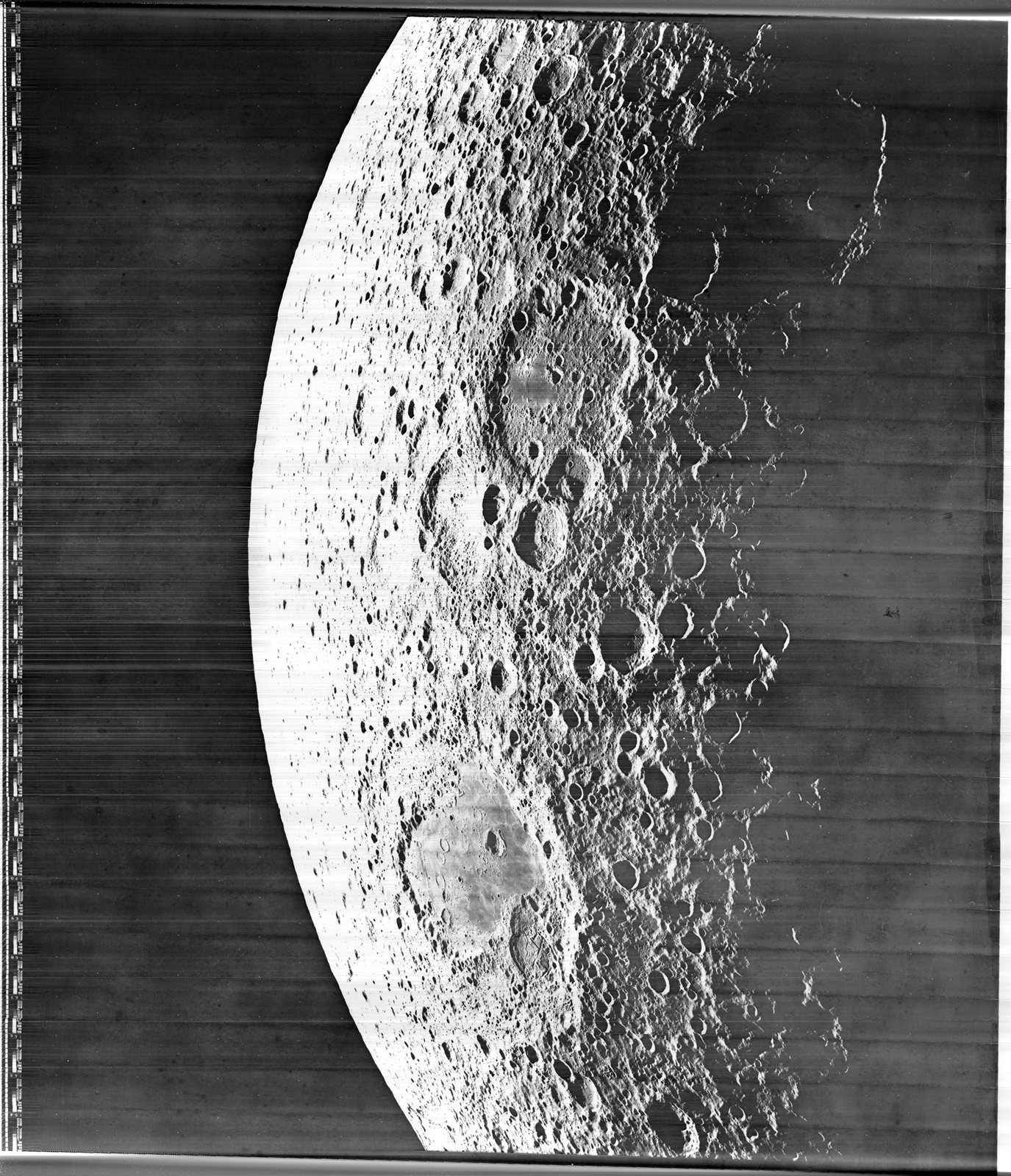
NASA 66-H-1293, Lunar Orbiter I, 1966: Leonard’s first “Super Rig”. NASA, as reproduced in Leonard’s book (plate 4)NASA 71-H-781, Apollo 14, 1971: the second “Super Rig”. Leonard’s reissue labels it a composite of frames AS14-70-9686 to 9689. NASA, as reproduced in Leonard’s book (plate 6)Lunar Orbiter III frame 84M, Sinus Medii, looking toward the horizon. “The Shard” and “the Tower” are names later researchers gave to features near the limb. NASA / Lunar and Planetary Institute
On the record“Annabel” was Leonard’s imagined dialogue. Swann quotes the Apollo 14 crew spotting a mile-high rig they call “Annabel” (“Oh, cameras, don’t fail us now!”), citing Leonard. In Leonard’s book the lines come after the words “Discovery of this huge object might have gone like this:”, and Leonard even writes “Annbell! [Or Barbara?]”. So it is not a transcript. The photo is real.
Worth knowingSwann ties 71-H-781 to Apollo 12. Leonard’s plate shows it is Apollo 14. Leonard’s 35 plates and their NASA numbers are listed on his book’s record, and the whole book is summarised, chapter by chapter, on our Leonard page. More on the Shard frame: The Shard and the Tower.
Chapter 7
The event in Los Angeles
August 1976, Hollywood. Swann is shopping for a dinner meant to loosen the tongues of two well-connected friends, neuropsychiatrist Shafica Karagulla and clairvoyant Viola Neal. At the artichokes stands a stunning woman: pink halter, eight-inch platform heels, purple sunglasses.
A wave of goosebumps, and he simply “knows” she is not human. Then he sees one of the twins at the end of the aisle, watching her, and the other at the far end, both now dressed in black. He retreats to the bread. In the car park his host Conrad glances at her and says, bored, that yes, she’s an extraterrestrial: “We’ve got a lot of them here.”
Over dinner and wine the two doctors whisper that “they” are many, some are bio-androids, and Earth psychics are their only enemies. Swann never mentioned Axelrod.
The produce aisle: the woman at the artichokes, a twin in black watching, Swann frozen with his bag. Illustration for uaptrail.com
Chapter 8
Grand Central Station
Days later a cheerful woman phones: be at the information booth in Grand Central at 7:30. A twin, dressed as a vagrant, leads him to a phone booth and leaves the receiver off the hook. After a check on his tattoo, the call is “linked” to Axelrod on a scrambled line.
Axelrod grills him about the woman: did she notice him, who came to the counter first? She is “very dangerous”, he says; if she ever comes near, move away, but naturally. Then a strange request: when SRI’s remote viewing reaches 65 percent accuracy, write “65” on a sheet and leave it under his desk blotter.
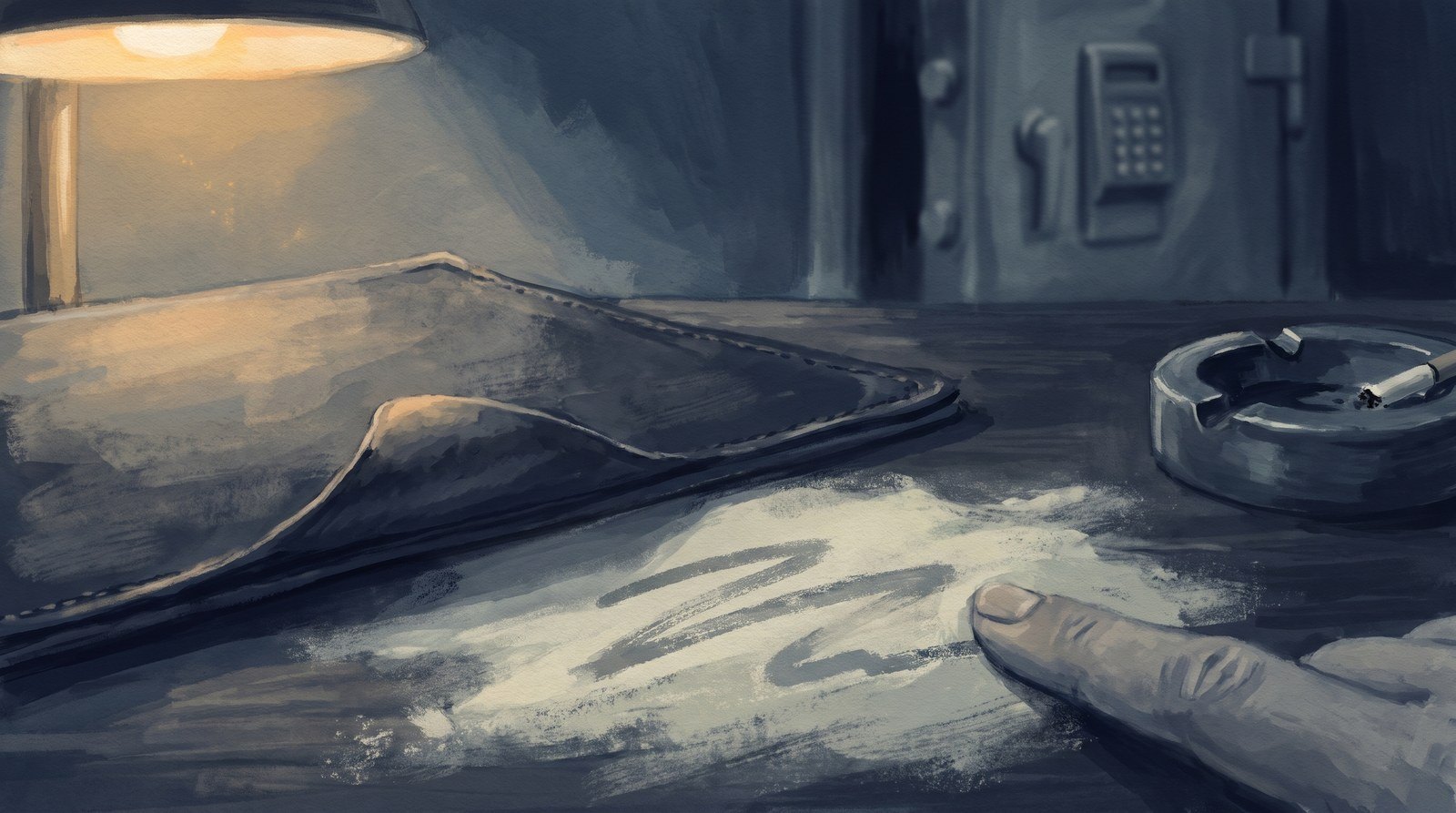
In June 1977 Swann does. His office has a code lock only he knows. About three months later the sheet is gone. In its place is a fine powder, with two words drawn in it by a finger: “Expect contact.”
Under the blotter at SRI: the note gone, a scrawl in the dust. Illustration for uaptrail.com
Chapter 9
Mr. Axelrod’s traveling plans
July 1977. Axelrod is standing by the big globe in SRI’s lobby and pulls Swann into the men’s room: can he get away for the weekend? A Jeep, the San Jose airport, a jet that “just LOOKS like a standard Lear”, five hours north, a landing with no runway lights, two hours in a van whose engine goes silent while it keeps moving.
He is given a light thermal jumpsuit with no metal at all, fastened with wood and leather. Then a forty-minute walk in the dark, without a cigar, to sit behind rocks above a small lake and wait. “They detect heat, noise, motion like mad.”
Chapter 10
Seeing one
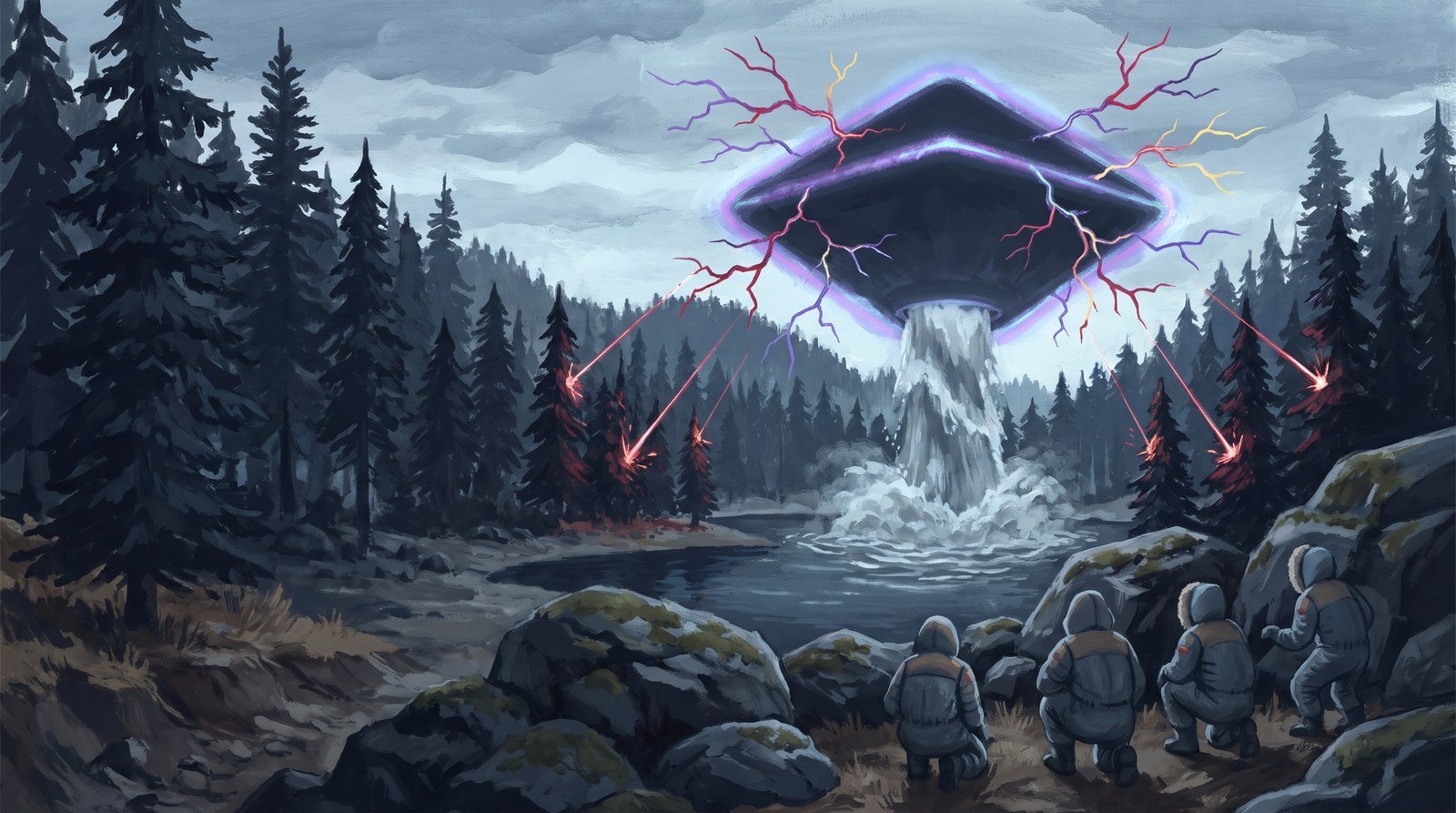
At dawn a grey fog over the lake turns neon blue, then angry purple, laced with purple, red and yellow lightning. Out of nowhere a craft fades in, triangular, pulsing into a diamond, and keeps growing in place to about ninety feet. A pressure wave shakes cones from the pines.
Ruby-red beams start blasting trees, hunting body heat. The twins drag Swann into the gully just before a “pop” where they had been sitting. His last sight is the lake’s water rising like a waterfall in reverse, into the machine.
Afterwards, bleeding and sick, he says it was a drone taking on water. On the way home, at a bush airstrip with an Alaska mail plane, he explains “analytical overlay”: people describe the unknown with whatever they already know. Axelrod says the mission will soon be disbanded. Swann never sees him again.
The craft over the lake, the red beams, and the water rising into it. Illustration for uaptrail.com
Chapter 11
UFOs everywhere, denials everywhere too
Swann is struck by how easily he forgot all this, a kind of amnesia. Two things bring it back. In January 1991 FATE magazine runs Felix Bach’s “Can Moon Illusions MOVE?”, with telescope sketches of towers, nets and arches that resemble Leonard’s and his own. And camcorders start filling TV with UFO footage that is hard to call fake.
Yet official denial never changes. He decides to write everything down before he forgets, and wonders whether a shared amnesia, “FORGET what you have seen”, might be induced on purpose. That question becomes Part Three.
Part Two
Moon activities
Here Swann leaves his own story aside and argues from published sources: the record shows a Moon far stranger than the textbooks allow, and the effort to keep it ordinary is itself the clue.
Chapter 12
The Moon as a target for spin doctoring
His opening claim: on the Moon, evidence doesn’t seem to matter. Realities are built by managing information: stress what supports them, dispose of what doesn’t, add useful illusions when needed. People like their “information comfort zone”, and an extraterrestrial factor would wreck it.
So there must be “a very good reason” why the Moon, of all things, has needed so much spin.
Chapter 13
The Moon, Earth’s natural satellite?
He sums up the tangle in five steps: the textbook Moon is dead and natural; modern data say otherwise; officials keep insisting; the propaganda needed is enormous; so something very big must be at stake.
Then the history: the race to colonise the Moon after Sputnik, the Orbiters scouting landing sites, Apollo 11 to 17, and then a sudden stop in December 1972 with three Apollo craft already paid for. The Soviets stop too. Both turn to Earth-orbiting stations instead. Why build the road and never drive it?
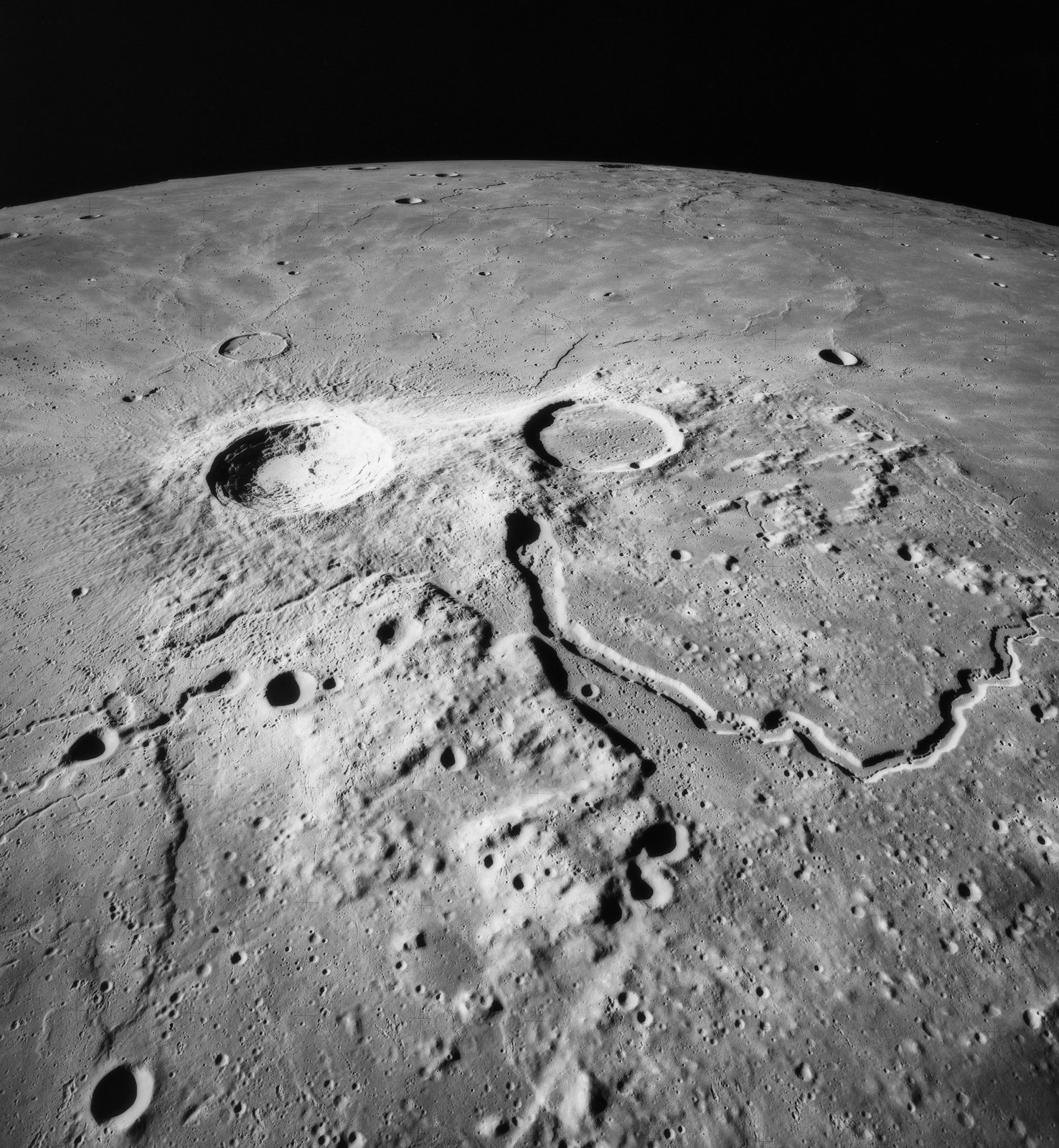
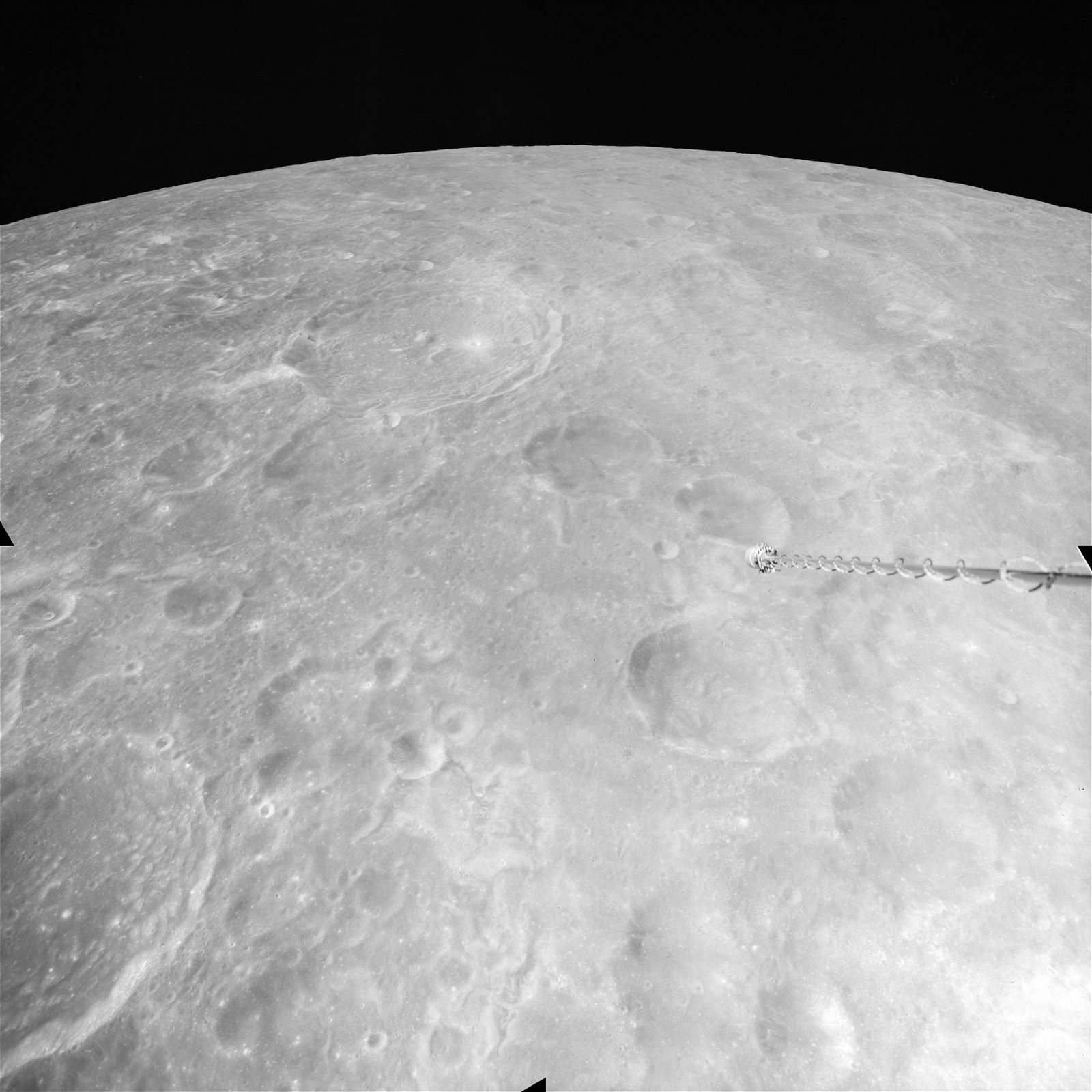
On the recordApollo 18, 19 and 20 were cancelled in 1970 (20 in January, 18 and 19 in September). Apollo 18’s planned site was Schröter’s Valley on the Aristarchus Plateau, the most active lunar-lights region. See Apollo 18.
Worth knowingClementine launched in January 1994 (the typescript says 1995; the Special Edition corrects it), and was a joint Defense Department (BMDO) and NASA mission.
Chapter 14
Situation: Moon rock
Anomalies, he says, are things science said couldn’t exist that turn up anyway. His examples: some Apollo samples were reported in 1973 as 5.3 billion years old, older than the solar system, with soil older still; the Moon is poor in iron where Earth is rich; and its mean density is 3.34 against Earth’s 5.5.
Taken together, he reads them as a Moon that formed somewhere else and arrived later, and whose low density hints at a hollow interior.
On the recordThe densities are right (Moon 3.34, Earth 5.5 grams per cubic centimetre), and the Moon’s iron poverty is real. Earl Ubell’s New York Times Magazine piece of 16 April 1972 is his source for a separate origin.
Still openThe “5.3 billion years” figure has not yet been found in the 1973 Lunar Science Conference papers.
Chapter 15
A natural satellite cannot be hollow
Swann quotes an MIT scientist, Sean C. Solomon, on Lunar Orbiter gravity data “indicating the frightening possibility that the moon might be hollow”, and Carl Sagan: “A natural satellite cannot be a hollow object.” Put together: if the Moon is hollow, it isn’t natural.
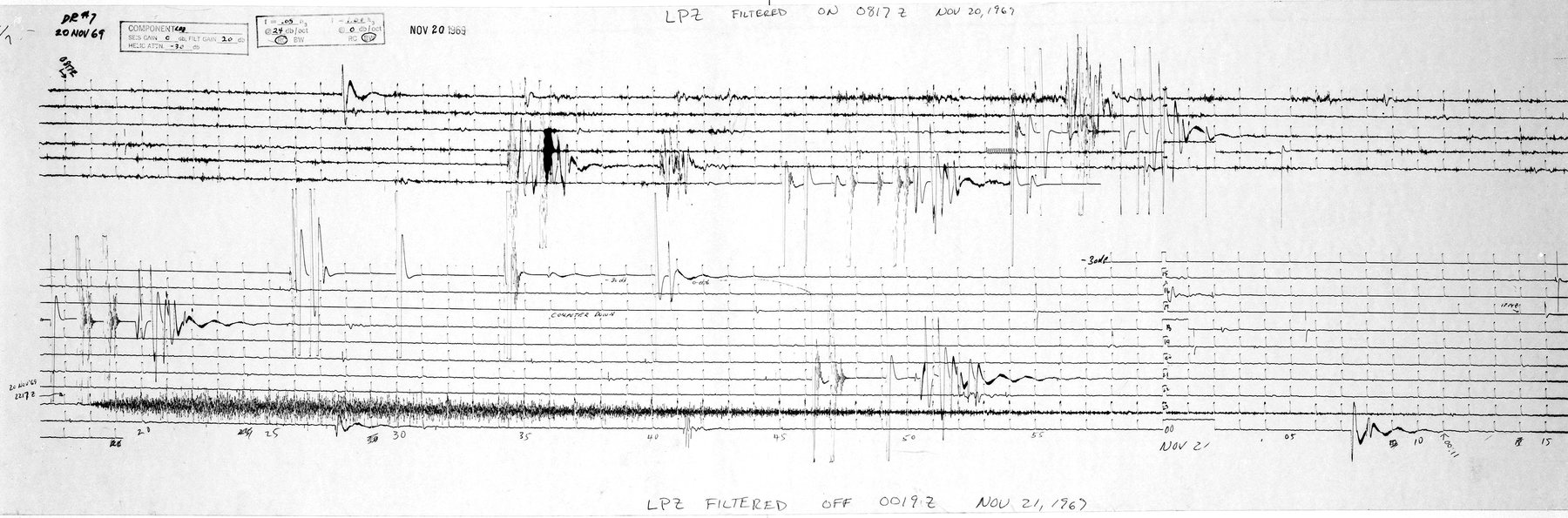
His strongest exhibit: in November 1969 Apollo 12 crashed its lunar module’s ascent stage into the surface, and the seismometers recorded the Moon reverberating for close to an hour. He reasons that the superpowers knew of big cavities before they went, planned to use them, and then, for some reason, did not.
The record of 20 November 1969: Apollo 12’s seismometer as the lunar module ascent stage struck the Moon. The ringing went on for close to an hour. NASA, S69-59547
On the recordThe long ringing after the Apollo 12 impact is real and was reported at the time. The standard explanation is that seismic waves scatter for a long time in dry, broken rock; Swann reads it as hollowness.
Worth knowingThe Sagan line is real (Shklovskii and Sagan, Intelligent Life in the Universe, 1966), but it was written about Mars’s moon Phobos, not our Moon. See the Phobos monolith. The Solomon quote is dated Astronautics, February 1962, which can’t be right, since it cites Lunar Orbiter results from 1966 and 1967; the original is still unlocated.
Chapter 16
The “missing” high-resolution evidence
Two kinds of evidence exist, he says: low-resolution images that fit the dead Moon, and high-resolution ones that don’t, which the public never sees. Spy satellites can read licence plates from orbit, and the great observatories surely turned to the Moon before Apollo, yet nothing sharp was ever released.
Clementine’s cameras raised hopes that went unmet. He points to William Corliss’s 1985 catalogue of lunar anomalies: lights, mists, “weather”, odd motions and more.
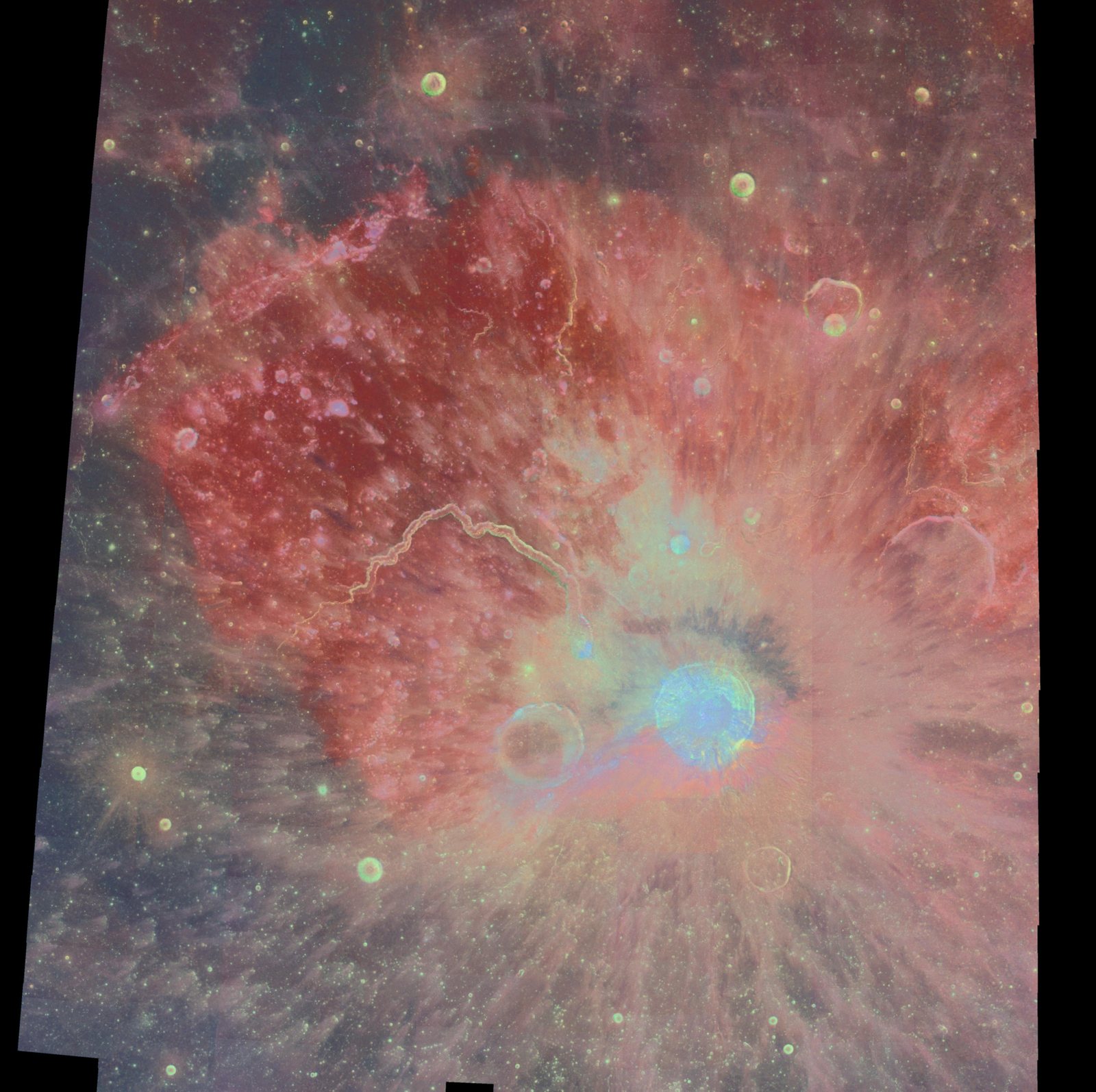
Clementine’s colour view of Aristarchus crater, one of the Moon’s most active places for lights. NASA/JPL, PIA00090
On the recordSwann’s point that the best optics sat under official control holds for his era. Adaptive optics, the trick that sharpens big telescopes, stayed classified until May 1991. Observatories still need Air Force approval before firing their guide-star lasers. The Air Force mapped the Moon from Lowell Observatory from 1961 to 1969, and the NRO had spare Hubble-class mirrors that it handed to NASA in 2012. One detail doesn’t hold: commercial scopes went beyond 14 inches (Meade sold a 16-inch by about 1994), and buying one never needed a permit.
On the recordThe sharp Moon really was missing in 1998. Lunar Orbiter’s pictures, taken with an NRO spy-camera design, were public only in degraded form until a restoration project recovered them in 2008–14. Full scans of Apollo’s panoramic camera came out from 2007. Japan held Kaguya’s HD movies until 2016, and China never opened Chang’e-2’s best frames. The Lunar Reconnaissance Orbiter finally delivered half-metre (2009) and then 25 cm (2011) images.
Worth knowingClementine’s sharpest camera saw 7–20 m per pixel, so it could never have read a “bubble-gum wrapper”, and its raw frames are all in NASA’s Planetary Data System. See Clementine’s blurred areas for the debate that followed.
Chapter 17
The matter of lunar lights
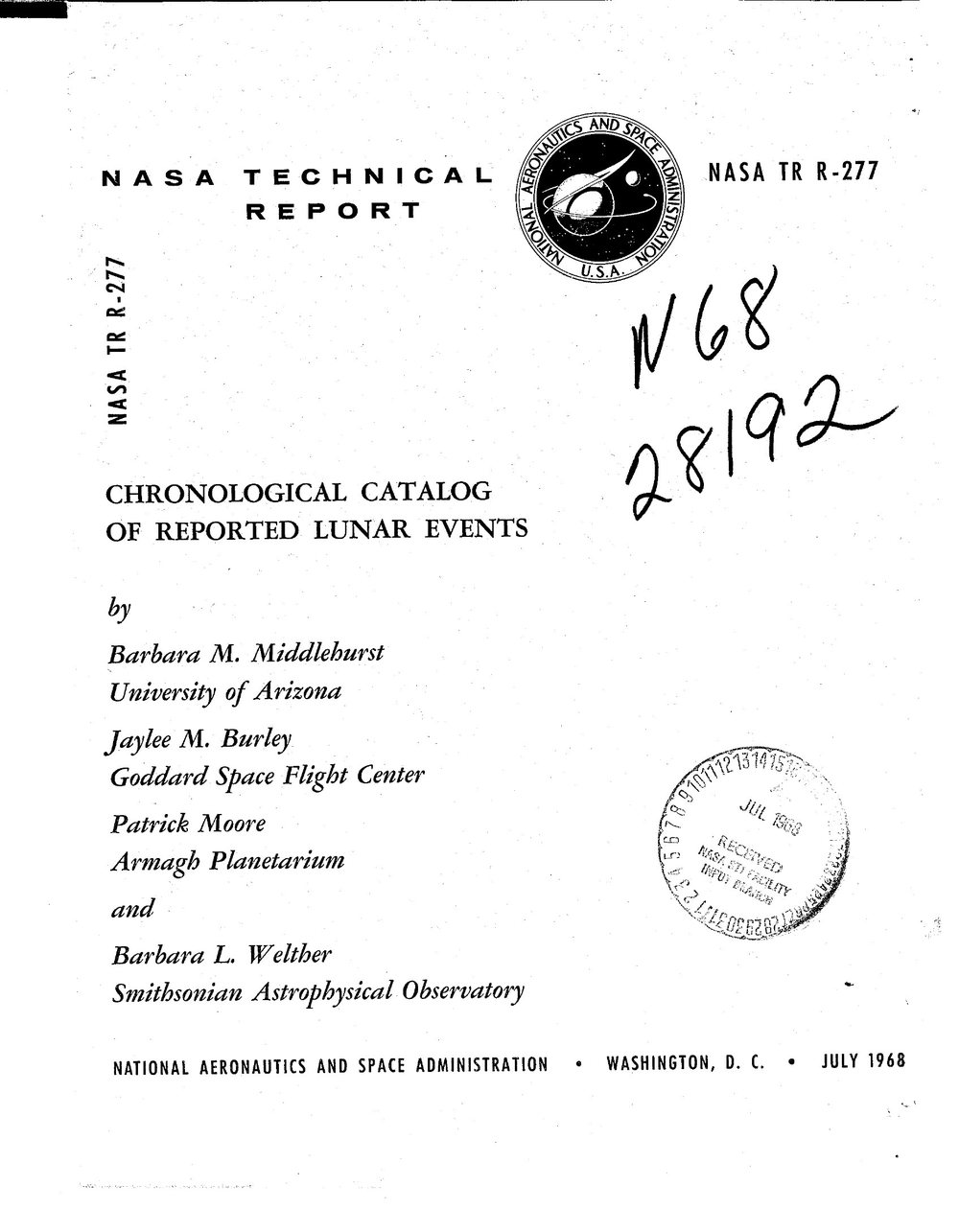
Lights on the Moon number in the thousands, some seen by the naked eye. In 1968 NASA published Chronological Catalog of Reported Lunar Events (Technical Report R-277): 579 events from 1540 to 1967, about three quarters of them lights, compiled by authors at Arizona, Goddard, Armagh and the Smithsonian.
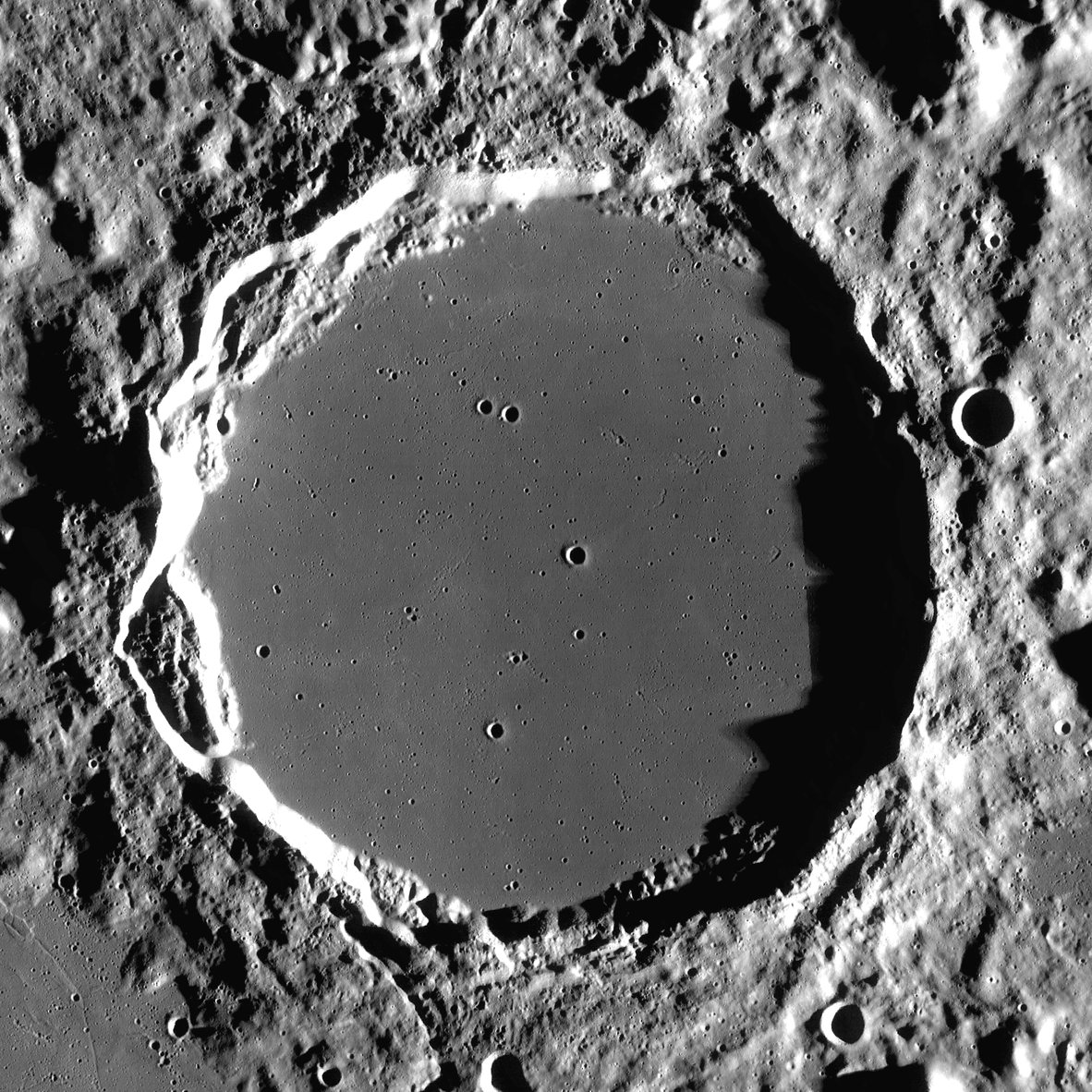
Swann asks why only 579, when the Royal Astronomical Society logged 1,600 events in two years in the 1800s, and why there was never a follow-up after the Orbiters and Apollo. Plato and Aristarchus are famous for lights, moving and geometric. He would have landed an Apollo in Plato. Instead every landing went near the equator, far from the activity.
NASA Technical Report R-277 (1968): the catalogue of 579 reported lunar events. NASA Technical Reports ServerPlato crater, about 60 miles across, famous for changing colours and lights. No mission ever landed there. NASA / GSFC / Arizona State University (LRO)Aristarchus (upper left) and the winding Schröter’s Valley, seen from Apollo 15 in 1971. Apollo 18 was meant to land here before it was cancelled. NASA, S71-44666
When water on the Moon was announced in spring 1998, Swann calls it a late admission. Harvard’s W. H. Pickering wrote in 1903 that the dead-Moon view rested on “the most inadequate negative evidence”; selenographers simply saw changes. M. K. Jessup (1957) and V. A. Firsoff (1959) argued for air and regional water; their books, he says, went quietly out of print.
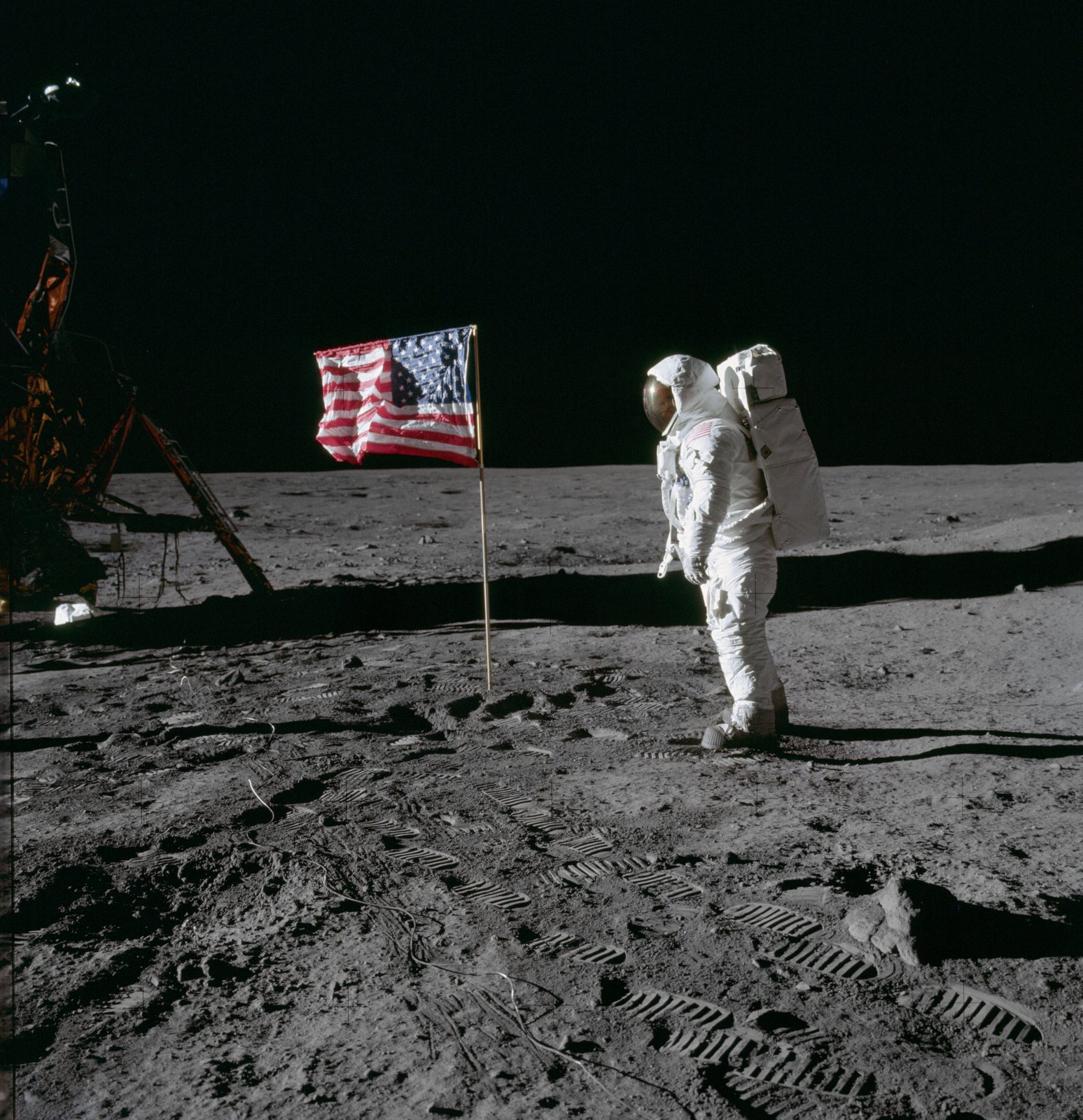
Stars flicker before the Moon covers them, he notes, as if through a thin atmosphere. And he repeats William Brian’s story (Moongate, 1982) that the first flag on the Moon billowed in a gust while no astronaut was near it, after which flags were stiffened with wire.
Buzz Aldrin and the flag at Tranquility Base, July 1969. NASA, AS11-40-5875
On the recordThe Moon does have a very thin atmosphere (an exosphere). Apollo 17’s LACE instrument measured argon and helium in 1972 and 1973, and sodium was found from Earth in 1988.
Worth knowingThe typescript says the flag scene was on “Apollo 4”; the first landing was Apollo 11. NASA’s explanation is that the flag moved while the astronauts were twisting the pole into the ground, and kept swinging because there is no air to damp it.
Chapter 19
Moon-style occupational hazards
Water, air, caves and fertile soil would have made the Moon easier to settle, so hiding them makes no sense on its own. What could make two superpowers walk away? On 12 October 1954, he writes, an astronomer at Edinburgh watched a dark sphere cross from Tycho to Aristarchus in twenty minutes, about 6,000 mph. That September, two men watched an object leave Mare Humboldtianum and rise into space.
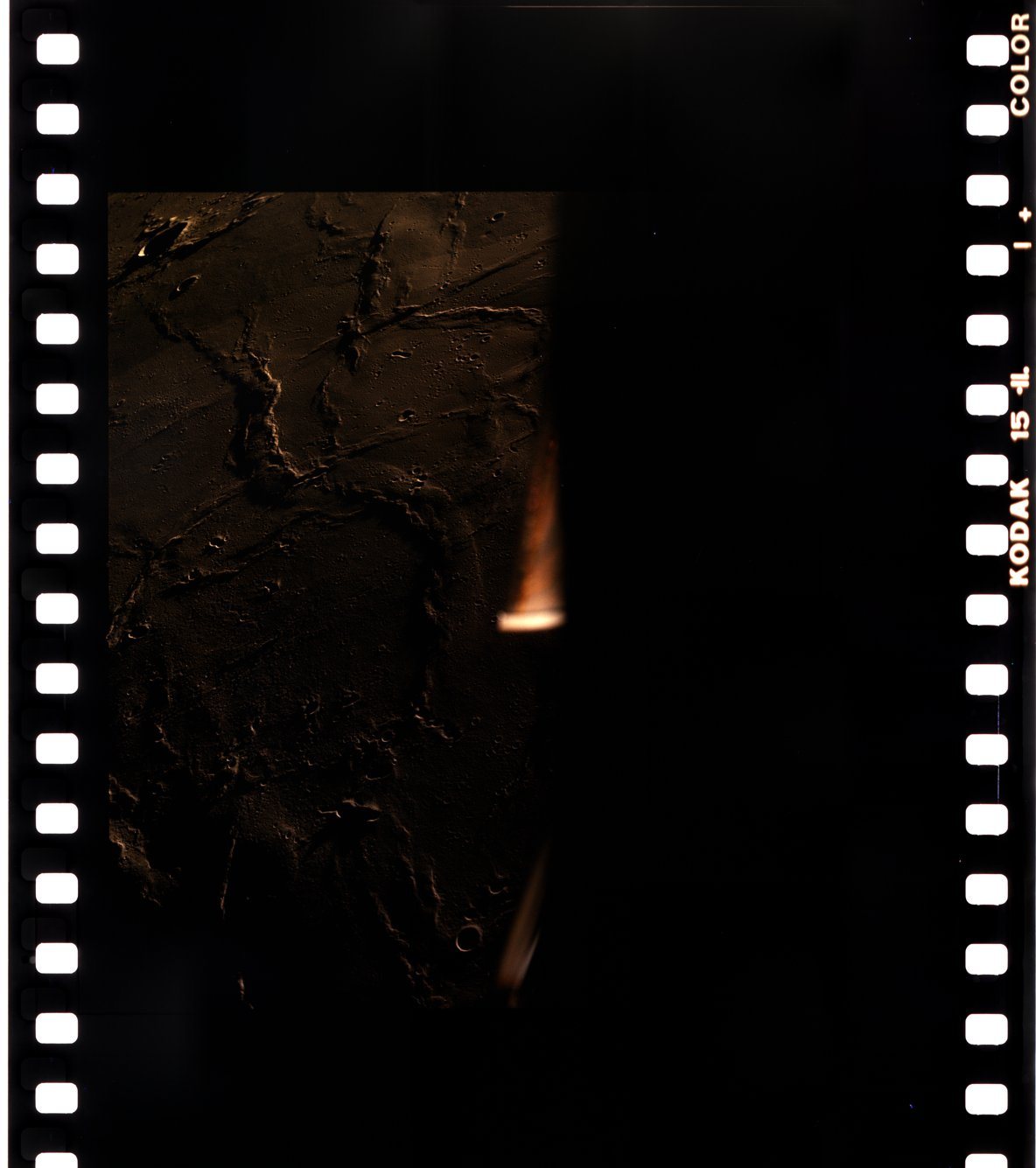
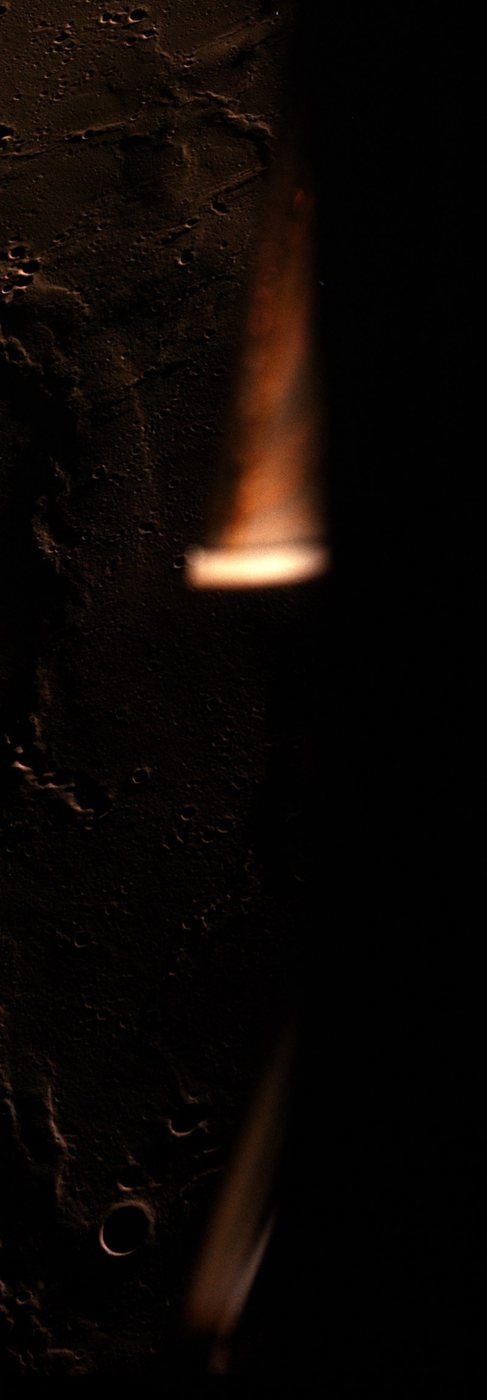
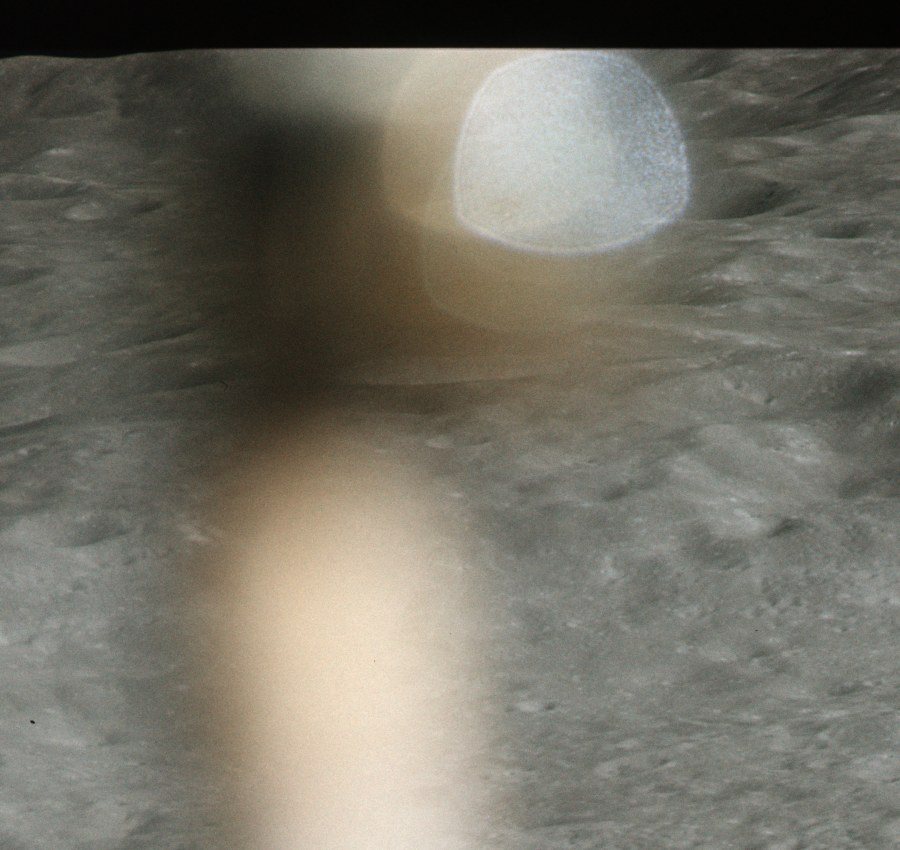
He cites two NASA photos that “escaped censorship”: Apollo 11 frame AS11-37-5438, a glowing cigar with a trail, and Apollo 16 frame AS16-120-19238, a large white cigar with a shadow. And he quotes Maurice Chatelain, who said he designed Apollo’s communications, on UFOs over Apollo 11 and a nuclear charge aboard Apollo 13.
His suggestion: “someone on the Moon” pushed us back and suggested we not return. Axelrod, he adds, knew all this in 1975, “and probably MUCH more.”
Edinburgh, 12 October 1954: a dark sphere crossing the Moon’s face. Illustration for uaptrail.comApollo 11 frame AS11-37-5438. The glowing shape with its tail lies right on the edge of the exposed area. NASA / JSC, scan via Arizona State UniversityClose-up of the glowing “cigar” in AS11-37-5438. NASA / JSC, scan via Arizona State UniversityApollo 16 frame AS16-120-19238: the white shape is out of focus while the craters are sharp, so it was much nearer the camera. NASA / JSC, scan via Arizona State University
On the recordBoth frames are real. In AS11-37-5438 the glow sits on the edge where the film exposure stops. A light leak would sit there too, but no one has shown it is one. In AS16-120-19238 the white object is blurred while the ground is sharp, so it was close to the camera. Its size can’t be read from the frame. See Swann’s Apollo “cigars”.
Worth knowingNo observer is named for the 1954 Edinburgh report. Chatelain’s Apollo claims are his own account, with no documents behind them. Apollo 16 landed on 21 April 1972; the book’s list repeats Apollo 15’s July 1971 date.
Part Three
Earthside telepathy versus Spaceside telepathy
Swann calls this part speculative. It is an argument, not evidence, and it is the reason he wrote the book.
Chapter 20
Information packages kept apart
The Moon can’t be hidden, but activity on it can, by teaching the Dead Moon as fact. Cover-ups work best by keeping related pieces of information apart. Swann rebuilds the space-age timeline from the Columbia Encyclopedia, with comments: Sputnik, Luna, Ranger, Surveyor, the Orbiters, the 1968 catalogue, six landings, then the turn to Skylab.
The missing piece, he says, is a matching timeline of UFO activity. Earth’s space story and the visitors’ space story are never told side by side.
Chapter 21
The problem of intellectual phase-locking
Around the cover-up has grown a whole counter-cover-up industry, and the two together keep everyone divided and confused, an old recipe called divide and rule. If the evidence went to court, he thinks, the cover-up would be indicted; instead it goes to science, which props it up.
People think in “packages” of agreed meaning. When a group agrees on one, its thinking “phase-locks”. The planet has phase-locked on a version of reality with almost no room for what Spaceside activity might mean.
Chapter 22
The telepathic connection?
Looking back, Swann realises Axelrod’s worry in Grand Central was about the woman’s telepathy, not his own: a telepathy “plus” that might bend minds. Axelrod knew they existed, that some live on Earth, and that they have it.
From 1989, studying qigong, Swann came to believe telepathy “plus” is possible for humans too. That is why he wrote the book. His conclusion: telepathy is “the most forbidden element” of human consciousness.
Chapter 23
Telepathy, the preeminent penetration modality
If telepathy worked, every institution would have to change, because it opens minds and secrets. At SRI, he says, some Washington visitors refused even to have lunch with him: “Jesus, he can read my mind!” The agencies funded remote viewing because it reads places, not minds.
The sender-and-receiver model of telepathy gets all the publicity precisely because it doesn’t work. And if he were a Spacesider, he writes, he would want humans kept that way: a “Telepathy War, won hands down so far by the Spacesiders”.
Chapter 24
The Earthside concept of telepathy
A short history of words. The Romans had intellectus, waking thought, and intuitus, everything else that guides us. French “clairvoyance” first meant insight; English narrowed it to seeing hidden objects. Thought-reading, then thought-transference, then in 1882 F. W. H. Myers coined “telepathy”, pictured as radio waves between two heads.
Swann thinks “thought” was the wrong substance and “information transference” the better idea, and that the radio-wave picture locked research into a dead end.
Chapter 25
Earthside group-think
As early as 1919, James Hyslop of Columbia reviewed the research and concluded there was no scientific evidence for any version of the mind-to-mind model. Yet the model survived, Swann argues, because it fails, and a failed model keeps secrets safe.
Group-think plainly exists, from mobs to company loyalty, which means group minds exist too, and group minds are the one topic most consistently avoided.
Chapter 26
Is consciousness individual or universal?
UFOs are seen and filmed everywhere, so their existence isn’t really what is being hidden. Something about them is. He compares the hostility to subliminal persuasion after Vance Packard’s The Hidden Persuaders (1957): deny, discredit, reduce confidence.
His closing speculation: an advanced intelligence with telepathy “plus” could quietly steer human thinking, deleting the idea of shared consciousness, splitting groups against each other, and stunting telepathy before it starts. He calls it “gross speculation” with holes. The one constant, he says, is the sidelining of telepathy.
Worth knowingThe cinema test Swann cites (“Drink Coca-Cola” flashed during a Kim Novak film) is James Vicary’s 1957 claim. In 1962 Vicary told Advertising Age it had been a gimmick based on too little data.
After Part Three
Postscript: lots of water on the Moon
Vindication, of a kind
In 1998 the Dead Moon Dictum fell almost overnight: ice at the poles, about six billion tonnes by one estimate, enough for 100,000 settlers for a century, and an American Geophysical Union release (17 August 1998) saying the space above the surface “is not a total vacuum”.
Swann’s point: the unofficial writers who claimed water and air all along were right. He lists three NASA photos he says show clouds: a “mackerel” cloud bank by Vitello (Lunar Orbiter V, MR-168), a cloud bank, two cigar-shaped objects and a dome in Mare Moscoviense (Orbiter V, HR 1033), and on Lobachevsky’s rim a large round object “like a golf ball sitting neatly on a tee” (Apollo 16, 16-758).
Lunar Prospector, whose instruments pointed to water ice at the poles in March 1998. NASA, Wikimedia CommonsLunar Orbiter V frame 168M over Vitello, Swann’s “mackerel cloud” frame. NASA / Lunar and Planetary InstituteLunar Orbiter V frame 103M, a far-side view including Mare Moscoviense, our best reading of his “HR 1033”. NASA / Lunar and Planetary InstituteApollo 16 mapping-camera frame AS16-M-0758, the likely match for his “16-758”. NASA / JSC, scan via Arizona State University
On the recordLunar Prospector’s water-ice result was announced in March 1998, and later missions confirmed ice in polar craters.
Still openIn the Vitello frame the dotted wavy band follows the seams between the strips the Orbiter camera was read out in, which suggests a scanning effect; that is proposed, not shown. The Moscoviense “cigars” and dome, and whether Lobachevsky is in AS16-M-0758, are not yet pinned down.
Special Edition, 2019
Subscript: the Mars chapter Swann left out
The 2019 Special Edition adds a chapter found in Swann’s draft papers at the University of West Georgia, numbered “9” and probably written in 1998, with introductions by two witnesses and an afterword by an Army remote viewer.
Intro
Stanley Krippner and Janet Mitchell
Psychologist Stanley Krippner met Swann in New York in 1972 and photographed his fingertip coronas in a small study. He and his wife Lelie were in the room for the 1975 Mars session, surprised at how casual Swann was, cigar in hand, reaching his “destination” in minutes. Krippner notes Swann claimed only 3 successes in 25 police cases: “Ingo never claimed to have a perfect record.”
Janet Lee Mitchell, his research partner at the American Society for Psychical Research for about twenty years, recorded his 1974 probe of Mercury before Mariner 10 arrived, and two sessions in 1975 and 1976 with Harold Sherman aimed at Mars. The records were notarised and are in the University of West Georgia archives, with the tapes.
9
The psychic probe of Mars
At 9 p.m. on 14 June 1975, ahead of the Viking landing, Swann in New York and Sherman in Arkansas “went” to Mars after three months of reading up on it. This time Swann felt the room and his body vanish. Then the phone rang: Sherman, who never shouted, shouting “Did you see what I saw!”
Sherman saw dome-like structures, a sense of life gone underground, and five stationary objects in the sky. Swann saw a bent, non-rusting structure like a power-line tower, and in a crater a checkerboard of squares about 100 feet across: “ruins, old.” They had every page notarised and agreed to say nothing.
In April 1984 SRI’s Lambert Dolphin showed Swann Viking photos: a buried pyramid, a checkerboard “city” about two miles across, domes, the work behind the Face on Mars. On 15 June 1984 Swann ran a group probe with sealed Martian coordinates. All five described a crater with ruins, plazas and vents to an underground complex, signs of “explosions” or “attacks”, and a hollow pyramid on the rim. Dolphin confirmed the site was a suspected crater “city” with a tall spiked shadow on its rim. Then, he writes, came a silence “so thick that it could be cut with a knife”.
On the recordTwo witnesses on the record (Krippner and Mitchell) confirm the 1975 session took place and was recorded and notarised; the archive is at the University of West Georgia. See the Face on Mars and the Cydonia pyramids.
Afterword
Thomas McNear: one of the five
Lt. Col. Thomas McNear (US Army, retired) was picked for the Army’s psychic program in 1981 after an “anonymous” survey that scored him 14 of 14 traits, and was the first Army officer Swann trained, and the only one through every stage. He was one of the five on 15 June 1984.
On Mars, he writes, he met and “communed” with entities, and boxed the memory away as absurd. In 2014 he read Joe McMoneagle’s Mind Trek and found the same entities, structures and sense of loss in McMoneagle’s Mars session of 22 May 1984, 24 days earlier. His own packet, with a ruled drawing of a hollow pyramid, has not been found in Swann’s archive.
“I don’t know what it is or its purpose, but I know when we find it we will know.”
If Swann’s Moon sessions were real, a group inside the US government knew by 1975 that the Moon is occupied, and turned to psychics because cameras and missions could not, or were not allowed to, go where the activity is.
It would explain the pattern he points to: landing sites far from Plato and Aristarchus, a 1968 lights catalogue with no sequel, Apollo 18 cancelled on its way to the most active plateau, and a twenty-year gap before anyone went back.
It would also explain why remote viewing, the one tool that worked at a distance, was funded in secret for two decades and then publicly dismissed.
And if telepathy really is the bridge, the most important question isn’t what is on the Moon, but why humans find it so easy to forget.
On the record
The CIA funded remote viewing at SRI from 1972 (SCANATE, Stargate).
The April 1973 Jupiter session was recorded in advance and is in the CIA reading room; Jupiter’s ring was found in 1979.
NASA’s 1968 catalogue of 579 lunar events is real, by authors at the four institutions Swann names.
Apollo 18 was headed for Schröter’s Valley on the Aristarchus Plateau before its cancellation in 1970.
The Apollo 12 impact made the Moon ring for close to an hour.
Water ice (1998) and a thin lunar atmosphere are now accepted.
Two witnesses confirm the 1975 Mars session, and a named Army officer confirms the 1984 group probe.
Still open
The 1975 Moon sessions rest on Swann’s word alone. Axelrod is a pseudonym and no document names his group.
Swann’s 1975 drawings for Axelrod were taken from him; only his later redrawings survive.
McNear’s 1984 packet and the full group data have not been found in the University of West Georgia archive.
The real source of the “hollow Moon” quote, and the 1973 “5.3 billion year” rock age.
Whether the Lobachevsky “golf ball” and the Moscoviense “cigars” can be found in the frames.
Sources
Ingo Swann, Penetration: The Question of Extraterrestrial and Human Telepathy (Rapid City: Ingo Swann Books, 1998), ISBN 0-9667674-0-3.
Ingo Swann, Penetration: Special Edition, with introductions by Stanley Krippner and Janet Lee Mitchell and an afterword by Thomas M. McNear (Swann-Ryder Productions, 2019), ISBN 978-1-949214-12-3.
George H. Leonard, Somebody Else Is On the Moon (New York: David McKay, 1976).
H. E. Puthoff, “CIA-Initiated Remote Viewing Program at Stanford Research Institute”, Journal of Scientific Exploration 10(1), 1996.
Swann and Sherman, Jupiter session, 27 April 1973: CIA reading room.
I. S. Shklovskii and Carl Sagan, Intelligent Life in the Universe (1966).
Joseph McMoneagle, Mind Trek (Hampton Roads, 1993).
Ingo Swann papers, University of West Georgia archives.
Images: NASA (JSC, Ames, JPL, GSFC), Lunar and Planetary Institute, Arizona State University scans, Wikimedia Commons as credited. Paintings are illustrations for uaptrail.com.