The Face on Mars
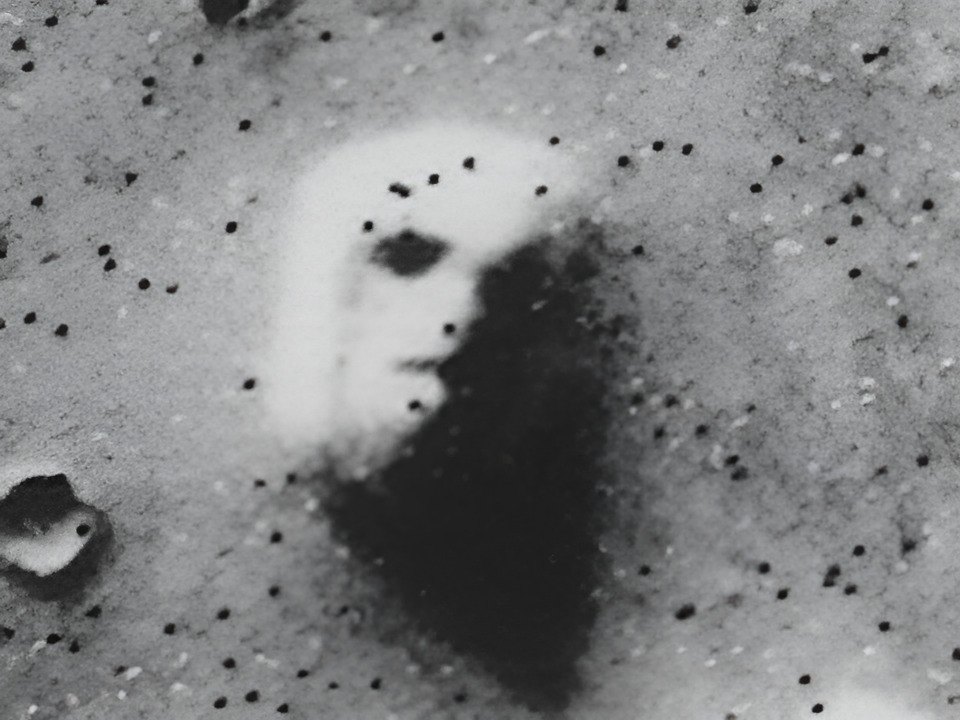
Viking 1 was photographing landing sites when frame 35A72 caught a mesa about 2 km across that looks like a human face staring up, with eyes, nose and mouth. NASA's own press release called it a 'huge rock formation ... which resembles a human head'. In 1979 engineers Vincent DiPietro and Gregory Molenaar found a second Viking image, 70A13, taken at a different sun angle, in which the face still held. NASA returned with sharper cameras in 1998, 2001 and 2007, and showed a natural-looking hill.
Evidence, in date order (4)
- 1976Viking frame 70A13 (DiPietro and Molenaar)sensor datasecond image at a different sun angle in which the face still held
- 10 Sept 1986Carl Sagan, letter to Carlottodocumentagreed the face impression persists across all three photometric angles Sagan's letter to Mark Carlotto, 10 September 1986
- 1988Mark Carlotto, Applied Optics 1988document3D shape-from-shading reconstruction of the Face Carlotto 1988: 'Digital imagery analysis of unusual Martian surface features'
- 1990Carlotto & Stein 1990documentfractal analysis found the Face the least natural object in the scene Carlotto & Stein 1990: 'A method of searching for artificial objects on planetary surfaces'
How plausible · Moderate
Official Viking images and published analyses support the face's persistence; later images were offered as a natural hill, which researchers dispute.
- ●●Checkable details check out Released official records.
- ●○Access Direct observation or instruments.
- ●○No gain sought Nothing to gain.
- ●○Character record Trained professionals.
- ●○Independent convergence Independent sources agree.
- ●○Physical traces or official reaction Instrument data or physical traces.
Plausibility weighs how well an account fits where secrecy hides the documents by design, so missing records never count against it. Strength measures what is documented. Assessed 2026-10-23.
On the record
- Viking 1 frames 35A72 (1976) and 70A13.
- NASA's 1976 caption describing a formation 'which resembles a human head'.
- Mars Global Surveyor images of 1998 and 2001, and HiRISE in 2007.Mars 1 million BC
Claims
Where
In The picture
Similar cases · sharing people, threads, topics or era
Connected cases
People and organizations
Threads · click one to see it on the board
Sources
- Wikipedia: Cydonia (Mars)
- NASA: Unmasking the Face on Mars
- Image: Viking 1's 1976 image: the 'Face' in the Cydonia region (NASA PIA01141).
- Image: The Viking view with an inset of the face.
- Image: Mars Global Surveyor's look at the Face, April 1998 (PIA01440).
- Image: HiRISE on the Mars Reconnaissance Orbiter, 2007.