Kelly Johnson's saucer: Lockheed's chief engineer and a test crew see the same object (Agoura, 1953)
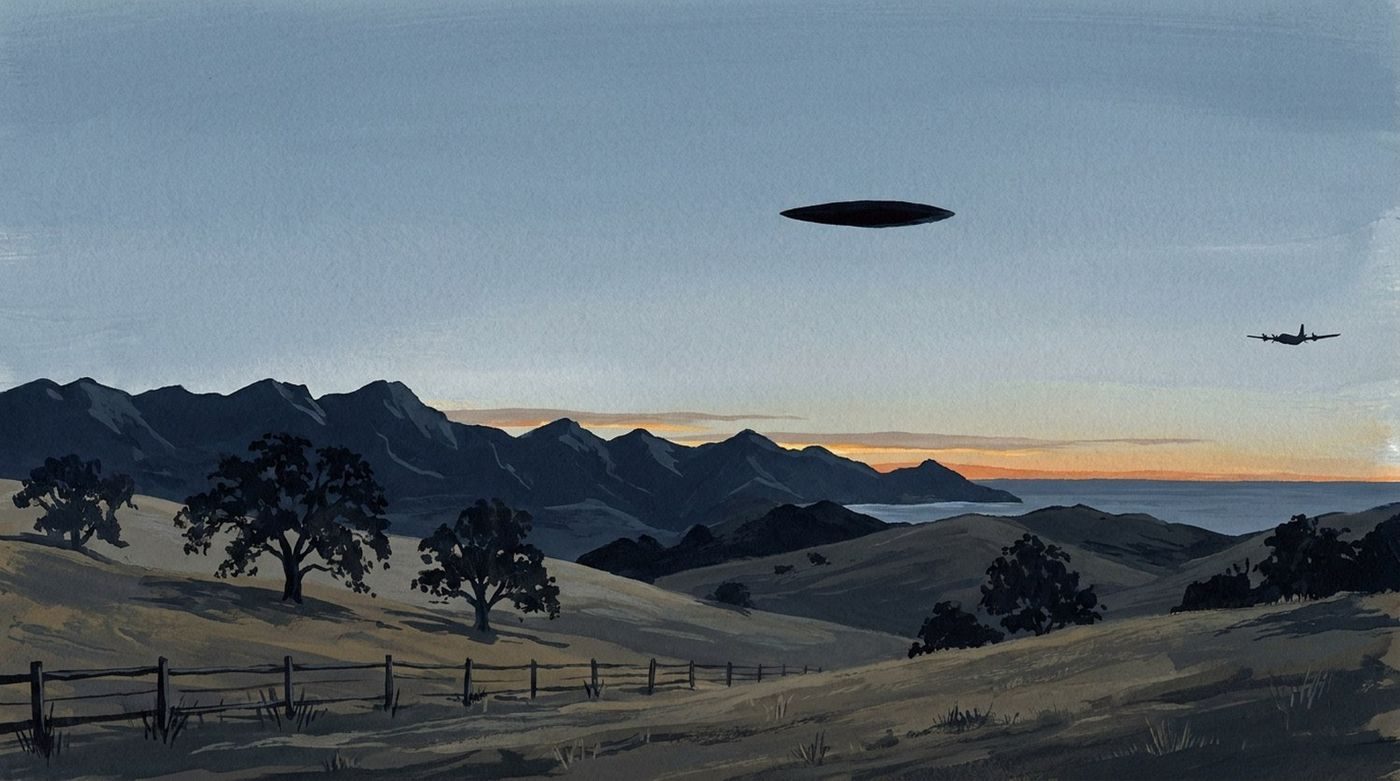
On 16 December 1953 Lockheed's chief engineer, Clarence "Kelly" Johnson, and a Lockheed flight-test crew 17,000 ft up saw the same dark, motionless object over Point Mugu at about 5 p.m., one party from the ground and one from the air. Johnson considered a lenticular cloud and rejected it; Project Blue Book filed it as one. The full file, DOW-UAP-D206, came out in PURSUE Release 08 in November 2026.
Johnson ran Lockheed's engineering and would go on to design the U-2 and SR-71. His report, "Sighting of a Flying Saucer by Certain Lockheed Aircraft Corporation Personnel", is dated 20 January 1954 and carries signed accounts from him and the crew of a Navy WV-2 Super Constellation on a test flight. It reached the Air Technical Intelligence Center only because Lt Gen D. L. Putt forwarded it on 15 February 1954. Putt wrote that Johnson "was most reluctant to write the report in the first place and then refused to forward it", believing that saucer witnesses "are not usually considered to be logical and practical hard-headed engineers".
From the ranch window
Johnson was looking at the sunset from his ranch house when he saw "what I first thought to be a black cloud" against a "gold and red" sky. "I wondered why this one object was so dark, considering that the sun was behind it." He thought of a smoke trail, then of a lenticular cloud: "Thinking it was a lenticular cloud, I continued to study it, but it did not move at all for three minutes." By the time his wife brought eight-power binoculars it was moving fast on a heading of 240 to 260 degrees. It stayed a sharp black ellipse, about 7 to 10 times longer than wide, and was gone within 90 seconds "in a long shallow climb". He put it roughly over Point Mugu, on a bearing of about 255 degrees.
From the cockpit
Co-pilot Rudy Thoren was climbing the WV-2 through 15,000 to 20,000 ft over the ocean off Long Beach when pilot Roy Wimmer said, "Look out, there's a flying saucer." Thoren turned toward it and held the heading for about five minutes. Wimmer first took it for a small cloud. Thoren decided it was not, "because it had too definite sharp edges and its appearance stayed constant"; it looked like "a very large flying wing airplane". At some 225 mph they did not close on it. In about a minute it shrank to "a mere speck" and vanished almost due west.
The test Johnson set
The next morning Thoren came to report. Johnson writes that he "immediately broke in, without letting him say what time and where he had seen the object", and told his own sighting first. Thoren's memo says Johnson named 5:05 p.m. and Point Mugu: "This literally bowled me over." Johnson closed his report: "I am now more firmly convinced than ever that such devices exist, and I have some highly technical converts in this belief as of that date."
I am now more firmly convinced than ever that such devices exist
The official verdict: Blue Book's card reads "OTHER: CLOUD. Lenticular Cloud." Nothing in the file says who tested that against Johnson's three stationary minutes, the 90-second departure or the crew's five-minute chase.
How plausible · High
Two sets of trained observers, one on the ground and one in the air, describe one stationary dark shape over Point Mugu at the same minutes; the engineer tested the cloud idea himself and the file still ends on "Lenticular Cloud".
- ●●Access Both parties watched it directly, the crew from about the same altitude.
- ●●Cost of speaking Johnson was reluctant to put his name to it, as Putt's letter says.
- ●●No gain sought Nothing to gain; he refused to forward it.
- ●●Consistent over time Johnson told his account before hearing the crew's time and place.
- ●●Character record Lockheed's chief engineer and its flight-test crew.
- ●●Checkable details check out DOW-UAP-D206 is released in full.
Plausibility weighs how well an account fits where secrecy hides the documents by design, so missing records never count against it. Strength measures what is documented. Assessed 2026-11-21.
On the record
- Blue Book card: 1700 local, 16 Dec 1953, Agoura; "ground & air visual"; 5 to 7 minutes; no photos.Blue Book
- Johnson's sketch is labelled "SAUCER SEEN DEC. 16, 1953", with a fineness ratio of 7:1 to 10:1.
- WV-2 crew: Roy Wimmer (pilot), Rudy Thoren (co-pilot), Joe Ware (flight test engineer); P. A. Colman, chief aerodynamicist, is also named as a witness.
- A pencil note on Thoren's memo reads "Plane went 18 miles in 5 min".
Claims
Similar cases
Connected cases
- Blue Book 1959Blue Book file
People and organizations
- Lockheed Martin Skunk Works orgWitnesses' employer
- United States Air Force orgEvaluated by
Sources
- DOW-UAP-D206, Unresolved UAP Report, California, 1953 (war.gov PURSUE Release 08)
- war.gov PURSUE Release 08 page
- CBS News, "New UFO files show Pentagon contractor planned underground vault for 'exotic material'" (20 Nov 2026)
- NewsNation, "Eighth UAP release includes radar analysis of object traveling near Mach 2.5" (20 Nov 2026)
- LiveNOW from FOX, "Pentagon releases eighth batch of declassified UFO files" (20 Nov 2026)
 Project Blue Book1959
 war.gov/ufo2026