Salem 1952: the Coast Guard photographer and four lights
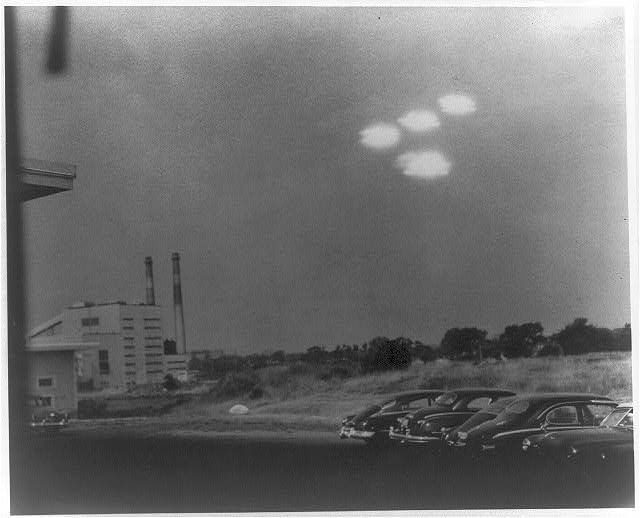
Four bright lights photographed over a Coast Guard air station by its own photographer on 16 July 1952, a picture the Air Force first called a hoax and eleven years later a reflection of the ceiling lights, two answers that cannot both be right.
Shell Alpert was filing negatives in the photo office, back to the window, when he noticed something bright outside: "several bright, almost brilliant, lights" beside the power plant's smoke stacks, white and perhaps wavering. His press camera lay on the desk for cleaning. As he readied it the lights dimmed, and he thought they might be a reflection. He ran to sick bay for a witness. Back in the office the lights were "again burning brightly", and he "dived for the camera and hit the shutter". As the two men looked out "there was a momentary flash and we could no longer see any lights."
He would not claim much: "I cannot in all honesty say that I saw objects or aircraft, merely some manner of lights." His commander certified the statement the next day, and the Coast Guard released the print as official photo 5554. The Library of Congress still holds it.
Two verdicts
The Air Force's photo lab worked from the original negative and finished on 1 August 1952. The lights cast no reflection on the polished cars below, so they could not be outside, the analyst reasoned; it must be a double exposure, a hoax. In October 1963 Blue Book looked again and chose another cause: reflections of the room's ceiling lights on the window glass, blurred because the camera was focused at infinity. The record card keeps the lab's first doubt, "open to doubt because there are no reflections of the object on nearby parked cars".
Researchers Joe Nyman and Barry Greenwood later pointed out the problem with the glass: the shot was taken through an open window's screen, as the Library of Congress caption itself says. Brad Sparks lists it among Blue Book's unknowns. Three days later radar and pilots began chasing lights over Washington.
Prosaic view: reflections of interior lights, Blue Book's 1963 answer. Natural cause proposed, not demonstrated.
Evidence, in date order
- 17 Jul 1952US Coast Guardofficialofficial photo 5554 and the photographer's certified statement
- 1 Aug 1952Project Blue Book (ATIC)officialphoto analysis and record card
- Library of Congressphysicalholds the print
How plausible · High
A Coast Guard photographer's official photo, analysed by the Air Force from the negative, whose two official explanations contradict each other; the photographer himself would not claim more than lights.
- ●●Access He saw and photographed them himself.
- ●●No gain sought An official photo; nothing sold.
- ●●Restraint 'merely some manner of lights'; he even suggested refraction himself.
- ●●Checkable details check out Statement, Blue Book analysis and the print at the Library of Congress.
- ●●Physical traces or official reaction The photograph and its negative.
- ●○Character record Station photographer, statement certified by his commander.
- −Contradicted by an insider Blue Book's 1963 reflection explanation, and the photographer's own first thought of a reflection.
Plausibility weighs how well an account fits where secrecy hides the documents by design, so missing records never count against it. Strength measures what is documented. Assessed 2026-11-23.
Claims
Similar cases
Connected cases
- Blue Book 1959Blue Book file
- Washington, 1952 1952Same week
- Lubbock Lights: the professors' lights and Hart's photos 1951Classic photo
- McMinnville: two photos of a disc over the Trent farm 1950Classic photo
 Project Blue Book1959
 Saucers over the Capitol1952
 Lubbock Lights1951
 McMinnville1950