1948 · United States (observatories, reconnaissance satellites, export rules)
The best optics under official control
On the recordStrength C · 6/10
Evidence 2/4 · Witnesses 1/3 · Backing 3/3
Declassification history, Laser Clearinghouse rules, ACIC program records, the NRO handover and licence limits are all official; Swann's part is analysis.
Plausibility Moderate
Score 10 · 7 factors for, 2 against
Official records show the sharpest optics were, and are, in military and intelligence hands; nothing documented restricts pointing at the Moon or buying a telescope, and two details Swann relied on do not hold.
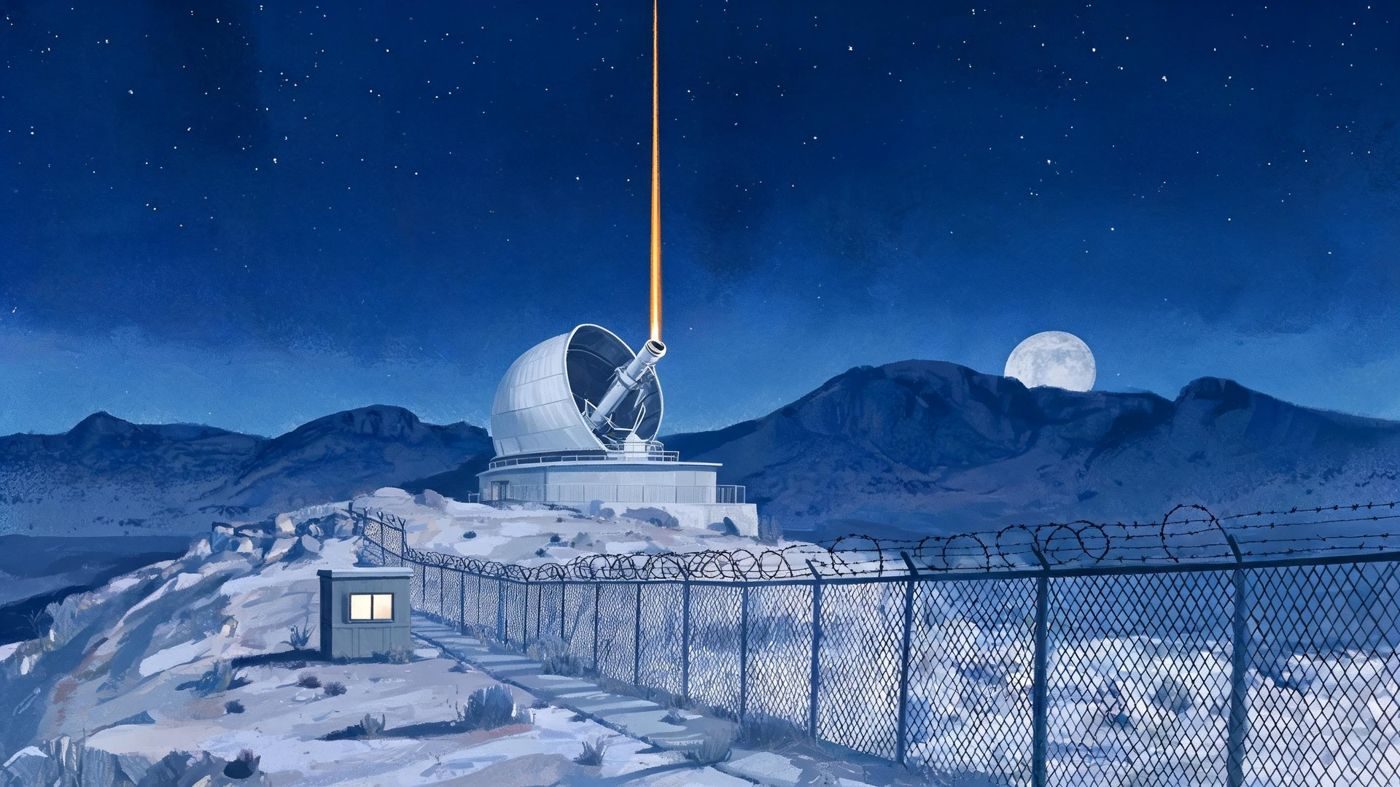
A fenced military observatory fires a laser guide star: adaptive optics was developed in secret for years before 1991. · Illustration for uaptrail.com
Official records: adaptive optics classified until 1991; Laser Clearinghouse approvals; ACIC lunar station at Lowell 1961-69 and NASA's Pic du Midi telescope; NRO 2.4 m telescopes given to NASA in 2012 and the 2019 USA 224 image; 0.5 m imagery cap to 2014 and Kyl-Bingaman; ECCN 6A004 and ITAR.
Swann's argument (analysis): the best equipment is under official control and only low-resolution images are released (Penetration pp. 97-120).
Does not hold as stated: no permit is needed to buy a telescope, and 16-inch commercial telescopes were on sale by about 1994; 'a dime on the Moon' is beyond any Earth telescope.
When1948-today
WhereUnited States (observatories, reconnaissance satellites, export rules)
Ingo Swann argued in Penetration (1998) that the equipment able to show the Moon in high resolution exists but is 'under official control', and that the larger telescopes were 'sequestered' worldwide. The record backs the core of this: adaptive optics were classified until May 1991, observatories still clear laser pointing with the Air Force, the Air Force ran its own lunar telescope station at Lowell (1961-69), the NRO had Hubble-class telescopes in storage, and commercial imagery and high-end mirrors are capped by licence and export rules. No document found restricts pointing a telescope at the Moon or buying one at home.
How plausible · Moderate
Official records show the sharpest optics were, and are, in military and intelligence hands; nothing documented restricts pointing at the Moon or buying a telescope, and two details Swann relied on do not hold.
●●
Access The records come from the bodies that held the optics: the Air Force, NSF, the NRO, Commerce.
●●
No gain sought Agency histories, rules and licences, not advocacy.
●●
Checkable details check out Declassification papers, the Clearinghouse rules, the ACIC history, the NRO handover and the Federal Register notice exist.
●●
Independent convergence Six independent record strands (adaptive optics, laser clearance, ACIC, NRO optics, imagery caps, export controls) agree that the best optics are under official control.
●●
Fits secrecy practice Adaptive optics were classified until 1991; reconnaissance optics remain classified.
●○
Physical traces or official reaction Official reaction: the 1991 declassification, the 2012 NRO handover, the 2019 USA 224 image.
Against
−
Contradicted by an insider Documentary: Meade's 16-inch LX200 was on sale about 1994 and Dobsonians of 20-25 inches existed, against Swann's 'largest commercial telescope is about 8-14 inches'; no US law requires a permit to buy a telescope. Detail only, not the core.
−
Details proved false The 1950s-60s sources' 'dime on the Moon' needs an aperture kilometres across; Hubble resolves about 100 m on the Moon. Physics, not opinion.
Plausibility weighs how well an account fits where secrecy hides the documents by design, so missing records never count against it. Strength measures what is documented. Assessed 2026-10-28.
On the record
Adaptive optics declassified May 1991 (Fugate, 178th AAS meeting, Seattle).
Laser guide star targets cleared with the Air Force Laser Clearinghouse; Keck lost 5-10% of nights to closures.
ACIC lunar mapping station at Lowell Observatory, Sep 1961 to Apr 1969; NASA-funded 1.06 m Pic du Midi telescope for Apollo.
Commercial imagery cap 0.5 m to June 2014; Kyl-Bingaman 2 m limit on Israel 1998-2020; ECCN 6A004 and ITAR on high-end optics.
Claims
The equipment for high-resolution evidence exists but is 'under official control' and not affordable at the public level; officials release only low-resolution images. 'The larger telescopes have been sequestered under official control, and this on a world-wide basis.' The Naval Observatory, Mount Wilson, Palomar (200-inch, 1948) and Lick (120-inch, 1959) were secretly used on the Moon, and no high-resolution data has been released since 1948.Ingo SwannIngo Swann, 'Penetration: The Question of Extraterrestrial and Human Telepathy' (1998)Swann on the MoonThe high-resolution Moon that came lateanalysisSourced, unconfirmedIngo Swann (Penetration, 1998, typescript pp. 97-120)
Adaptive optics and laser guide stars, the key to sharp ground-based images, were developed in secret by the Air Force and SDI at the Starfire Optical Range and the Air Force Maui Optical Site; much of it was declassified only in May 1991, when Robert Q. Fugate presented it at the 178th AAS meeting in Seattle to about 400 people.United States Air ForcefirsthandOn the recordUS Air Force / SDI declassification (AIP Physics Today history; NSF history, arXiv 2006.05899; Fugate's Air Force biography)
Every observatory using a laser guide star must send its targets to the Laser Clearinghouse (Air Force/Space Command, Vandenberg) two to three days ahead, shut the laser on command when satellites pass and accept blanket closures after launches; Keck lost 5-10% of nights to last-minute closures, and NSF requires compliance at telescopes it funds. Craig Foltz (NSF): 'Towards the end of 2007, the laser clearing house list of restrictions seemed to get a bit tighter.'United States Air ForcefirsthandOn the recordLaser Clearinghouse rules (Physics Today, 9 Oct 2009; IDA study D-4202)
The Air Force's Aeronautical Chart and Information Center (ACIC) mapped the Moon from 1959 and kept a station at Lowell Observatory, Flagstaff, from September 1961 to April 1969, using the 24-inch Clark refractor and a 20-inch bought for the program, with 35 mm and 70 mm cameras; its Lunar Astronautical Charts were used to choose Apollo sites. NASA also paid for the 1.06 m telescope at Pic du Midi (1963, or 1965 by another source) to photograph the Moon for Apollo.United States Air ForceNASASwann on the MoonNASA, secrecy and the archive anomaliesThe high-resolution Moon that came latefirsthandOn the recordLowell Observatory, 'Our Lunar Legacy'; the-moon.us LAC history; NASA APOD 25 Jan 2008
In June 2012 the NRO gave NASA two surplus 2.4 m space telescopes built for reconnaissance, Hubble-sized with about 100 times the field of view; one became the Roman Space Telescope. On 30 August 2019 President Trump tweeted a classified image of Iran's Semnan launch pad, which amateur trackers matched to the KH-11 satellite USA 224; experts were surprised how sharp it was.National Reconnaissance Office (NRO)NASANASA, secrecy and the archive anomaliesfirsthandOn the recordNRO / NASA (Planetary Society; Space.com; Live Science)
US-licensed commercial satellite imagery was held at 0.5 m until June 2014, when DigitalGlobe won approval to sell sharper; the Kyl-Bingaman Amendment (Section 1064, 1997 NDAA) held imagery of Israel to 2 m from 1998 until NOAA relaxed it to 0.4 m on 21 July 2020.firsthandOn the recordUS Commerce / NOAA licensing (SpaceNews; Spacepolicyonline; Federal Register 2020-15770)
In The picture
The Moon is not emptyEdgar Mitchell is said to have described blue lights escorting Apollo 14. Ingo Swann wrote that a man he called Axelrod took him blindfolded to an underground site and had him view the Moon: towers over a hundred feet tall, domes, mining and humanlike beings, which the group already knew about. He also wrote that the…
Similar cases · sharing people, threads, topics or era