Show
1966 · Lunar orbit (US, Japanese, Chinese and Indian missions)

The high-resolution Moon that came late
On the record
Strength B · 8/10
Evidence 3/4 · Witnesses 2/3 · Backing 3/3

Each delay is documented by the agency concerned; named firsthand witnesses (Wolfe, Johnston, Brandenburg) add on-record accounts.

Plausibility High
Score 13 · 8 factors for, 1 against

The agencies' own records show the best lunar imagery reached the public late, degraded or in part from 1966 to 2021, with spy-derived cameras behind the first two; intent is not shown, and since 2009 LRO has delivered the high-resolution Moon.

See the factors ↓

Unresolved
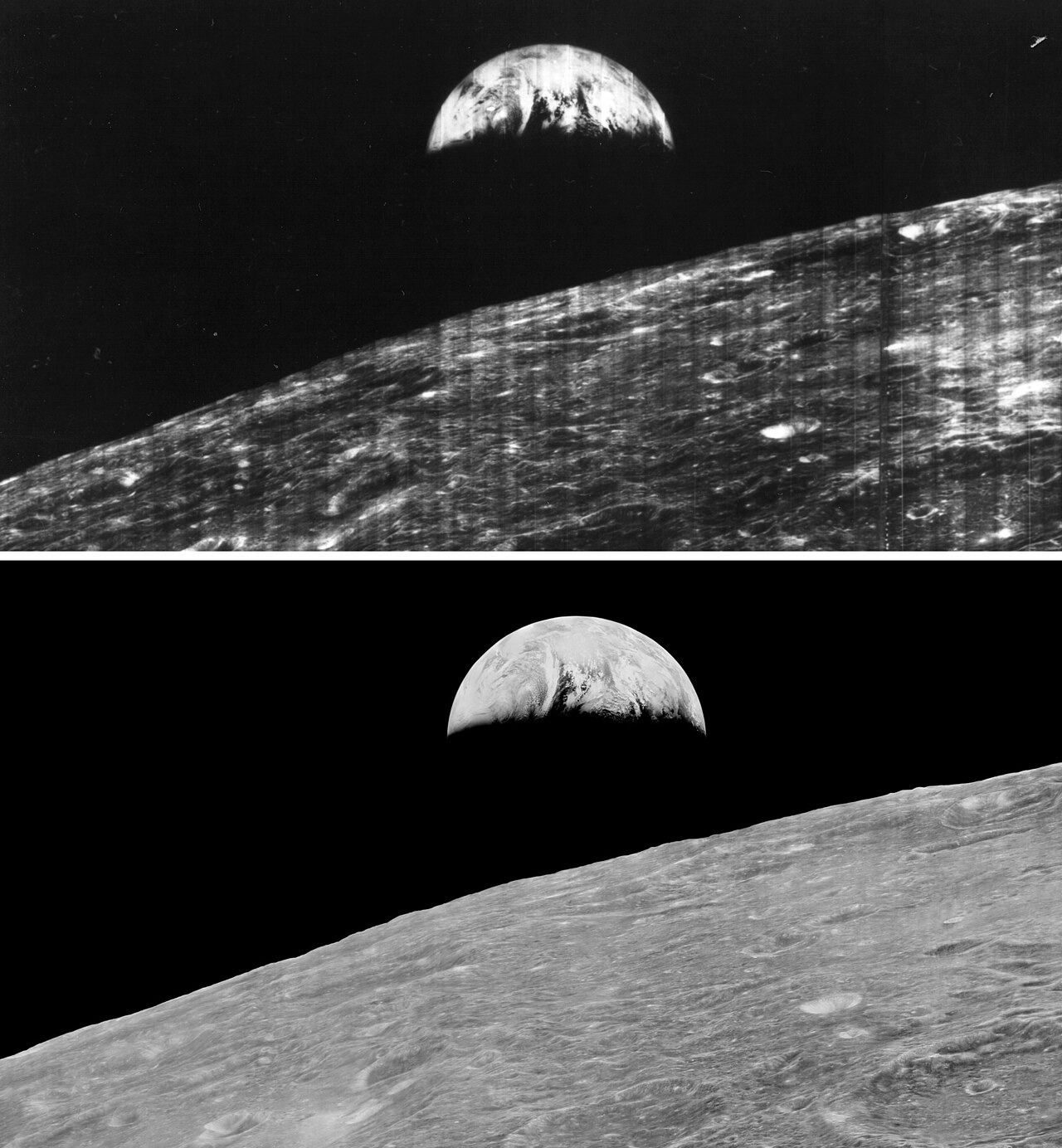
Lunar Orbiter 1's 1966 Earthrise: the print the public got in 1966 (top) and LOIRP's restoration from the original tapes in 2008 (bottom). · NASA / LOIRP, public domain
  • Agency records: Lunar Orbiter's NRO Samos camera and the LOIRP recovery; Apollo pan camera from the KA-80A, scanned only from 2007; Apollo 11 tapes lost; Clementine all in PDS; Kaguya HDTV held to 2016; Chang'e-2 full resolution not open; LRO 25 cm; Chandrayaan-2 only three OHRC images in 2020.
  • Named, firsthand: Karl Wolfe (Lunar Orbiter mosaic at Langley, about 1965); Ken Johnston (ordered to destroy Apollo images); John Brandenburg (Clementine looked for bases).
  • Secondhand: the airman's 'base on the back side' via Wolfe; Donna Hare's technician on airbrushing.
  • Official question: Brookings for NASA (1960) asked how a discovery might be 'presented to or withheld from the public'.
When1966-2021
WhereLunar orbit (US, Japanese, Chinese and Indian missions)

Ingo Swann wrote in 1998 that the world 'awaited in vain' for high-resolution pictures of the Moon. The agencies' own records show a pattern behind that: Lunar Orbiter flew an NRO spy camera and its best data sat on tapes for 40 years; the Apollo pan camera, also spy-derived, waited 35 years for full scans; the Apollo 11 originals are lost; Kaguya's HD movies were held 7 years; Chang'e-2's best frames were not opened to outsiders; and India released only three images from the sharpest lunar camera at first. Named insiders (Karl Wolfe, Ken Johnston, John Brandenburg) describe images seen, destroyed or kept quiet. Since 2009 LRO has released 0.5 m and 25 cm images, so the claim that nothing was ever delivered no longer holds.

How plausible · High

The agencies' own records show the best lunar imagery reached the public late, degraded or in part from 1966 to 2021, with spy-derived cameras behind the first two; intent is not shown, and since 2009 LRO has delivered the high-resolution Moon.

  • ●●
    Access Records from NRO, NASA, JAXA, ISRO and CAS themselves, plus insiders who worked on the imagery (Wolfe, Johnston, Brandenburg).
  • ●●
    No gain sought Agency histories and archive notes; the named witnesses gained nothing documented.
  • ●●
    Checkable details check out NRO history, LOIRP data, ASU scans, NASA tapes report, JAXA and ISRO release notes all exist.
  • ●●
    Independent convergence Eight missions across four space agencies show the same pattern, independently documented.
  • ●●
    Physical traces or official reaction The data itself: LOIRP's recovered tapes show the 1960s prints were degraded; the release records date each delay.
  • ●●
    Fits secrecy practice Lunar Orbiter's camera came from the NRO under compartmented security; the pan camera was a spy camera; Brookings raised withholding in 1960.
Against
  • −
    Contradicted by an insider Documentary: Clementine's frames were released in full to the PDS and its HIRES reached 7-20 m, against Swann's 'not released' and 'bubble-gum wrapper'; LRO's releases since 2009 end 'never delivered'. The delay pattern itself stands.

Plausibility weighs how well an account fits where secrecy hides the documents by design, so missing records never count against it. Strength measures what is documented. Assessed 2026-10-28.

On the record

  • Lunar Orbiter (1966-67): NRO Samos E-1 camera; degraded prints; full data only via LOIRP 2008-2014.
  • Apollo 15-17 pan camera (Itek KA-80A): full scans from 2007.
  • Apollo 11 slow-scan tapes: lost (NASA, 2009).NASA, secrecy and the archive anomalies
  • Clementine (1994): all frames in PDS; HIRES about 7-20 m.
  • Kaguya HDTV: all 600+ movies only in Sep 2016.
  • Chang'e-2: about 1 m captured, 7 m map released 2012.

Claims

The world 'awaited in vain' for Clementine's high-resolution looks; its cameras 'can read from space a bubble-gum wrapper' and its 'High resolution photos … have not been released'.Ingo SwannIngo Swann, 'Penetration: The Question of Extraterrestrial and Human Telepathy' (1998)ClementineanalysisSourced, unconfirmedIngo Swann (Penetration, 1998, typescript pp. 101, 124, 153)
Lunar Orbiter I-V (1966-67) used the NRO's Samos E-1 spy camera, transferred in secret under 'compartmented security'. The public got 1960s prints from kinescoped film with a much narrower tonal range (about 1:256 against 1:1000 on the tapes); full-quality data came out only through LOIRP (2008-2014), after the original tapes nearly went to scrap in 1986 and JPL archivist Nancy Evans saved them.National Reconnaissance Office (NRO)NASAfirsthandOn the recordNRO history 'SAMOS to the Moon'; LOIRP
The Apollo 15-17 panoramic camera (1-2 m) was Itek's KA-80A optical bar camera, used on the A-12, U-2 and SR-71; the public got prints at the time, and full film-grain scans (200 px/mm, about 11.8 GB a frame) only from 2007 on, by ASU and JSC.Apollo 15NASAfirsthandOn the recordNASA Apollo Flight Journal; Smithsonian; ASU Apollo scan archive
The original Apollo 11 slow-scan TV telemetry tapes are gone, probably erased and reused around 1980; NASA's 2009 search found 'the Apollo-era telemetry tapes no longer exist—anywhere'.Apollo 11NASAfirsthandOn the recordNASA, Apollo 11 TV Tapes report (2009)
All Clementine (1994, BMDO-NASA) raw frames from every camera, more than 1.9 million images, went into the PDS EDR archive, on CD-ROM from the mid-1990s and now online; HIRES reached about 7-20 m a pixel.ClementineClementine's blurred areasfirsthandOn the recordNSSDC; PDS Clementine HIRES mosaic
Kaguya/SELENE's HDTV camera (2007-09) shot more than 600 HD movies; a handful of clips came out with JAXA/NHK in 2007-09, and all 600+ only in September 2016, seven years after the mission ended, with no reason given.firsthandOn the recordJAXA DARTS (13 Sep 2016); Planetary Society

Where

Lunar orbit (US, Japanese, Chinese and Indian missions)
36.0°N 138.0°E · region only

In The picture

The Moon is not emptyEdgar Mitchell is said to have described blue lights escorting Apollo 14. Ingo Swann wrote that a man he called Axelrod took him blindfolded to an underground site and had him view the Moon: towers over a hundred feet tall, domes, mining and humanlike beings, which the group already knew about. He also wrote that the…

Similar cases · sharing people, threads, topics or era

Connected cases

People and organizations

Sources

A research project by Igor FrancePrivacy