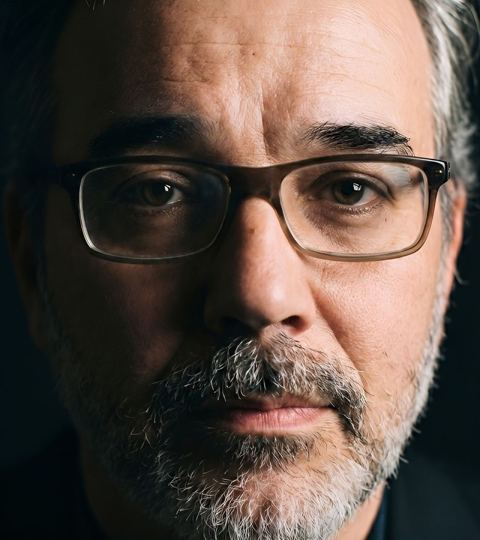
Richard Dolan
Richard Dolan is a UFO historian and author who has written about how the US national security state handled the phenomenon since the early 2000s, and who is now writing a three-volume history of unidentified submerged objects. He is best known for the two volumes of UFOs and the National Security State, covering 1941 to 1973 and 1973 to 1991, and for coining the term "breakaway civilization".
Dolan has a master's degree in history from the University of Rochester, where he studied Cold War diplomacy. He co-wrote A.D. After Disclosure with Bryce Zabel and co-founded Richard Dolan Press. Volume 1 of A History of UFOs: Unidentified Submerged Objects, which Coulthart calls a 2025 release, runs to the end of 1969; volume 2, on the 1970s and 1980s, was about to come out when he spoke to Ross Coulthart on Reality Check. After his own filters he kept about 700 USO cases for the three volumes and coded each in 15 or 16 categories, from shape and colour to whether it was seen by day or night.
His numbers
Each figure is his own analysis of that catalogue.
- The 1967 switch. Up to about 1967 his cases split 51% day and 49% night. After that about 75% are at night, "almost like flipping a switch", and military encounters reach "the high 80s percent". To him the change was too sudden to be chance: "This is a decision that someone made." An unnamed geospatial source of Coulthart's tied it to a new spy satellite (the undersea program). Dolan had guessed at satellites too: "I had speculated as well that it was satellite technology that prompted the switch".
- EM effects. From 1951, the year of his first USO case with electromagnetic effects, 9.5% of cases have them, and military vessels are twice as likely to as civilian ones.
- Missing time and beings. Missing time in 17 cases, beings in 23, both in 3: together 5.5% of cases, which he calls "one out of 20".
- Speed. Fast contacts usually run to several hundred knots; one or two descriptions put an object beyond 600 to 700 mph under water, in US and Soviet accounts alike. For the Soviet side he machine-translated a Russian book on USOs by two former Soviet Navy officers, one of them a "Vladimir" who has since died.
- Depth of history. The first USO he has "genuine confidence in" dates from 1717.
Catalina
He calls the waters around Catalina Island a hotspot, with cases rising sharply in the 1970s and 1980s. From the later decades he describes a 1982 family on a Gulfstar boat who watched a large yellow object criss-cross 50 ft beneath them, and a lone boater who reached Catalina two hours late with "no idea why". He doubts secret military testing explains them, since these are US waters, not contested ones.
Wheels in the sea
Ship captains in the late 1800s described giant rotating luminous wheels, almost all in eastern waters. A US Navy commander in the Strait of Hormuz in 1949 saw "three of them in succession" pass under his vessel and drew one. Tim Gallaudet has suggested bioluminescence; Dolan, who says he has "major major respect" for him, points out that the San Diego dinoflagellate study they both read produced only "short-lived streaks".
Sweden and the nuclear link
Dolan says a real US deception campaign in the 1980s, run by William Casey and Caspar Weinberger, made Swedish incursions look Soviet to pull Sweden toward NATO. He adds that it cannot account for the silent, ship-sized transmedium objects in his Baltic cases. On nuclear sites he credits a statistical study by Donald Johnson of CUFOS, and agrees with Robert Hastings that there is a link.
His reading
These are his hypotheses, and he labels them as such ("admittedly it's speculation").
- A long-term presence that follows a protocol, "basically observe, test, record, and then withdraw". He treats the silence as policy and the restraint as "one that implies control".
- A "policy of data denial": systems fail just as our collection would be at its best, while they are "calibrating themselves against us".
- Bases under the oceans and inside mountains, with Catalina "a real possibility".
- Extraterrestrial origin as the "problem-free explanation". The breakaway civilization exists but is "reactive to the primary phenomenon, which is not human".
- A hoped-for "non-intervention directive", and no open contact while the cognitive gap is so wide.
- A "potential threat" more than a hostile one, though civilians were attacked at Colares. Infiltration or management of human affairs is "not impossible".
- With Kevin Knuth, reasons to live in the sea: shielding from radiation, stable temperature and pressure, distance from humans, and perhaps a water home world.
- "We are profoundly outmatched", in psychology as much as in technology.
Open questions
- Who are the two former Soviet Navy officers behind the Russian USO book? The "Vladimir" is probably Vladimir Azhazha; the co-author is unidentified.
- Which senior Reagan-era officials admitted the Swedish deception, and where?
Claims
Cases
- 1949Catalina Island reports, 1949-1955
- 1977Colares and Operação Prato: the FAB's Pará sightings file
- 2019The Wilson–Davis memo
- 2024'Exposing the Truth' hearing
Connected
- Kevin Knuth personDraws on his reasons for the sea
- Ross Coulthart personInterviewed by
- Tim Gallaudet personDisputes his bioluminescence reading of the luminous wheels